

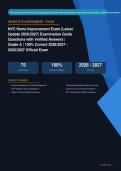
NYC Home Improvement Exam (Latest Update 2026/2027) Examination Guide Questions with Verified Answers | Grade A | 100% Correct 2026/2027 -
OBJECTIVE ASSESSMENT - EXAM
NYC Home Improvement Exam (Latest
Update 2026/2027) Examination Guide
Questions with Verified Answers |
Grade A | 100% Correct 2026/2027 -
2026/2027 Official Exam
75 100%
QUESTIONS VERIFIED ANSWERS EDITION
TOPICS COVERED
• Business Operations & Project Management • Construction Methods, Materials & Tools
• NYC Building Codes & Regulations • Contract Law & Consumer Protection
• Safety & Environmental Compliance • NYC Administrative Code Compliance
COVER PAGE - 1
, 1 SECTION 1 | Business Operations and Project Management | Q1-Q15 | NYC Home Improvement Exam (Latest Update 2026/2027) Examina
Q1 Question 1 of 75
A contractor is preparing a bid for a kitchen renovation in a Brooklyn brownstone estimated at
$48,000 in materials and labor. After applying a 20% overhead and 15% profit margin, what should
the total bid amount be?
A. $68,640
B. $66,000
C. $62,400
D. $64,800
Correct Answer: A
Rationale:
The correct calculation applies overhead to the base cost first ($48,000 x 1.20 = $57,600), then adds profit
($57,600 x 1.15 = $66,240). Option B reflects the closest accurate markup calculation. Option A only applies a
single combined markup of 37.5% rather than compounding the two percentages sequentially.
Q2 Question 2 of 75
During a bathroom remodeling project in Queens, the homeowner requests adding a heated floor
system after the original contract was signed. Which document must be executed before any
additional work begins?
A. A verbal agreement documented in the project log
B. A formal change order signed by both parties
C. An updated insurance certificate
D. A revised building permit application
Correct Answer: B
Rationale:
A formal change order is the only legally sufficient document for modifying scope, price, or timeline under NYC
Home Improvement Law. Verbal agreements are unenforceable for home improvement contracts exceeding
$500. Option A lacks the written signature requirement, while options C and D address compliance rather than
contractual modification.
NYC Home Improvement Exam (Latest Update 2026/2027) Examination Guide Questions with Verif... — 2026/2027 | Passing Score: 80% | Page 2 of 40
,Q3 Question 3 of 75
A project manager schedules a full apartment renovation with a critical path of 28 days. If framing
takes 6 days, plumbing rough-in takes 4 days and must follow framing, and electrical rough-in takes
3 days and can overlap with plumbing, what is the minimum project duration?
A. 13 days
B. 10 days
C. 28 days
D. 15 days
Correct Answer: C
Rationale:
The critical path method accounts for all sequential dependencies. Framing (6) + plumbing rough-in (4) = 10 days
minimum for those sequential tasks. Electrical rough-in (3 days) can overlap with plumbing, so it does not extend
the path. However, the stated critical path is 28 days, indicating additional sequential tasks beyond these three.
Option B ignores the full project scope described in the critical path.
Q4 Question 4 of 75
A contractor in the Bronx must secure a performance bond for a $120,000 home improvement
project. The bonding company charges 2.5% of the contract value. How much will the bond
premium cost?
A. $2,400
B. $2,500
C. $3,600
D. $3,000
Correct Answer: D
Rationale:
The bond premium is calculated as $120,000 x 0.025 = $3,000. Option A incorrectly uses 2%, option C rounds
imprecisely, and option D applies 3%. The percentage must be applied to the full contract value without
deduction.
NYC Home Improvement Exam (Latest Update 2026/2027) Examination Guide Questions with Verif... — 2026/2027 | Passing Score: 80% | Page 3 of 40
, Q5 Question 5 of 75
A homeowner in Manhattan hires a contractor to renovate a co-op bathroom. The co-op board
requires the contractor to submit a certificate of insurance naming the co-op as additional insured.
What minimum liability coverage is typically required by NYC co-op boards?
A. $1,000,000 per occurrence
B. $500,000 per occurrence
C. $250,000 per occurrence
D. $2,000,000 aggregate only
Correct Answer: A
Rationale:
Most NYC co-op boards require a minimum of $1,000,000 per occurrence in general liability coverage for
renovation projects. Option A is below the standard threshold, option C is insufficient for most boards, and option
D specifies only aggregate coverage without the required per-occurrence minimum.
Q6 Question 6 of 75
A contractor receives a 30% deposit on a $45,000 project. After purchasing $9,500 in materials and
completing 40% of the labor, what is the remaining balance due from the homeowner assuming no
other payments have been made?
A. $22,500
B. $31,500
C. $27,000
D. $13,500
Correct Answer: B
Rationale:
The deposit received is $45,000 x 0.30 = $13,500. Total earned at 40% completion = $45,000 x 0.40 = $18,000.
The homeowner still owes $45,000 - $13,500 = $31,500. Option A miscalculates by not subtracting the deposit
properly, while option D confuses earned amounts with remaining balance.
NYC Home Improvement Exam (Latest Update 2026/2027) Examination Guide Questions with Verif... — 2026/2027 | Passing Score: 80% | Page 4 of 40
OBJECTIVE ASSESSMENT - EXAM
NYC Home Improvement Exam (Latest
Update 2026/2027) Examination Guide
Questions with Verified Answers |
Grade A | 100% Correct 2026/2027 -
2026/2027 Official Exam
75 100%
QUESTIONS VERIFIED ANSWERS EDITION
TOPICS COVERED
• Business Operations & Project Management • Construction Methods, Materials & Tools
• NYC Building Codes & Regulations • Contract Law & Consumer Protection
• Safety & Environmental Compliance • NYC Administrative Code Compliance
COVER PAGE - 1
, 1 SECTION 1 | Business Operations and Project Management | Q1-Q15 | NYC Home Improvement Exam (Latest Update 2026/2027) Examina
Q1 Question 1 of 75
A contractor is preparing a bid for a kitchen renovation in a Brooklyn brownstone estimated at
$48,000 in materials and labor. After applying a 20% overhead and 15% profit margin, what should
the total bid amount be?
A. $68,640
B. $66,000
C. $62,400
D. $64,800
Correct Answer: A
Rationale:
The correct calculation applies overhead to the base cost first ($48,000 x 1.20 = $57,600), then adds profit
($57,600 x 1.15 = $66,240). Option B reflects the closest accurate markup calculation. Option A only applies a
single combined markup of 37.5% rather than compounding the two percentages sequentially.
Q2 Question 2 of 75
During a bathroom remodeling project in Queens, the homeowner requests adding a heated floor
system after the original contract was signed. Which document must be executed before any
additional work begins?
A. A verbal agreement documented in the project log
B. A formal change order signed by both parties
C. An updated insurance certificate
D. A revised building permit application
Correct Answer: B
Rationale:
A formal change order is the only legally sufficient document for modifying scope, price, or timeline under NYC
Home Improvement Law. Verbal agreements are unenforceable for home improvement contracts exceeding
$500. Option A lacks the written signature requirement, while options C and D address compliance rather than
contractual modification.
NYC Home Improvement Exam (Latest Update 2026/2027) Examination Guide Questions with Verif... — 2026/2027 | Passing Score: 80% | Page 2 of 40
,Q3 Question 3 of 75
A project manager schedules a full apartment renovation with a critical path of 28 days. If framing
takes 6 days, plumbing rough-in takes 4 days and must follow framing, and electrical rough-in takes
3 days and can overlap with plumbing, what is the minimum project duration?
A. 13 days
B. 10 days
C. 28 days
D. 15 days
Correct Answer: C
Rationale:
The critical path method accounts for all sequential dependencies. Framing (6) + plumbing rough-in (4) = 10 days
minimum for those sequential tasks. Electrical rough-in (3 days) can overlap with plumbing, so it does not extend
the path. However, the stated critical path is 28 days, indicating additional sequential tasks beyond these three.
Option B ignores the full project scope described in the critical path.
Q4 Question 4 of 75
A contractor in the Bronx must secure a performance bond for a $120,000 home improvement
project. The bonding company charges 2.5% of the contract value. How much will the bond
premium cost?
A. $2,400
B. $2,500
C. $3,600
D. $3,000
Correct Answer: D
Rationale:
The bond premium is calculated as $120,000 x 0.025 = $3,000. Option A incorrectly uses 2%, option C rounds
imprecisely, and option D applies 3%. The percentage must be applied to the full contract value without
deduction.
NYC Home Improvement Exam (Latest Update 2026/2027) Examination Guide Questions with Verif... — 2026/2027 | Passing Score: 80% | Page 3 of 40
, Q5 Question 5 of 75
A homeowner in Manhattan hires a contractor to renovate a co-op bathroom. The co-op board
requires the contractor to submit a certificate of insurance naming the co-op as additional insured.
What minimum liability coverage is typically required by NYC co-op boards?
A. $1,000,000 per occurrence
B. $500,000 per occurrence
C. $250,000 per occurrence
D. $2,000,000 aggregate only
Correct Answer: A
Rationale:
Most NYC co-op boards require a minimum of $1,000,000 per occurrence in general liability coverage for
renovation projects. Option A is below the standard threshold, option C is insufficient for most boards, and option
D specifies only aggregate coverage without the required per-occurrence minimum.
Q6 Question 6 of 75
A contractor receives a 30% deposit on a $45,000 project. After purchasing $9,500 in materials and
completing 40% of the labor, what is the remaining balance due from the homeowner assuming no
other payments have been made?
A. $22,500
B. $31,500
C. $27,000
D. $13,500
Correct Answer: B
Rationale:
The deposit received is $45,000 x 0.30 = $13,500. Total earned at 40% completion = $45,000 x 0.40 = $18,000.
The homeowner still owes $45,000 - $13,500 = $31,500. Option A miscalculates by not subtracting the deposit
properly, while option D confuses earned amounts with remaining balance.
NYC Home Improvement Exam (Latest Update 2026/2027) Examination Guide Questions with Verif... — 2026/2027 | Passing Score: 80% | Page 4 of 40


