CASE TOPIC
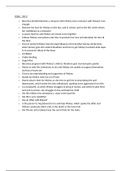
Evans v. Teamsters Local Union No. 31, [2008] 1 S.C.R. 661; 2008 SCC 20 (paras.1-51)
Facts:
-Defendant is building next door to the plaintiff’s property
-The building operation causes large amounts of vibration, such that it damages the plaintiff’s property
-The costs of restoring the property far exceeds the diminution of value of the premises
-The plaintiff’s intention is to spend the money on the cost of reinstatement
Issues:
Were E’s actions in not taking the 24 working months notice a failure to mitigate damages?
Reasoning: (SCC Bastarache J.)
Where employer has ended employment without notice, employer is required to pay damages in lieu of notice; however, that requirement is subject to
employee mitigating dmgs by seeking alternative income
·In some cases, this may require a dismissed employee to mitigate his dmgs by returning to work for the same employer
Employer bears onus of demonstrating:
1. That the employee has failed to make reasonable efforts to find work
2. That work could have been found
* Where employer offers a chance to mitigate dmgs by returning to work for the employer, central issue is whether a reasonable person would accept the
opportunity
·Similar salary Mitigation
·Working conditions are similar, not demeaning
·Personal relationships aren’t a problem
-Critical that an employee not be forced to mitigate by working in an atmosphere of hostility, embarrassment or humiliation
- Application:
-Evidence doesn’t support conclusion that E.’s circumstances justified his refusal to resume employment with the union
-There was no evidence of acrimony between new president and E.; relationship between E. and union was not seriously damaged
-Was not objectively unreasonable for E to return to work to mitigate dmgs
Abella (dissenting):
A person should not be forced to mitigate dmgs by working for employer who has terminated them
-Different employees react in different ways, and both objective AND subjective factors should be taken into account
-Trial judge’s findings should be restored
Holding:
-The court gives the cost of reinstatement
-The plaintiff had sought and successfully gained an interlocutory injunction to prevent the nuisance (vibration)
-The application for the injunction shows the fixity of intention as does the fact that this is the family home
-The court alludes to the notion of proportionality between the cost of restoration and diminution in value
Bowes v. Goss Power Products Ltd. (2012), 293 O.A.C. 1; 2012 ONCA 425 Mitigation
Facts: As is set out in the court’s reasons for decision, the employee Peter Bowes, entered into a written contract of employment with Goss Power Products
Ltd., which provided that he would receive six months’ notice or pay in lieu thereof if his employment was terminated without cause. The employment
agreement, prepared by the employer, was silent with respect to a duty to mitigate.
Goss Power terminated the appellant’s employment without cause. The letter of termination stated that Mr. Bowes would be paid his salary for six months but
was required to seek alternative employment during this period, keeping the respondent apprised of his efforts in this regard.
Approximately two weeks after he was terminated, Mr. Bowes was fortunate to obtain a new position at the same salary he had been earning with Goss Power.
Goss Power paid the statutorily required three weeks’ salary, but nothing more. Bowes sued.
Court of Appeal’s Decision
,In reversing the decision of Justice Whitaker of the Ontario Superior Court of Justice, reasons for decision reported at Bowes v. Goss Power Products Ltd,
Chief Justice Winkler, for the unanimous five-member bench (Simmons, Cronk, Armstrong and Watt JJ.A. concurring) gave effect to the rule in Machtinger
that parties to employment agreements can include a fixed period of notice in an employment agreement, thereby displacing the common law period of
“reasonable notice,” provided that the agreement does not violate the minimum statutory requirement relating to notice.
- As Justice Winkler observed:
Establishing a pre-determined period of notice in the contract of employment has certain distinct advantages. Most notably, it provides certainty. From the
employer’s perspective, it has the advantage of “capping” the period of reasonable notice that a court might otherwise award in a suit for wrongful dismissal.
Likewise, from the employee’s perspective, it ensures a guaranteed entitlement that may be greater than that which a court would award under common law.
For both parties, pre-determining the period of notice avoids the need for litigation to assess notice upon termination. [Para. 26]
- On the original application however, Justice Whitaker had relied the decision in Graham v. Marleau, Lemire Securities Inc., 2000 (Ont. S.C.J.) and held that,
a desire for certainty in setting out a specific term of notice does not mean that the parties intended to relieve the appellant of his obligation to mitigate. Justice
Winkler disagreed, expressly rejecting the decision inGraham at paragraph 36 of his reasons for decision.
Said Justice Winkler,
An employment agreement that stipulates a fixed term of notice or payment in lieu should be treated as fixing liquidated damages or a contractual
amount. It follows that, in such cases, there is no obligation on the employee to mitigate his or her damages. [Para. 34]
Later adding,
Damages for contractually stipulated notice or pay in lieu should not be analogized directly to damages for common law reasonable notice. The parties
have specifically contracted for something different; it is an error to simply equate the two. [Para. 37]
In conclusion, Justice Winkler wrote that:
Although decisions of trial courts appear to go both ways on the issue in this appeal, the preponderance of appellate jurisprudence supports the view
that, where an employment agreement contains a stipulated entitlement on termination without cause, the amount in question is either
liquidated damages or a contractual sum. Either way, mitigation is irrelevant. [Emphasis added. Para. 61]
Commentary
It is hard to miss the import of the Court of Appeal’s decision. Justice Winkler did not mince words and this observer sees no ambiguity in the court’s
statement.
The case is interesting on account of the ever-growing use of fixed-term notice periods. More and more employers, seeking the “certainty” of payment
contemplated by these agreements are using these agreements and litigating that they are determinative. And all is well and good, says the Court of
Appeal, except that one cannot have his cake and eat it too. If employers want the certainty of fixed-term notice periods, then they have to accept that
unless the agreement provides that there is a duty to mitigate, no such duty exists.
John Hallam Ltd. v. Bainton [1920] 54 D.L.R. 537, 60 S.C.R. 325
FACTS: acceptance of goods refused, vendors wouldn’t take it back, resold over contract price
HELD: appeal dismissed
Mitigation
RATIO: where on a sale according to sample, goods delivered are of quality inferior to that warranted the purchaser is entitled to recover as
damages the difference between market value of goods received and those which should have been supplied
Southcott Estates Inc v Toronto Catholic District School Board, 2012 SCC 51, [2012] 2 SCR 675
- is about an agreement to buy surplus school land for use as a housing development. The school board did not complete the transaction, and it was undeniably
in breach of contract.Interestingly, at the end of a long legal process, the plaintiff Southcott received neither specific performance nor in the alternative,
monetary damages. This is contrary to what one would expect, and it is worth looking at because transactions of this type are fairly common.
-There are two significant statements of principle coming from the Supreme Court ("SCC") in this case. The first one relates to specific performance, and the Mitigation
second one amounts to a new ground for piercing the corporate veil for single purpose subsidiaries. Justice Karakatsanis delivered the opinion of a 6-to-1
majority.
- Specific Performance is Rarely Available for Commercial Real Estate
-The principle of specific performance is applicable when the subject matter of the contract is something unique, such as a work of art or a piece of land with
, special characteristics. In these cases, monetary damages would not suffice to compensate the disappointed buyer. It is an equitable remedy that may be
available to a purchaser when the seller fails to complete the transaction, and being equitable, it is always at the discretion of the court to decide whether it
should be granted or not.
-The guiding principle that should govern specific performance in a modern economy was aptly stated by Adams J in his influential decision in Domowicz v
Orsa Investments Ltd, [1993] 5 OR (3d) 661 (ON SC):
- Damages will ordinarily be adequate in a market economy to enable the aggrieved promisee to obtain an acceptable substitute and will encourage
economic activity and minimize economic waste; only where this remedy is inadequate will a court decree specific performance, as in the case of
unique goods where damages are inadequate because there may be no available substitute transaction.
- The SCC has decisively curtailed the availability of specific performance in the context of commercial land transactions. In Southcott, the Court reinforced the
principle enunciated by Sopinka J in Semelhago v Paramadevan, [1996] 2 SCR 415, at para 22, that specific performance should, "...not be granted as a matter
of course absent evidence that the property is unique."
- Unlike somebody who has his heart set on a particular house to live in, a developer is only interested in the land for the profit that it will yield. From this point
of view, one piece of land is pretty much like another:
-A plaintiff deprived of an investment property does not have a "fair, real, and substantial justification" or a "substantial and legitimate" interest in
specific performance ... unless he can show that money is not a complete remedy because the land has "a peculiar and special value" to
him....Southcott could not make such a claim.It was engaged in a commercial transaction for the purpose of making a profit.The property's particular
qualities were only of value due to their ability to further profitability.(para 41)
- Being a Single-Purpose Corporation Did not Excuse Southcott from the Duty to Mitigate
-Holding out for specific performance turned out to be a strategic mistake for Southcott, that resulted in it coming away empty-handed. Ordinarily, if specific
performance is not granted, the victim of the breach can still seek damages to compensate it for its lost expectation of profit. However, before it can ask for
damages, it must show that it could not have made just as much money by quickly making an alternative purchase when the first contract is breached. This is
the principle of mitigation:
Losses that could reasonably have been avoided are, in effect, caused by the plaintiff's inaction, rather than the defendant's wrong. As a general rule, a
plaintiff will not be able to recover for those losses which he could have avoided by taking reasonable steps. Where it is alleged that the plaintiff has
failed to mitigate, the burden of proof is on the defendant, who needs to prove both that the plaintiff has failed to make reasonable efforts to mitigate
and that mitigation was possible. (para 24)
- Southcott thought it had a reasonable argument for failing to mitigate. It was a single purpose corporation with limited capital, set up by its parent company
for the purpose of this specific transaction and no other. It argued that it had all its capital tied up in this transaction, and it did not have the resources to mitigate
by seeking an alternative purchase.
-The Court rejected this argument by effectively piercing the corporate veil, and viewing Southcott as what it was, a member of a large corporate group.
Evidence had been shown at the trial that Southcott's parent company was regularly buying similar pieces of land during the course of this lawsuit. It had the
resources, and it could easily have bought one more piece of land to compensate for this failed acquisition. As noted by the Court,
Real estate developers frequently create single-purpose corporations for the sole purpose of purchasing and developing properties for profit. The
corporation has limited liability and no assets other than those that arise from the particular real estate investment. (para 1)
- The SCC appears to take a dim view of such artificial corporate structures:
Finding that losses cannot be reasonably avoided, simply because it is a single-purpose corporation within a larger group of companies, would give an
unfair advantage to those conducting business through single-purpose corporations.... Those who choose the benefits of incorporation must bear the
corresponding burdens. (paras 29-30)
- At first blush, the last sentence may appear puzzling. Southcott was a corporation asking to be viewed as a separate legal personality independent of its owner.
That is one of the usual benefits of incorporation, and that is what the SCC refused to give it. What did the court mean by the "corresponding burdens"?
-If one thinks of the deeper reason why these deals are done through special purpose corporations, the statement begins to make sense. Developers structure
purchases this way so that, if a market correction reduces land values, the parent company can pull the plug on its subsidiary, and avoid liability for damages
for not completing a purchase. If the purchaser had backed out, and the land had declined substantially in value, the seller would have been unable to recover
any damages beyond the deposit. Therefore, it is arguably fair that Southcott failed to recover damages when the shoe was on the other foot. The Court of
Appeal had awarded nominal damages of $1, and its decision was affirmed by the Supreme Court.
In the important case of Southcott Estates Inc v Toronto Catholic District School Board the majority held:
Evans v. Teamsters Local Union No. 31, [2008] 1 S.C.R. 661; 2008 SCC 20 (paras.1-51)
Facts:
-Defendant is building next door to the plaintiff’s property
-The building operation causes large amounts of vibration, such that it damages the plaintiff’s property
-The costs of restoring the property far exceeds the diminution of value of the premises
-The plaintiff’s intention is to spend the money on the cost of reinstatement
Issues:
Were E’s actions in not taking the 24 working months notice a failure to mitigate damages?
Reasoning: (SCC Bastarache J.)
Where employer has ended employment without notice, employer is required to pay damages in lieu of notice; however, that requirement is subject to
employee mitigating dmgs by seeking alternative income
·In some cases, this may require a dismissed employee to mitigate his dmgs by returning to work for the same employer
Employer bears onus of demonstrating:
1. That the employee has failed to make reasonable efforts to find work
2. That work could have been found
* Where employer offers a chance to mitigate dmgs by returning to work for the employer, central issue is whether a reasonable person would accept the
opportunity
·Similar salary Mitigation
·Working conditions are similar, not demeaning
·Personal relationships aren’t a problem
-Critical that an employee not be forced to mitigate by working in an atmosphere of hostility, embarrassment or humiliation
- Application:
-Evidence doesn’t support conclusion that E.’s circumstances justified his refusal to resume employment with the union
-There was no evidence of acrimony between new president and E.; relationship between E. and union was not seriously damaged
-Was not objectively unreasonable for E to return to work to mitigate dmgs
Abella (dissenting):
A person should not be forced to mitigate dmgs by working for employer who has terminated them
-Different employees react in different ways, and both objective AND subjective factors should be taken into account
-Trial judge’s findings should be restored
Holding:
-The court gives the cost of reinstatement
-The plaintiff had sought and successfully gained an interlocutory injunction to prevent the nuisance (vibration)
-The application for the injunction shows the fixity of intention as does the fact that this is the family home
-The court alludes to the notion of proportionality between the cost of restoration and diminution in value
Bowes v. Goss Power Products Ltd. (2012), 293 O.A.C. 1; 2012 ONCA 425 Mitigation
Facts: As is set out in the court’s reasons for decision, the employee Peter Bowes, entered into a written contract of employment with Goss Power Products
Ltd., which provided that he would receive six months’ notice or pay in lieu thereof if his employment was terminated without cause. The employment
agreement, prepared by the employer, was silent with respect to a duty to mitigate.
Goss Power terminated the appellant’s employment without cause. The letter of termination stated that Mr. Bowes would be paid his salary for six months but
was required to seek alternative employment during this period, keeping the respondent apprised of his efforts in this regard.
Approximately two weeks after he was terminated, Mr. Bowes was fortunate to obtain a new position at the same salary he had been earning with Goss Power.
Goss Power paid the statutorily required three weeks’ salary, but nothing more. Bowes sued.
Court of Appeal’s Decision
,In reversing the decision of Justice Whitaker of the Ontario Superior Court of Justice, reasons for decision reported at Bowes v. Goss Power Products Ltd,
Chief Justice Winkler, for the unanimous five-member bench (Simmons, Cronk, Armstrong and Watt JJ.A. concurring) gave effect to the rule in Machtinger
that parties to employment agreements can include a fixed period of notice in an employment agreement, thereby displacing the common law period of
“reasonable notice,” provided that the agreement does not violate the minimum statutory requirement relating to notice.
- As Justice Winkler observed:
Establishing a pre-determined period of notice in the contract of employment has certain distinct advantages. Most notably, it provides certainty. From the
employer’s perspective, it has the advantage of “capping” the period of reasonable notice that a court might otherwise award in a suit for wrongful dismissal.
Likewise, from the employee’s perspective, it ensures a guaranteed entitlement that may be greater than that which a court would award under common law.
For both parties, pre-determining the period of notice avoids the need for litigation to assess notice upon termination. [Para. 26]
- On the original application however, Justice Whitaker had relied the decision in Graham v. Marleau, Lemire Securities Inc., 2000 (Ont. S.C.J.) and held that,
a desire for certainty in setting out a specific term of notice does not mean that the parties intended to relieve the appellant of his obligation to mitigate. Justice
Winkler disagreed, expressly rejecting the decision inGraham at paragraph 36 of his reasons for decision.
Said Justice Winkler,
An employment agreement that stipulates a fixed term of notice or payment in lieu should be treated as fixing liquidated damages or a contractual
amount. It follows that, in such cases, there is no obligation on the employee to mitigate his or her damages. [Para. 34]
Later adding,
Damages for contractually stipulated notice or pay in lieu should not be analogized directly to damages for common law reasonable notice. The parties
have specifically contracted for something different; it is an error to simply equate the two. [Para. 37]
In conclusion, Justice Winkler wrote that:
Although decisions of trial courts appear to go both ways on the issue in this appeal, the preponderance of appellate jurisprudence supports the view
that, where an employment agreement contains a stipulated entitlement on termination without cause, the amount in question is either
liquidated damages or a contractual sum. Either way, mitigation is irrelevant. [Emphasis added. Para. 61]
Commentary
It is hard to miss the import of the Court of Appeal’s decision. Justice Winkler did not mince words and this observer sees no ambiguity in the court’s
statement.
The case is interesting on account of the ever-growing use of fixed-term notice periods. More and more employers, seeking the “certainty” of payment
contemplated by these agreements are using these agreements and litigating that they are determinative. And all is well and good, says the Court of
Appeal, except that one cannot have his cake and eat it too. If employers want the certainty of fixed-term notice periods, then they have to accept that
unless the agreement provides that there is a duty to mitigate, no such duty exists.
John Hallam Ltd. v. Bainton [1920] 54 D.L.R. 537, 60 S.C.R. 325
FACTS: acceptance of goods refused, vendors wouldn’t take it back, resold over contract price
HELD: appeal dismissed
Mitigation
RATIO: where on a sale according to sample, goods delivered are of quality inferior to that warranted the purchaser is entitled to recover as
damages the difference between market value of goods received and those which should have been supplied
Southcott Estates Inc v Toronto Catholic District School Board, 2012 SCC 51, [2012] 2 SCR 675
- is about an agreement to buy surplus school land for use as a housing development. The school board did not complete the transaction, and it was undeniably
in breach of contract.Interestingly, at the end of a long legal process, the plaintiff Southcott received neither specific performance nor in the alternative,
monetary damages. This is contrary to what one would expect, and it is worth looking at because transactions of this type are fairly common.
-There are two significant statements of principle coming from the Supreme Court ("SCC") in this case. The first one relates to specific performance, and the Mitigation
second one amounts to a new ground for piercing the corporate veil for single purpose subsidiaries. Justice Karakatsanis delivered the opinion of a 6-to-1
majority.
- Specific Performance is Rarely Available for Commercial Real Estate
-The principle of specific performance is applicable when the subject matter of the contract is something unique, such as a work of art or a piece of land with
, special characteristics. In these cases, monetary damages would not suffice to compensate the disappointed buyer. It is an equitable remedy that may be
available to a purchaser when the seller fails to complete the transaction, and being equitable, it is always at the discretion of the court to decide whether it
should be granted or not.
-The guiding principle that should govern specific performance in a modern economy was aptly stated by Adams J in his influential decision in Domowicz v
Orsa Investments Ltd, [1993] 5 OR (3d) 661 (ON SC):
- Damages will ordinarily be adequate in a market economy to enable the aggrieved promisee to obtain an acceptable substitute and will encourage
economic activity and minimize economic waste; only where this remedy is inadequate will a court decree specific performance, as in the case of
unique goods where damages are inadequate because there may be no available substitute transaction.
- The SCC has decisively curtailed the availability of specific performance in the context of commercial land transactions. In Southcott, the Court reinforced the
principle enunciated by Sopinka J in Semelhago v Paramadevan, [1996] 2 SCR 415, at para 22, that specific performance should, "...not be granted as a matter
of course absent evidence that the property is unique."
- Unlike somebody who has his heart set on a particular house to live in, a developer is only interested in the land for the profit that it will yield. From this point
of view, one piece of land is pretty much like another:
-A plaintiff deprived of an investment property does not have a "fair, real, and substantial justification" or a "substantial and legitimate" interest in
specific performance ... unless he can show that money is not a complete remedy because the land has "a peculiar and special value" to
him....Southcott could not make such a claim.It was engaged in a commercial transaction for the purpose of making a profit.The property's particular
qualities were only of value due to their ability to further profitability.(para 41)
- Being a Single-Purpose Corporation Did not Excuse Southcott from the Duty to Mitigate
-Holding out for specific performance turned out to be a strategic mistake for Southcott, that resulted in it coming away empty-handed. Ordinarily, if specific
performance is not granted, the victim of the breach can still seek damages to compensate it for its lost expectation of profit. However, before it can ask for
damages, it must show that it could not have made just as much money by quickly making an alternative purchase when the first contract is breached. This is
the principle of mitigation:
Losses that could reasonably have been avoided are, in effect, caused by the plaintiff's inaction, rather than the defendant's wrong. As a general rule, a
plaintiff will not be able to recover for those losses which he could have avoided by taking reasonable steps. Where it is alleged that the plaintiff has
failed to mitigate, the burden of proof is on the defendant, who needs to prove both that the plaintiff has failed to make reasonable efforts to mitigate
and that mitigation was possible. (para 24)
- Southcott thought it had a reasonable argument for failing to mitigate. It was a single purpose corporation with limited capital, set up by its parent company
for the purpose of this specific transaction and no other. It argued that it had all its capital tied up in this transaction, and it did not have the resources to mitigate
by seeking an alternative purchase.
-The Court rejected this argument by effectively piercing the corporate veil, and viewing Southcott as what it was, a member of a large corporate group.
Evidence had been shown at the trial that Southcott's parent company was regularly buying similar pieces of land during the course of this lawsuit. It had the
resources, and it could easily have bought one more piece of land to compensate for this failed acquisition. As noted by the Court,
Real estate developers frequently create single-purpose corporations for the sole purpose of purchasing and developing properties for profit. The
corporation has limited liability and no assets other than those that arise from the particular real estate investment. (para 1)
- The SCC appears to take a dim view of such artificial corporate structures:
Finding that losses cannot be reasonably avoided, simply because it is a single-purpose corporation within a larger group of companies, would give an
unfair advantage to those conducting business through single-purpose corporations.... Those who choose the benefits of incorporation must bear the
corresponding burdens. (paras 29-30)
- At first blush, the last sentence may appear puzzling. Southcott was a corporation asking to be viewed as a separate legal personality independent of its owner.
That is one of the usual benefits of incorporation, and that is what the SCC refused to give it. What did the court mean by the "corresponding burdens"?
-If one thinks of the deeper reason why these deals are done through special purpose corporations, the statement begins to make sense. Developers structure
purchases this way so that, if a market correction reduces land values, the parent company can pull the plug on its subsidiary, and avoid liability for damages
for not completing a purchase. If the purchaser had backed out, and the land had declined substantially in value, the seller would have been unable to recover
any damages beyond the deposit. Therefore, it is arguably fair that Southcott failed to recover damages when the shoe was on the other foot. The Court of
Appeal had awarded nominal damages of $1, and its decision was affirmed by the Supreme Court.
In the important case of Southcott Estates Inc v Toronto Catholic District School Board the majority held: