

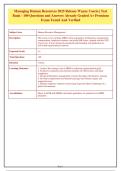
Managing Human Resources 2025 Release Wayne Cascio | Test
Bank - 100 Questions and Answers Already Graded A+ Premium
Exam Tested And Verified
Subject Area Human Resource Management
Description This exam covers strategic HRM, talent acquisition, performance management,
compensation, employee relations, and global HR issues, aligned with the 2025
Cascio text. It tests advanced conceptual understanding and application in
real-world organizational contexts.
Expected Grade A+
Total Questions 100
Duration 3 hours
Learning Outcomes 1. Analyze the strategic role of HRM in achieving organizational goals.
2. Evaluate recruitment and selection methods for effectiveness and legal
compliance.
3. Design performance management systems that align with business strategy.
4. Develop compensation and benefits packages that balance equity and
competitiveness.
5. Manage employee relations and navigate legal and ethical challenges in a
global environment.
Accreditation Meets AACSB and SHRM curriculum guidelines for graduate-level HRM
programs.
Page 1
,1. A multinational corporation is expanding into a new country with a collectivist
culture. Which HR strategy would best align with the local cultural values to
enhance employee engagement?
A. Implement individual performance-based pay to drive competition.
B. Establish team-based rewards and emphasize group harmony.
C. Offer flexible work arrangements focused on personal autonomy.
D. Use standardized global HR policies to ensure consistency.
Answer: B. Establish team-based rewards and emphasize group harmony.
Collectivist cultures value group cohesion and cooperation. Team-based rewards align
with these values, fostering engagement. Individual pay (A) may create conflict;
autonomy (C) is individualistic; standardized policies (D) ignore cultural nuances.
2. In a high-stakes job analysis for a cybersecurity analyst position, which method
provides the most defensible data for establishing job-relatedness in a discrimination
lawsuit?
A. Position Analysis Questionnaire (PAQ)
B. Critical Incident Technique (CIT)
C. Task Inventory Analysis
D. Functional Job Analysis (FJA)
Answer: C. Task Inventory Analysis
Task Inventory Analysis yields detailed, verifiable task statements and frequency
ratings, which are highly defensible in court. PAQ is more generic, CIT focuses on
behaviors rather than tasks, and FJA is less specific to job duties.
Page 2
,3. A company uses a structured interview with behaviorally anchored rating scales
(BARS). What is the primary psychometric advantage of BARS over traditional
Likert scales?
A. Reduces social desirability bias in responses.
B. Increases inter-rater reliability by anchoring ratings to specific behaviors.
C. Allows for easier statistical analysis of interview scores.
D. Minimizes the halo effect by averaging multiple ratings.
Answer: B. Increases inter-rater reliability by anchoring ratings to specific
behaviors.
BARS provide concrete behavioral anchors, reducing subjectivity and enhancing
consistency across raters (inter-rater reliability). Social desirability (A) is not directly
addressed; statistical ease (C) is secondary; halo effect (D) is reduced but not the
primary advantage.
4. Under the Fair Labor Standards Act (FLSA), which of the following employees is
most likely to be classified as exempt from overtime pay?
A. A warehouse worker paid $15 per hour with a high school diploma.
B. A salaried marketing manager earning $50,000/year who supervises two employees.
C. An hourly administrative assistant earning $35,000/year.
D. A freelance graphic designer working on a per-project basis.
Answer: B. A salaried marketing manager earning $50,000/year who supervises
two employees.
The FLSA exempts executive, administrative, and professional employees earning
above a salary threshold ($684/week in 2025) and performing exempt duties. The
marketing manager meets the salary and duties test. The warehouse worker (A) is
nonexempt; the administrative assistant (C) likely fails the salary test; the freelancer
(D) is not an employee.
Page 3
, 5. A firm uses a forced distribution performance appraisal system. Which of the
following is a valid criticism of this approach?
A. It fails to differentiate between high and low performers.
B. It can demotivate employees when the distribution is perceived as unfair.
C. It requires extensive training for raters to be effective.
D. It is too time-consuming for managers to implement.
Answer: B. It can demotivate employees when the distribution is perceived as
unfair.
Forced distribution can create a competitive environment where employees feel unfairly
categorized, especially in small teams where true performance differences are minimal.
It does differentiate (A), training (C) is not the primary criticism, and time (D) is not its
main drawback.
6. In the context of strategic HRM, which type of employee skills are most critical for
a company pursuing a cost leadership strategy?
A. Innovative and creative skills for product development.
B. Customer service and relationship-building skills.
C. Efficient, standardized, and process-oriented skills.
D. Cross-functional and adaptive skills for dynamic markets.
Answer: C. Efficient, standardized, and process-oriented skills.
Cost leadership focuses on operational efficiency and low costs. Employees with
efficient, standardized skills help minimize waste and maximize productivity.
Innovation (A) is for differentiation; customer service (B) is for customer intimacy;
adaptability (D) is for agility.
Page 4
Bank - 100 Questions and Answers Already Graded A+ Premium
Exam Tested And Verified
Subject Area Human Resource Management
Description This exam covers strategic HRM, talent acquisition, performance management,
compensation, employee relations, and global HR issues, aligned with the 2025
Cascio text. It tests advanced conceptual understanding and application in
real-world organizational contexts.
Expected Grade A+
Total Questions 100
Duration 3 hours
Learning Outcomes 1. Analyze the strategic role of HRM in achieving organizational goals.
2. Evaluate recruitment and selection methods for effectiveness and legal
compliance.
3. Design performance management systems that align with business strategy.
4. Develop compensation and benefits packages that balance equity and
competitiveness.
5. Manage employee relations and navigate legal and ethical challenges in a
global environment.
Accreditation Meets AACSB and SHRM curriculum guidelines for graduate-level HRM
programs.
Page 1
,1. A multinational corporation is expanding into a new country with a collectivist
culture. Which HR strategy would best align with the local cultural values to
enhance employee engagement?
A. Implement individual performance-based pay to drive competition.
B. Establish team-based rewards and emphasize group harmony.
C. Offer flexible work arrangements focused on personal autonomy.
D. Use standardized global HR policies to ensure consistency.
Answer: B. Establish team-based rewards and emphasize group harmony.
Collectivist cultures value group cohesion and cooperation. Team-based rewards align
with these values, fostering engagement. Individual pay (A) may create conflict;
autonomy (C) is individualistic; standardized policies (D) ignore cultural nuances.
2. In a high-stakes job analysis for a cybersecurity analyst position, which method
provides the most defensible data for establishing job-relatedness in a discrimination
lawsuit?
A. Position Analysis Questionnaire (PAQ)
B. Critical Incident Technique (CIT)
C. Task Inventory Analysis
D. Functional Job Analysis (FJA)
Answer: C. Task Inventory Analysis
Task Inventory Analysis yields detailed, verifiable task statements and frequency
ratings, which are highly defensible in court. PAQ is more generic, CIT focuses on
behaviors rather than tasks, and FJA is less specific to job duties.
Page 2
,3. A company uses a structured interview with behaviorally anchored rating scales
(BARS). What is the primary psychometric advantage of BARS over traditional
Likert scales?
A. Reduces social desirability bias in responses.
B. Increases inter-rater reliability by anchoring ratings to specific behaviors.
C. Allows for easier statistical analysis of interview scores.
D. Minimizes the halo effect by averaging multiple ratings.
Answer: B. Increases inter-rater reliability by anchoring ratings to specific
behaviors.
BARS provide concrete behavioral anchors, reducing subjectivity and enhancing
consistency across raters (inter-rater reliability). Social desirability (A) is not directly
addressed; statistical ease (C) is secondary; halo effect (D) is reduced but not the
primary advantage.
4. Under the Fair Labor Standards Act (FLSA), which of the following employees is
most likely to be classified as exempt from overtime pay?
A. A warehouse worker paid $15 per hour with a high school diploma.
B. A salaried marketing manager earning $50,000/year who supervises two employees.
C. An hourly administrative assistant earning $35,000/year.
D. A freelance graphic designer working on a per-project basis.
Answer: B. A salaried marketing manager earning $50,000/year who supervises
two employees.
The FLSA exempts executive, administrative, and professional employees earning
above a salary threshold ($684/week in 2025) and performing exempt duties. The
marketing manager meets the salary and duties test. The warehouse worker (A) is
nonexempt; the administrative assistant (C) likely fails the salary test; the freelancer
(D) is not an employee.
Page 3
, 5. A firm uses a forced distribution performance appraisal system. Which of the
following is a valid criticism of this approach?
A. It fails to differentiate between high and low performers.
B. It can demotivate employees when the distribution is perceived as unfair.
C. It requires extensive training for raters to be effective.
D. It is too time-consuming for managers to implement.
Answer: B. It can demotivate employees when the distribution is perceived as
unfair.
Forced distribution can create a competitive environment where employees feel unfairly
categorized, especially in small teams where true performance differences are minimal.
It does differentiate (A), training (C) is not the primary criticism, and time (D) is not its
main drawback.
6. In the context of strategic HRM, which type of employee skills are most critical for
a company pursuing a cost leadership strategy?
A. Innovative and creative skills for product development.
B. Customer service and relationship-building skills.
C. Efficient, standardized, and process-oriented skills.
D. Cross-functional and adaptive skills for dynamic markets.
Answer: C. Efficient, standardized, and process-oriented skills.
Cost leadership focuses on operational efficiency and low costs. Employees with
efficient, standardized skills help minimize waste and maximize productivity.
Innovation (A) is for differentiation; customer service (B) is for customer intimacy;
adaptability (D) is for agility.
Page 4


