ATI RN LEADERSHIP PROCTORED EXAM | EDITION 100 Questions | Comprehensive
LEADERSHIP ATI PROCTORED EXAM
ATI Leadership Proctored Real Exam Questions and Detailed Answers | Brand New 2026/2027
Edition
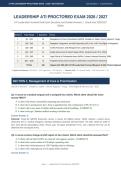
Section Topic Range Questions Focus
1 Q1 - Q25 25 Management of Care & Prioritization (ABCDE, Unstable vs. Stable, Clinical Judgment, Triage)
2 Q26 - Q45 20 Delegation, Assignment, and Staff Supervision (RN / LPN / UAP, Five Rights of Delegation)
3 Q46 - Q60 15 Conflict Resolution, Staff Management & Leadership Styles
4 Q61 - Q75 15 Quality Improvement & Patient Safety (NPSG, Sentinel Events, RCA, PDSA)
5 Q76 - Q90 15 Legal, Ethical, & Professional Issues (HIPAA, Consent, Advance Directives, DNR)
6 Q91 - Q100 10 Integrated Clinical Case Scenarios & NGN-Style Comprehensive Reasoning
TOTAL 100 Aligned with 2026-2027 ATI RN Leadership Proctored Blueprint & NGN Clinical Judgment
Cognitive Distribution: 25% Recall | 55% Application | 20% Analysis • Question Style: 75% Scenario-based | 20% Direct Recall | 5%
Clinical Judgment / Prioritization
SECTION 1: Management of Care & Prioritization
ABCDE Framework - Unstable vs. Stable - Clinical Judgment - Triage - Client Rights & Advocacy (Q1 - Q25)
Q1: A nurse on a medical-surgical unit is assigned four clients. Which client should the nurse
assess FIRST?
A. A client with chronic osteoarthritis requesting pain medication
B. A client who is postoperative day 1 from an appendectomy with a temperature of 99.2 F (37.3 C)
C. A client with a new onset of stridor and increased work of breathing [CORRECT]
D. A client with type 2 diabetes mellitus awaiting a breakfast tray
Correct Answer: C
Rationale: Using the ABCDE framework, Airway is always the highest priority. Stridor indicates a partial airway
obstruction and is a medical emergency requiring immediate assessment and intervention. The other clients are stable or
have lower-priority physiological needs; chronic pain, low-grade postoperative fever, and a delayed meal tray can be
addressed after securing the airway.
Q2: A nurse receives change-of-shift report on four clients. Which client should be assessed first?
A. A client with an SpO2 of 88% on room air who appears anxious [CORRECT]
B. A client with a serum sodium of 136 mEq/L requesting water
C. A client with a blood pressure of 118/74 mmHg ready for discharge
D. A client with a blood glucose of 142 mg/dL before breakfast
Correct Answer: A
Page 1 - Leadership ATI Proctored Exam 2026/2027
,ATI RN LEADERSHIP PROCTORED EXAM | EDITION 100 Questions | Comprehensive
Rationale: An SpO2 of 88% indicates hypoxia and is an acute change in Breathing that requires immediate assessment and
oxygen therapy. Hypoxia can rapidly progress to respiratory failure and cardiac dysrhythmias. The other findings are within
acceptable or stable ranges and do not represent acute physiological threats; they can be addressed after stabilizing
oxygenation.
Q3: A nurse is caring for a client who returned from a colon resection 4 hours ago. The client has a
saturated abdominal dressing with bright red blood. Which action should the nurse take FIRST?
A. Apply direct pressure to the site and call the surgeon [CORRECT]
B. Increase the IV fluid rate and reassess in 15 minutes
C. Remove the dressing to inspect the incision
D. Document the finding and reassess in 30 minutes
Correct Answer: A
Rationale: Active bright red bleeding from a surgical site indicates hemorrhage, a Circulation priority under ABCDE. The
nurse must apply direct pressure to control bleeding and immediately notify the surgeon. Increasing IV fluids alone does not
address the source, removing the dressing may disrupt the incision, and delaying intervention risks hypovolemic shock.
Q4: A nurse is caring for a client with a traumatic brain injury. Which finding is the EARLIEST and
most sensitive indicator of increased intracranial pressure (ICP) and requires immediate action?
A. Widening pulse pressure
B. Change in level of consciousness (LOC) [CORRECT]
C. Decerebrate posturing
D. Sluggish pupillary response
Correct Answer: B
Rationale: A change in level of consciousness is the earliest and most sensitive indicator of increased ICP because the
cerebral cortex is highly sensitive to changes in perfusion and pressure. Late signs such as widening pulse pressure,
posturing, and fixed pupils indicate life-threatening brainstem compression. Early recognition of altered LOC allows for
timely intervention to prevent irreversible neurologic damage.
Q5: A nurse is assessing a postoperative client 6 hours after an open cholecystectomy. The client's
heart rate is 120/min, blood pressure is 102/64 mmHg, and urine output is 20 mL/hr. Which
complication should the nurse suspect FIRST?
A. Incisional pain
B. Hypovolemic shock secondary to hemorrhage [CORRECT]
C. Urinary retention
D. Malignant hyperthermia
Correct Answer: B
Rationale: Sustained tachycardia (HR 120), hypotension, and oliguria (urine output less than 30 mL/hr) in a postoperative
client are classic red flags for hypovolemic shock from internal hemorrhage. While pain can elevate heart rate, it does not
typically cause hypotension and oliguria simultaneously. Urinary retention does not cause tachycardia and hypotension, and
malignant hyperthermia presents with hypercarbia and muscle rigidity intraoperatively.
Page 2 - Leadership ATI Proctored Exam 2026/2027
,ATI RN LEADERSHIP PROCTORED EXAM | EDITION 100 Questions | Comprehensive
Q6: A newly licensed nurse asks the charge nurse whether to administer a PRN analgesic to a client
who reports pain rated 6/10. Which response by the charge nurse reflects the nursing process
correctly?
A. Administer the medication now and reassess pain in 30 minutes
B. Assess the client's pain characteristics, location, and vital signs before administering the medication
[CORRECT]
C. Ask the client to wait until the next scheduled assessment
D. Delegate the medication administration to the LPN
Correct Answer: B
Rationale: Assessment is always the first step in the nursing process before any intervention. The nurse must assess the
pain's characteristics, location, quality, and any accompanying changes in vital signs before administering analgesics to
identify potential complications or contraindications. Administering medication without assessment, delaying treatment, or
delegating without assessment violates the nursing process and could mask a serious condition.
Q7: A nurse is caring for four clients. Which client should the nurse assess FIRST?
A. A client with chronic COPD who has a respiratory rate of 22/min and SpO2 of 92% on 2 L oxygen
B. A client with acute chest pain rated 8/10 and diaphoresis that began 10 minutes ago [CORRECT]
C. A client with chronic heart failure reporting mild ankle swelling at end of day
D. A client with chronic back pain requesting a PRN analgesic
Correct Answer: B
Rationale: Acute conditions take priority over chronic conditions because they represent sudden physiological changes that
may indicate a life-threatening event. Acute chest pain with diaphoresis suggests possible myocardial infarction, requiring
immediate assessment and intervention. The COPD client's findings are consistent with chronic disease, and the ankle
swelling and chronic pain are expected findings in stable chronic conditions.
Q8: A nurse is planning care for a client who is homeless and newly diagnosed with tuberculosis.
Using Maslow's hierarchy, which client need should the nurse address FIRST?
A. Teaching the client about medication adherence
B. Arranging for shelter and nutritious meals through social services [CORRECT]
C. Referring the client to a support group for emotional coping
D. Discussing long-term employment options with the client
Correct Answer: B
Rationale: Maslow's hierarchy dictates that physiological needs (food, shelter) precede safety needs (medication adherence)
and psychosocial needs (support groups, employment). A homeless client cannot realistically adhere to a complex TB
regimen without stable shelter and nutrition. Addressing physiological needs first establishes the foundation for safety and
higher-level interventions.
Q9: An emergency department nurse is triaging four clients arriving simultaneously after a
motor-vehicle crash. Which client should be categorized as EMERGENT (Priority 1)?
A. A client with a closed femur fracture complaining of severe pain
B. A client with an open head wound and uncontrolled external bleeding [CORRECT]
C. A client with a superficial laceration to the forearm
D. A client complaining of nausea after witnessing the crash
Correct Answer: B
Page 3 - Leadership ATI Proctored Exam 2026/2027
, ATI RN LEADERSHIP PROCTORED EXAM | EDITION 100 Questions | Comprehensive
Rationale: Emergent triage (Priority 1) applies to clients with life-threatening injuries requiring immediate intervention to
survive. An open head wound with uncontrolled bleeding represents an immediate threat to Airway, Breathing, and
Circulation. The femur fracture is urgent (Priority 2), the laceration is non-urgent (Priority 3), and nausea without injury is
the lowest priority.
Q10: A nurse is triaging clients in a disaster scenario with mass casualties. Which client should
receive the BLACK triage tag?
A. A client with a respiratory rate of 32/min and absent radial pulse
B. A client with an open femur fracture and a palpable radial pulse
C. A client with massive head trauma, no spontaneous respirations, and no pulse [CORRECT]
D. A client with a sucking chest wound and audible stridor
Correct Answer: C
Rationale: In disaster triage, a black tag is assigned to clients who are deceased or have injuries incompatible with survival,
so that limited resources are directed to those who can benefit. A client with no respirations and no pulse after massive head
trauma is deceased or unsalvageable. The other clients have survivable injuries and require immediate (red) or delayed
(yellow) care.
Q11: A nurse is assessing four postoperative clients. Which finding requires the MOST immediate
intervention?
A. A client on postoperative day 2 with a temperature of 100.4 F (38 C)
B. A client on postoperative day 1 with a respiratory rate of 10/min after receiving morphine
[CORRECT]
C. A client on postoperative day 3 with a blood pressure of 110/70 mmHg
D. A client on postoperative day 1 with a pain rating of 6/10 at the incision site
Correct Answer: B
Rationale: A respiratory rate of 10/min after morphine indicates opioid-induced respiratory depression, an immediate
Breathing emergency. Narcotic analgesics depress the respiratory center, and bradypnea can progress to apnea. The nurse
should administer naloxone per protocol and notify the provider. Low-grade fever, mild pain, and stable blood pressure are
expected postoperative findings requiring routine management.
Q12: A nurse is caring for a client with pneumonia whose SpO2 drops from 94% to 88% during
ambulation. Which action should the nurse take FIRST?
A. Encourage the client to continue ambulating to build endurance
B. Assist the client back to bed and apply supplemental oxygen [CORRECT]
C. Document the finding and reassess after ambulation
D. Administer a PRN bronchodilator immediately
Correct Answer: B
Rationale: An SpO2 of 88% indicates hypoxia and requires immediate assessment and intervention. The nurse should stop
the activity, return the client to bed to reduce oxygen demand, and apply supplemental oxygen. Continuing ambulation
would worsen hypoxia, and delaying intervention risks respiratory failure. Bronchodilator administration requires further
assessment and provider orders.
Page 4 - Leadership ATI Proctored Exam 2026/2027
LEADERSHIP ATI PROCTORED EXAM
ATI Leadership Proctored Real Exam Questions and Detailed Answers | Brand New 2026/2027
Edition
Section Topic Range Questions Focus
1 Q1 - Q25 25 Management of Care & Prioritization (ABCDE, Unstable vs. Stable, Clinical Judgment, Triage)
2 Q26 - Q45 20 Delegation, Assignment, and Staff Supervision (RN / LPN / UAP, Five Rights of Delegation)
3 Q46 - Q60 15 Conflict Resolution, Staff Management & Leadership Styles
4 Q61 - Q75 15 Quality Improvement & Patient Safety (NPSG, Sentinel Events, RCA, PDSA)
5 Q76 - Q90 15 Legal, Ethical, & Professional Issues (HIPAA, Consent, Advance Directives, DNR)
6 Q91 - Q100 10 Integrated Clinical Case Scenarios & NGN-Style Comprehensive Reasoning
TOTAL 100 Aligned with 2026-2027 ATI RN Leadership Proctored Blueprint & NGN Clinical Judgment
Cognitive Distribution: 25% Recall | 55% Application | 20% Analysis • Question Style: 75% Scenario-based | 20% Direct Recall | 5%
Clinical Judgment / Prioritization
SECTION 1: Management of Care & Prioritization
ABCDE Framework - Unstable vs. Stable - Clinical Judgment - Triage - Client Rights & Advocacy (Q1 - Q25)
Q1: A nurse on a medical-surgical unit is assigned four clients. Which client should the nurse
assess FIRST?
A. A client with chronic osteoarthritis requesting pain medication
B. A client who is postoperative day 1 from an appendectomy with a temperature of 99.2 F (37.3 C)
C. A client with a new onset of stridor and increased work of breathing [CORRECT]
D. A client with type 2 diabetes mellitus awaiting a breakfast tray
Correct Answer: C
Rationale: Using the ABCDE framework, Airway is always the highest priority. Stridor indicates a partial airway
obstruction and is a medical emergency requiring immediate assessment and intervention. The other clients are stable or
have lower-priority physiological needs; chronic pain, low-grade postoperative fever, and a delayed meal tray can be
addressed after securing the airway.
Q2: A nurse receives change-of-shift report on four clients. Which client should be assessed first?
A. A client with an SpO2 of 88% on room air who appears anxious [CORRECT]
B. A client with a serum sodium of 136 mEq/L requesting water
C. A client with a blood pressure of 118/74 mmHg ready for discharge
D. A client with a blood glucose of 142 mg/dL before breakfast
Correct Answer: A
Page 1 - Leadership ATI Proctored Exam 2026/2027
,ATI RN LEADERSHIP PROCTORED EXAM | EDITION 100 Questions | Comprehensive
Rationale: An SpO2 of 88% indicates hypoxia and is an acute change in Breathing that requires immediate assessment and
oxygen therapy. Hypoxia can rapidly progress to respiratory failure and cardiac dysrhythmias. The other findings are within
acceptable or stable ranges and do not represent acute physiological threats; they can be addressed after stabilizing
oxygenation.
Q3: A nurse is caring for a client who returned from a colon resection 4 hours ago. The client has a
saturated abdominal dressing with bright red blood. Which action should the nurse take FIRST?
A. Apply direct pressure to the site and call the surgeon [CORRECT]
B. Increase the IV fluid rate and reassess in 15 minutes
C. Remove the dressing to inspect the incision
D. Document the finding and reassess in 30 minutes
Correct Answer: A
Rationale: Active bright red bleeding from a surgical site indicates hemorrhage, a Circulation priority under ABCDE. The
nurse must apply direct pressure to control bleeding and immediately notify the surgeon. Increasing IV fluids alone does not
address the source, removing the dressing may disrupt the incision, and delaying intervention risks hypovolemic shock.
Q4: A nurse is caring for a client with a traumatic brain injury. Which finding is the EARLIEST and
most sensitive indicator of increased intracranial pressure (ICP) and requires immediate action?
A. Widening pulse pressure
B. Change in level of consciousness (LOC) [CORRECT]
C. Decerebrate posturing
D. Sluggish pupillary response
Correct Answer: B
Rationale: A change in level of consciousness is the earliest and most sensitive indicator of increased ICP because the
cerebral cortex is highly sensitive to changes in perfusion and pressure. Late signs such as widening pulse pressure,
posturing, and fixed pupils indicate life-threatening brainstem compression. Early recognition of altered LOC allows for
timely intervention to prevent irreversible neurologic damage.
Q5: A nurse is assessing a postoperative client 6 hours after an open cholecystectomy. The client's
heart rate is 120/min, blood pressure is 102/64 mmHg, and urine output is 20 mL/hr. Which
complication should the nurse suspect FIRST?
A. Incisional pain
B. Hypovolemic shock secondary to hemorrhage [CORRECT]
C. Urinary retention
D. Malignant hyperthermia
Correct Answer: B
Rationale: Sustained tachycardia (HR 120), hypotension, and oliguria (urine output less than 30 mL/hr) in a postoperative
client are classic red flags for hypovolemic shock from internal hemorrhage. While pain can elevate heart rate, it does not
typically cause hypotension and oliguria simultaneously. Urinary retention does not cause tachycardia and hypotension, and
malignant hyperthermia presents with hypercarbia and muscle rigidity intraoperatively.
Page 2 - Leadership ATI Proctored Exam 2026/2027
,ATI RN LEADERSHIP PROCTORED EXAM | EDITION 100 Questions | Comprehensive
Q6: A newly licensed nurse asks the charge nurse whether to administer a PRN analgesic to a client
who reports pain rated 6/10. Which response by the charge nurse reflects the nursing process
correctly?
A. Administer the medication now and reassess pain in 30 minutes
B. Assess the client's pain characteristics, location, and vital signs before administering the medication
[CORRECT]
C. Ask the client to wait until the next scheduled assessment
D. Delegate the medication administration to the LPN
Correct Answer: B
Rationale: Assessment is always the first step in the nursing process before any intervention. The nurse must assess the
pain's characteristics, location, quality, and any accompanying changes in vital signs before administering analgesics to
identify potential complications or contraindications. Administering medication without assessment, delaying treatment, or
delegating without assessment violates the nursing process and could mask a serious condition.
Q7: A nurse is caring for four clients. Which client should the nurse assess FIRST?
A. A client with chronic COPD who has a respiratory rate of 22/min and SpO2 of 92% on 2 L oxygen
B. A client with acute chest pain rated 8/10 and diaphoresis that began 10 minutes ago [CORRECT]
C. A client with chronic heart failure reporting mild ankle swelling at end of day
D. A client with chronic back pain requesting a PRN analgesic
Correct Answer: B
Rationale: Acute conditions take priority over chronic conditions because they represent sudden physiological changes that
may indicate a life-threatening event. Acute chest pain with diaphoresis suggests possible myocardial infarction, requiring
immediate assessment and intervention. The COPD client's findings are consistent with chronic disease, and the ankle
swelling and chronic pain are expected findings in stable chronic conditions.
Q8: A nurse is planning care for a client who is homeless and newly diagnosed with tuberculosis.
Using Maslow's hierarchy, which client need should the nurse address FIRST?
A. Teaching the client about medication adherence
B. Arranging for shelter and nutritious meals through social services [CORRECT]
C. Referring the client to a support group for emotional coping
D. Discussing long-term employment options with the client
Correct Answer: B
Rationale: Maslow's hierarchy dictates that physiological needs (food, shelter) precede safety needs (medication adherence)
and psychosocial needs (support groups, employment). A homeless client cannot realistically adhere to a complex TB
regimen without stable shelter and nutrition. Addressing physiological needs first establishes the foundation for safety and
higher-level interventions.
Q9: An emergency department nurse is triaging four clients arriving simultaneously after a
motor-vehicle crash. Which client should be categorized as EMERGENT (Priority 1)?
A. A client with a closed femur fracture complaining of severe pain
B. A client with an open head wound and uncontrolled external bleeding [CORRECT]
C. A client with a superficial laceration to the forearm
D. A client complaining of nausea after witnessing the crash
Correct Answer: B
Page 3 - Leadership ATI Proctored Exam 2026/2027
, ATI RN LEADERSHIP PROCTORED EXAM | EDITION 100 Questions | Comprehensive
Rationale: Emergent triage (Priority 1) applies to clients with life-threatening injuries requiring immediate intervention to
survive. An open head wound with uncontrolled bleeding represents an immediate threat to Airway, Breathing, and
Circulation. The femur fracture is urgent (Priority 2), the laceration is non-urgent (Priority 3), and nausea without injury is
the lowest priority.
Q10: A nurse is triaging clients in a disaster scenario with mass casualties. Which client should
receive the BLACK triage tag?
A. A client with a respiratory rate of 32/min and absent radial pulse
B. A client with an open femur fracture and a palpable radial pulse
C. A client with massive head trauma, no spontaneous respirations, and no pulse [CORRECT]
D. A client with a sucking chest wound and audible stridor
Correct Answer: C
Rationale: In disaster triage, a black tag is assigned to clients who are deceased or have injuries incompatible with survival,
so that limited resources are directed to those who can benefit. A client with no respirations and no pulse after massive head
trauma is deceased or unsalvageable. The other clients have survivable injuries and require immediate (red) or delayed
(yellow) care.
Q11: A nurse is assessing four postoperative clients. Which finding requires the MOST immediate
intervention?
A. A client on postoperative day 2 with a temperature of 100.4 F (38 C)
B. A client on postoperative day 1 with a respiratory rate of 10/min after receiving morphine
[CORRECT]
C. A client on postoperative day 3 with a blood pressure of 110/70 mmHg
D. A client on postoperative day 1 with a pain rating of 6/10 at the incision site
Correct Answer: B
Rationale: A respiratory rate of 10/min after morphine indicates opioid-induced respiratory depression, an immediate
Breathing emergency. Narcotic analgesics depress the respiratory center, and bradypnea can progress to apnea. The nurse
should administer naloxone per protocol and notify the provider. Low-grade fever, mild pain, and stable blood pressure are
expected postoperative findings requiring routine management.
Q12: A nurse is caring for a client with pneumonia whose SpO2 drops from 94% to 88% during
ambulation. Which action should the nurse take FIRST?
A. Encourage the client to continue ambulating to build endurance
B. Assist the client back to bed and apply supplemental oxygen [CORRECT]
C. Document the finding and reassess after ambulation
D. Administer a PRN bronchodilator immediately
Correct Answer: B
Rationale: An SpO2 of 88% indicates hypoxia and requires immediate assessment and intervention. The nurse should stop
the activity, return the client to bed to reduce oxygen demand, and apply supplemental oxygen. Continuing ambulation
would worsen hypoxia, and delaying intervention risks respiratory failure. Bronchodilator administration requires further
assessment and provider orders.
Page 4 - Leadership ATI Proctored Exam 2026/2027