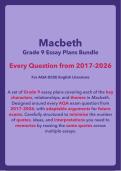
Macbeth
Grade 9 Essay Plans Bundle
Every Question from 2017-2026
For AQA GCSE English Literature
A set of Grade 9 essay plans covering each of the key
characters, relationships, and themes in Macbeth.
Designed around every AQA exam question from
2017–2026, with adaptable arguments for future
exams. Carefully structured to minimise the number
of quotes, ideas, and interpretations you need to
memorise by reusing the same quotes across
multiple essays.
, Macbeth
• Macbeth’s ambition
o moral conflict – “That is a step on which I must fall down, or else overleap, for in my
way it lies.” ACT 1 SCENE 5
▪ soliloquy provides insight for the audience as to Macbeths inner turmoil
▪ highlights Macbeths inner conflict to heighten his tragic downfall when he
does finally succumb to his hamartia
▪ “that” is objectifying, showing how he only sees Malcom as an obstacle to
what he wants most
▪ chain of being imagery physically represents his transgressive acts, almost
acknowledging how he’s crossing boundaries he knows he shouldn’t be.
▪ serves as a warning to the audience following the gunpower plot
o secretive – “stars, hide your fires, let not light see my black and deep desires.” ACT 1
SCENE 5
▪ “black” represents evil -> direct connotations to death
▪ “deep” shows complexity, may foreshadow that he knows that by killing
Duncan he’ll also have to kill other people, ambition spiralling
▪ light imagery may represent god, shows how Macbeth knows the extent of
his actions (through those descriptions) and acknowledges how they go
against his religious beliefs -> so tries to hide them from god
▪ commentary on structure of society, possibly exploring how Macbeths
ambition is problematic as it goes against Jacobean societal structures.
o overwhelming – “but only vaulting ambition, which overleaps itself” ACT 1 SCENE 7
▪ consistent use of word ‘overleaps’ physically embodies the idea of his
ambition spiralling out of control.
▪ represents how he himself ‘overleaps’ his place in society following the
spark of ambition
▪ “vaulting” – emphasises idea that Macbeth sees people as mere obstacles,
and ‘vaulting’ them refers to murdering them.
▪ two moments that example this -> earlier in the play where he’s reluctant to
murder Duncan, and yet doesn’t hesitate about killing Banquo
▪ shows how ambition has consumed him -> the negative presentation of it
within the play can be reflected on society as a whole as to its consequences
o acknowledges it isn’t right – “A dagger of the mind, a false creation” ACT 2 SCENE 1
▪ “dagger of the mind” dagger here could represent his ambition, Macbeth
hasn’t killed yet so his mind is still mostly rational, may be acknowledging
that his ambition is an irrational voice in his mind that will tarnish his
perception on right and wrong -> one of the only times Macbeth considers
how events will play out and contemplates the morality of the situation
▪ “a false creation” suggests he believes it to be the work of the witches,
possibly that he thinks his ambition is fabricated and implanted into his
mind and not who he truly is, ‘creation’ links to religion, may suggest he
considers his morals and everything he’s learnt before he kills duncan
• Macbeth’s power
o power stripped from him – “this dead butcher” ACT 5 SCENE 9
▪ “this” demonstrative pronoun disregards him, almost used as euphemism,
suggests he cannot be named (blood lust originating from his desire for
power causes him to lose all titles, even his own name)
▪ “butcher” spotlights violence oppose to power -> earlier referred to as
tyrant which gave some status, in death lost all power that he fought for
Grade 9 Essay Plans Bundle
Every Question from 2017-2026
For AQA GCSE English Literature
A set of Grade 9 essay plans covering each of the key
characters, relationships, and themes in Macbeth.
Designed around every AQA exam question from
2017–2026, with adaptable arguments for future
exams. Carefully structured to minimise the number
of quotes, ideas, and interpretations you need to
memorise by reusing the same quotes across
multiple essays.
, Macbeth
• Macbeth’s ambition
o moral conflict – “That is a step on which I must fall down, or else overleap, for in my
way it lies.” ACT 1 SCENE 5
▪ soliloquy provides insight for the audience as to Macbeths inner turmoil
▪ highlights Macbeths inner conflict to heighten his tragic downfall when he
does finally succumb to his hamartia
▪ “that” is objectifying, showing how he only sees Malcom as an obstacle to
what he wants most
▪ chain of being imagery physically represents his transgressive acts, almost
acknowledging how he’s crossing boundaries he knows he shouldn’t be.
▪ serves as a warning to the audience following the gunpower plot
o secretive – “stars, hide your fires, let not light see my black and deep desires.” ACT 1
SCENE 5
▪ “black” represents evil -> direct connotations to death
▪ “deep” shows complexity, may foreshadow that he knows that by killing
Duncan he’ll also have to kill other people, ambition spiralling
▪ light imagery may represent god, shows how Macbeth knows the extent of
his actions (through those descriptions) and acknowledges how they go
against his religious beliefs -> so tries to hide them from god
▪ commentary on structure of society, possibly exploring how Macbeths
ambition is problematic as it goes against Jacobean societal structures.
o overwhelming – “but only vaulting ambition, which overleaps itself” ACT 1 SCENE 7
▪ consistent use of word ‘overleaps’ physically embodies the idea of his
ambition spiralling out of control.
▪ represents how he himself ‘overleaps’ his place in society following the
spark of ambition
▪ “vaulting” – emphasises idea that Macbeth sees people as mere obstacles,
and ‘vaulting’ them refers to murdering them.
▪ two moments that example this -> earlier in the play where he’s reluctant to
murder Duncan, and yet doesn’t hesitate about killing Banquo
▪ shows how ambition has consumed him -> the negative presentation of it
within the play can be reflected on society as a whole as to its consequences
o acknowledges it isn’t right – “A dagger of the mind, a false creation” ACT 2 SCENE 1
▪ “dagger of the mind” dagger here could represent his ambition, Macbeth
hasn’t killed yet so his mind is still mostly rational, may be acknowledging
that his ambition is an irrational voice in his mind that will tarnish his
perception on right and wrong -> one of the only times Macbeth considers
how events will play out and contemplates the morality of the situation
▪ “a false creation” suggests he believes it to be the work of the witches,
possibly that he thinks his ambition is fabricated and implanted into his
mind and not who he truly is, ‘creation’ links to religion, may suggest he
considers his morals and everything he’s learnt before he kills duncan
• Macbeth’s power
o power stripped from him – “this dead butcher” ACT 5 SCENE 9
▪ “this” demonstrative pronoun disregards him, almost used as euphemism,
suggests he cannot be named (blood lust originating from his desire for
power causes him to lose all titles, even his own name)
▪ “butcher” spotlights violence oppose to power -> earlier referred to as
tyrant which gave some status, in death lost all power that he fought for