

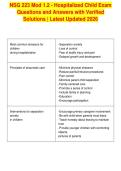
NSG 223 Mod 1.2 - Hospitalized Child Exam
Questions and Answers with Verified
Solutions | Latest Updated 2026
Most common stressors for -Separation anxiety
children -Loss of control
during hospitalization -Fear of bodily injury and pain
-Delayed growth and development
Principles of atraumatic care -Minimize physical stressors
-Reduce painful/intrusive procedures
-Pain control
-Minimize parent-child separation
-Family-centered care
-Promote a sense of control
-Include family in planning
-Education
-Encourage participation
Interventions for separation -Encourage primary caregiver involvement
anxiety -Be with child when parents must leave
in children -Teach honesty about leaving to maintain
trust
-Provide younger children with comforting
objects,
pictures of parents
, Regression -Child starts and behaving and responding
in ways
more appropriate for a younger age
-Often occurs when children are stressed
-Examples: bed-wetting, tantrums,
thumb-sucking,
clutching blankets/dolls
How to respond to regression -Accepting
-Help family accept and cope
Nursing interventions for feelings -Maintain consistent routines
of -Play
loss of control in toddlers -Involve parents
Nursing interventions for feelings -Maintain consistent routines
of -Play
loss of control in preschoolers -Bargaining
Nursing interventions for feelings -Maintain consistent routines, structure
of -Promote independence
loss of control in school age
children
Nursing interventions for feelings -Offer choices
of -Encourage socializing
loss of control in teenagers -Encourage them to keep a diary
Questions and Answers with Verified
Solutions | Latest Updated 2026
Most common stressors for -Separation anxiety
children -Loss of control
during hospitalization -Fear of bodily injury and pain
-Delayed growth and development
Principles of atraumatic care -Minimize physical stressors
-Reduce painful/intrusive procedures
-Pain control
-Minimize parent-child separation
-Family-centered care
-Promote a sense of control
-Include family in planning
-Education
-Encourage participation
Interventions for separation -Encourage primary caregiver involvement
anxiety -Be with child when parents must leave
in children -Teach honesty about leaving to maintain
trust
-Provide younger children with comforting
objects,
pictures of parents
, Regression -Child starts and behaving and responding
in ways
more appropriate for a younger age
-Often occurs when children are stressed
-Examples: bed-wetting, tantrums,
thumb-sucking,
clutching blankets/dolls
How to respond to regression -Accepting
-Help family accept and cope
Nursing interventions for feelings -Maintain consistent routines
of -Play
loss of control in toddlers -Involve parents
Nursing interventions for feelings -Maintain consistent routines
of -Play
loss of control in preschoolers -Bargaining
Nursing interventions for feelings -Maintain consistent routines, structure
of -Promote independence
loss of control in school age
children
Nursing interventions for feelings -Offer choices
of -Encourage socializing
loss of control in teenagers -Encourage them to keep a diary


