

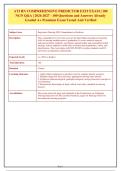
ATI RN COMPREHENSIVE PREDICTOR EXIT EXAM | 180
NGN Q&A | 2026-2027 - 100 Questions and Answers Already
Graded A+ Premium Exam Tested And Verified
Subject Area Registered Nursing (RN) Comprehensive Predictor
Description This comprehensive exit exam assesses the knowledge and clinical reasoning
skills of nursing students prior to graduation. It covers medical-surgical,
maternal-newborn, pediatric, psychiatric-mental health, and community health
nursing, with an emphasis on the latest evidence-based guidelines, safety, and
prioritization. The exam aligns with NCLEX-RN test plan standards and US
university accreditation requirements.
Expected Grade A+ (90% or higher)
Total Questions 100
Duration 3 hours
Learning Outcomes 1. Apply clinical judgment to prioritize care for complex patient scenarios.
2. Interpret diagnostic data and select appropriate nursing interventions.
3. Synthesize pharmacological, pathophysiological, and psychosocial concepts in
care planning.
4. Demonstrate knowledge of legal, ethical, and safety standards in nursing
practice.
Accreditation This exam meets the rigor and standards of the Commission on Collegiate
Nursing Education (CCNE) and the National League for Nursing (NLN) for
baccalaureate nursing programs.
Page 1
,1. A patient with cirrhosis and ascites develops oliguria, serum sodium 122 mEq/L,
and urine sodium <10 mEq/L. Which intervention should the nurse question?
A. Administer 3% hypertonic saline at 50 mL/hr
B. Restrict oral fluid intake to 1 L/day
C. Administer spironolactone 100 mg orally daily
D. Insert a peritoneal catheter for large-volume paracentesis
Answer: A. Administer 3% hypertonic saline at 50 mL/hr
Hypertonic saline is indicated for severe symptomatic hyponatremia (e.g., seizures), but
this patient's hyponatremia is likely dilutional from hypervolemia (ascites, oliguria).
Rapid correction can cause osmotic demyelination. Fluid restriction, spironolactone
(for hyperaldosteronism), and paracentesis are appropriate for management of ascites
and dilutional hyponatremia.
2. A nurse is assessing a patient with suspected acute respiratory distress syndrome
(ARDS). Which finding is most consistent with the pathophysiology of ARDS?
A. Increased pulmonary artery wedge pressure (PAWP) >18 mm Hg
B. Bilateral diffuse infiltrates on chest X-ray with normal cardiac function
C. Elevated B-type natriuretic peptide (BNP) levels
D. Pleural effusion on ultrasound
Answer: B. Bilateral diffuse infiltrates on chest X-ray with normal cardiac function
ARDS is characterized by non-cardiogenic pulmonary edema due to increased
alveolar-capillary permeability, leading to bilateral infiltrates on imaging without
evidence of left atrial hypertension (normal PAWP). Elevated PAWP or BNP suggests
cardiogenic pulmonary edema. Pleural effusion is not typical of ARDS.
Page 2
,3. A patient with type 2 diabetes mellitus is admitted with a serum glucose of 680
mg/dL, pH 7.28, serum bicarbonate 18 mEq/L, and positive serum ketones. The
nurse reviews the orders. Which prescription should the nurse clarify?
A. Administer 0.9% normal saline at 1 L/hr for the first hour
B. Start intravenous regular insulin at 0.1 units/kg/hr
C. Administer sodium bicarbonate 50 mEq intravenously over 30 minutes
D. Monitor serum potassium every 2 hours
Answer: C. Administer sodium bicarbonate 50 mEq intravenously over 30 minutes
In diabetic ketoacidosis (DKA), bicarbonate therapy is generally not recommended
unless pH is <6.9, as it may worsen intracellular acidosis and cause hypokalemia. The
patient's pH is 7.28, which does not meet the threshold for bicarbonate administration.
Fluid resuscitation, insulin infusion, and potassium monitoring are standard.
4. A patient is receiving a continuous infusion of heparin for a pulmonary embolism.
The current aPTT is 90 seconds (therapeutic range 60-80 seconds). The nurse should
anticipate which of the following?
A. Increase the heparin infusion rate by 2 units/kg/hr
B. Hold the heparin infusion for 1 hour and restart at a lower rate
C. Administer protamine sulfate 1 mg per 100 units of heparin
D. Continue the current infusion rate and recheck aPTT in 6 hours
Answer: B. Hold the heparin infusion for 1 hour and restart at a lower rate
An aPTT of 90 seconds is above the therapeutic range (60-80 seconds), indicating an
excessive anticoagulant effect. The standard protocol is to hold the infusion and restart
at a lower rate when aPTT returns to therapeutic range. Increasing the rate would
worsen the risk of bleeding. Protamine is reserved for severe bleeding or reversal.
Page 3
, 5. A patient with chronic kidney disease (CKD) stage 4 has a serum calcium of 8.0
mg/dL, phosphate 5.8 mg/dL, and intact PTH 300 pg/mL. The nurse anticipates
which intervention?
A. Administer calcium carbonate with meals
B. Administer calcitriol 0.25 mcg daily
C. Initiate sevelamer carbonate 800 mg with meals
D. Prepare the patient for parathyroidectomy
Answer: C. Initiate sevelamer carbonate 800 mg with meals
In CKD, hyperphosphatemia drives secondary hyperparathyroidism. The first step is to
bind dietary phosphate with a phosphate binder like sevelamer. Calcium-based binders
(calcium carbonate) can contribute to hypercalcemia, especially if calcitriol is also
given. Calcitriol may be used later if PTH remains elevated. Parathyroidectomy is
reserved for refractory cases.
6. A patient admitted for acute pancreatitis has a nasogastric tube to low
intermittent suction. Which finding requires immediate intervention?
A. Serum amylase 450 units/L (normal 30-110)
B. Nasogastric output 200 mL over 4 hours
C. Serum calcium 7.2 mg/dL (normal 8.5-10.5)
D. Abdominal distension with hypoactive bowel sounds
Answer: C. Serum calcium 7.2 mg/dL (normal 8.5-10.5)
Hypocalcemia in acute pancreatitis indicates fat saponification and may be a marker of
severe disease (Ranson criteria). It can lead to tetany and cardiac arrhythmias.
Elevated amylase is expected. NG output of 200 mL/4 hr is normal. Abdominal
distension and hypoactive bowel sounds are common due to ileus.
Page 4
NGN Q&A | 2026-2027 - 100 Questions and Answers Already
Graded A+ Premium Exam Tested And Verified
Subject Area Registered Nursing (RN) Comprehensive Predictor
Description This comprehensive exit exam assesses the knowledge and clinical reasoning
skills of nursing students prior to graduation. It covers medical-surgical,
maternal-newborn, pediatric, psychiatric-mental health, and community health
nursing, with an emphasis on the latest evidence-based guidelines, safety, and
prioritization. The exam aligns with NCLEX-RN test plan standards and US
university accreditation requirements.
Expected Grade A+ (90% or higher)
Total Questions 100
Duration 3 hours
Learning Outcomes 1. Apply clinical judgment to prioritize care for complex patient scenarios.
2. Interpret diagnostic data and select appropriate nursing interventions.
3. Synthesize pharmacological, pathophysiological, and psychosocial concepts in
care planning.
4. Demonstrate knowledge of legal, ethical, and safety standards in nursing
practice.
Accreditation This exam meets the rigor and standards of the Commission on Collegiate
Nursing Education (CCNE) and the National League for Nursing (NLN) for
baccalaureate nursing programs.
Page 1
,1. A patient with cirrhosis and ascites develops oliguria, serum sodium 122 mEq/L,
and urine sodium <10 mEq/L. Which intervention should the nurse question?
A. Administer 3% hypertonic saline at 50 mL/hr
B. Restrict oral fluid intake to 1 L/day
C. Administer spironolactone 100 mg orally daily
D. Insert a peritoneal catheter for large-volume paracentesis
Answer: A. Administer 3% hypertonic saline at 50 mL/hr
Hypertonic saline is indicated for severe symptomatic hyponatremia (e.g., seizures), but
this patient's hyponatremia is likely dilutional from hypervolemia (ascites, oliguria).
Rapid correction can cause osmotic demyelination. Fluid restriction, spironolactone
(for hyperaldosteronism), and paracentesis are appropriate for management of ascites
and dilutional hyponatremia.
2. A nurse is assessing a patient with suspected acute respiratory distress syndrome
(ARDS). Which finding is most consistent with the pathophysiology of ARDS?
A. Increased pulmonary artery wedge pressure (PAWP) >18 mm Hg
B. Bilateral diffuse infiltrates on chest X-ray with normal cardiac function
C. Elevated B-type natriuretic peptide (BNP) levels
D. Pleural effusion on ultrasound
Answer: B. Bilateral diffuse infiltrates on chest X-ray with normal cardiac function
ARDS is characterized by non-cardiogenic pulmonary edema due to increased
alveolar-capillary permeability, leading to bilateral infiltrates on imaging without
evidence of left atrial hypertension (normal PAWP). Elevated PAWP or BNP suggests
cardiogenic pulmonary edema. Pleural effusion is not typical of ARDS.
Page 2
,3. A patient with type 2 diabetes mellitus is admitted with a serum glucose of 680
mg/dL, pH 7.28, serum bicarbonate 18 mEq/L, and positive serum ketones. The
nurse reviews the orders. Which prescription should the nurse clarify?
A. Administer 0.9% normal saline at 1 L/hr for the first hour
B. Start intravenous regular insulin at 0.1 units/kg/hr
C. Administer sodium bicarbonate 50 mEq intravenously over 30 minutes
D. Monitor serum potassium every 2 hours
Answer: C. Administer sodium bicarbonate 50 mEq intravenously over 30 minutes
In diabetic ketoacidosis (DKA), bicarbonate therapy is generally not recommended
unless pH is <6.9, as it may worsen intracellular acidosis and cause hypokalemia. The
patient's pH is 7.28, which does not meet the threshold for bicarbonate administration.
Fluid resuscitation, insulin infusion, and potassium monitoring are standard.
4. A patient is receiving a continuous infusion of heparin for a pulmonary embolism.
The current aPTT is 90 seconds (therapeutic range 60-80 seconds). The nurse should
anticipate which of the following?
A. Increase the heparin infusion rate by 2 units/kg/hr
B. Hold the heparin infusion for 1 hour and restart at a lower rate
C. Administer protamine sulfate 1 mg per 100 units of heparin
D. Continue the current infusion rate and recheck aPTT in 6 hours
Answer: B. Hold the heparin infusion for 1 hour and restart at a lower rate
An aPTT of 90 seconds is above the therapeutic range (60-80 seconds), indicating an
excessive anticoagulant effect. The standard protocol is to hold the infusion and restart
at a lower rate when aPTT returns to therapeutic range. Increasing the rate would
worsen the risk of bleeding. Protamine is reserved for severe bleeding or reversal.
Page 3
, 5. A patient with chronic kidney disease (CKD) stage 4 has a serum calcium of 8.0
mg/dL, phosphate 5.8 mg/dL, and intact PTH 300 pg/mL. The nurse anticipates
which intervention?
A. Administer calcium carbonate with meals
B. Administer calcitriol 0.25 mcg daily
C. Initiate sevelamer carbonate 800 mg with meals
D. Prepare the patient for parathyroidectomy
Answer: C. Initiate sevelamer carbonate 800 mg with meals
In CKD, hyperphosphatemia drives secondary hyperparathyroidism. The first step is to
bind dietary phosphate with a phosphate binder like sevelamer. Calcium-based binders
(calcium carbonate) can contribute to hypercalcemia, especially if calcitriol is also
given. Calcitriol may be used later if PTH remains elevated. Parathyroidectomy is
reserved for refractory cases.
6. A patient admitted for acute pancreatitis has a nasogastric tube to low
intermittent suction. Which finding requires immediate intervention?
A. Serum amylase 450 units/L (normal 30-110)
B. Nasogastric output 200 mL over 4 hours
C. Serum calcium 7.2 mg/dL (normal 8.5-10.5)
D. Abdominal distension with hypoactive bowel sounds
Answer: C. Serum calcium 7.2 mg/dL (normal 8.5-10.5)
Hypocalcemia in acute pancreatitis indicates fat saponification and may be a marker of
severe disease (Ranson criteria). It can lead to tetany and cardiac arrhythmias.
Elevated amylase is expected. NG output of 200 mL/4 hr is normal. Abdominal
distension and hypoactive bowel sounds are common due to ileus.
Page 4


