The First British Penal Colony in Australia
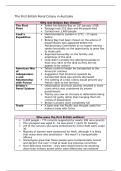
Why was Botany Bay chosen?
The First Sailed into Botany Bay on 18th January 1788
Fleet Passage took 252 days and 69 people died
Carried over 1,400 people
Cook’s Had returned to London in 1771 – 17 years
Expedition before
Botany Bay had been chosen on the advice of
Joseph Banks who appeared before the
Parliamentary Committee as an expert witness –
spoke favourably on the opportunity to grow flax
to make sails
Reported favourably on the fertility and
emptiness of the land
Cook didn’t consider the Aboriginal people to
have any claim to the land as they did not
appear to be using it
American War Felons could no longer be transported to the
of American colonies
Independenc Suggestion that American loyalists be
e and transported there was quickly dismissed
Relationship The settling of a new colony would prevent any
with France French claim to the territory
Britain’s Urbanisation and slum poverty resulted in more
Penal System crime which was undeterred by severe
punishments
Trial by jury saw an increase in defendants being
found not guilty rather than hanging them for
crimes of desperation
Britain’s prisons were completely full
Trade A base near the Pacific was thought useful for
indirect trade with China
Who were the first British settlers?
1,420 people – 775 convicts supported by nearly 300 non-convicts
The youngest was aged 9 – he was given 7 years for stealing
2/3 of the convicts who were sentenced for minor theft were under
30
Majority of women were sentenced for theft, although it is likely
that many were also prostitutes – this wasn’t a transportable
offence
Stereotypes grew that these people were fundamentally honest
and decent, but over ½ had at least one previous conviction
Over 600 were marines – they were disinclined to do anything
other than military duties which were effectively non-existent
, Syndey Cove
Failure of Lacked fresh water supply
Botany Bay The area was unsuitable for cultivation – poor
soil quality
Challenges at Within 6 months, the livestock that had been
Sydney Cove bought with the Fleet had either been eaten or
disappeared
No plough available to till the soil or animal
suitable to pull a plough
The soil was thin and did not yield much of a
crop
Governor Phillip initially lodged under a canvas
structure which let in the wind and rain
Building efforts hampered by the difficulty to
make brick and the lack of mortar available
Settlement existed on original supplies and
whatever fresh fish or birdlife they could kill
Settlers traded with the Aboriginals whose
superior hunting skills enabled them to kill
kangaroo
Phillip’s Had to act without advice from London
Challenges in Was faced with an unfamiliar environment
Managing the The convicts were not knowledgeable or skilled
Settlement Often had to resort to harsh physical
punishments to maintain control – lashings and
hangings were frequent
Phillip’s instructions left a great deal to his own
initiative:
- London initially envisaged that the colony
would be self-sufficient within 4 years and
costed the venture at just over £70,000
- All supplies and food were the property of
the government and were to be distributed
at the governor’s discretion
- All produce grown or income derived from
the planned flax industry in Norfolk Island
was to be the property of the government
(never materialised as the flax was the
wrong type)
- Needed to allocate plots of land to those
convicts who had served their sentences
Phillip’s When he sailed back to Britain in 1792,
Successes everyone was housed in wattle and daub
dwellings and there was a brick-built governor’s
mansion
66 grants of land had been made – 53 to ex-
Why was Botany Bay chosen?
The First Sailed into Botany Bay on 18th January 1788
Fleet Passage took 252 days and 69 people died
Carried over 1,400 people
Cook’s Had returned to London in 1771 – 17 years
Expedition before
Botany Bay had been chosen on the advice of
Joseph Banks who appeared before the
Parliamentary Committee as an expert witness –
spoke favourably on the opportunity to grow flax
to make sails
Reported favourably on the fertility and
emptiness of the land
Cook didn’t consider the Aboriginal people to
have any claim to the land as they did not
appear to be using it
American War Felons could no longer be transported to the
of American colonies
Independenc Suggestion that American loyalists be
e and transported there was quickly dismissed
Relationship The settling of a new colony would prevent any
with France French claim to the territory
Britain’s Urbanisation and slum poverty resulted in more
Penal System crime which was undeterred by severe
punishments
Trial by jury saw an increase in defendants being
found not guilty rather than hanging them for
crimes of desperation
Britain’s prisons were completely full
Trade A base near the Pacific was thought useful for
indirect trade with China
Who were the first British settlers?
1,420 people – 775 convicts supported by nearly 300 non-convicts
The youngest was aged 9 – he was given 7 years for stealing
2/3 of the convicts who were sentenced for minor theft were under
30
Majority of women were sentenced for theft, although it is likely
that many were also prostitutes – this wasn’t a transportable
offence
Stereotypes grew that these people were fundamentally honest
and decent, but over ½ had at least one previous conviction
Over 600 were marines – they were disinclined to do anything
other than military duties which were effectively non-existent
, Syndey Cove
Failure of Lacked fresh water supply
Botany Bay The area was unsuitable for cultivation – poor
soil quality
Challenges at Within 6 months, the livestock that had been
Sydney Cove bought with the Fleet had either been eaten or
disappeared
No plough available to till the soil or animal
suitable to pull a plough
The soil was thin and did not yield much of a
crop
Governor Phillip initially lodged under a canvas
structure which let in the wind and rain
Building efforts hampered by the difficulty to
make brick and the lack of mortar available
Settlement existed on original supplies and
whatever fresh fish or birdlife they could kill
Settlers traded with the Aboriginals whose
superior hunting skills enabled them to kill
kangaroo
Phillip’s Had to act without advice from London
Challenges in Was faced with an unfamiliar environment
Managing the The convicts were not knowledgeable or skilled
Settlement Often had to resort to harsh physical
punishments to maintain control – lashings and
hangings were frequent
Phillip’s instructions left a great deal to his own
initiative:
- London initially envisaged that the colony
would be self-sufficient within 4 years and
costed the venture at just over £70,000
- All supplies and food were the property of
the government and were to be distributed
at the governor’s discretion
- All produce grown or income derived from
the planned flax industry in Norfolk Island
was to be the property of the government
(never materialised as the flax was the
wrong type)
- Needed to allocate plots of land to those
convicts who had served their sentences
Phillip’s When he sailed back to Britain in 1792,
Successes everyone was housed in wattle and daub
dwellings and there was a brick-built governor’s
mansion
66 grants of land had been made – 53 to ex-