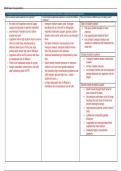
SNAB Topic 1 Key questions:
1.1 Understand why many animals have a heart and circulation (mass transport to overcome limitations of diffusion in meeting the requirements of organisms).
Why are transport systems needed by some organisms? How do transport systems help organisms to overcome the limitations What are the features of different types of circulatory system?
of diffusion?
o the cells of all organisms need of supply o transport medium (water, polar, hydrogen Open circulatory system
oxygen and glucose for aerobic respiration bonding) acts as a solvent for biologically • Has open-ended vessels so lower
o and removal of wastes such as carbon important molecules (oxygen, glucose, carbon pressure
dioxide and urea dioxide, amino acids, urea) and so can transport • Has haemolymph instead of blood
o organisms with a high surface area to volume them • Has a heart, transport medium and
ratio can meet these requirements by o the heart contracts to put pressure on the vessels so substances still transported by
diffusion alone (due to Ficks Law, high transport medium, transport medium moves mass flow
surface area means high rate of diffusion) from high pressure to low pressure
o organisms with a low SA:volume ratio have o dissolved substances get transported by mass Closed circulatory systems
an inadequate rate of diffusion flow • Transport medium always inside blood
o There is an inadequate supply of oxygen o blood vessels maintain pressure on transport vessels
o Aerobic respiration cannot occur, and cells medium, so it can move greater distances • so has a higher pressure,
stop functioning (lack of ATP) o this maintains high concentration gradients near • so transport medium can be transported
cells (oxygen, glucose high conc., carbon greater distances (so organisms can be
dioxide low conc.) larger)
o so high (adequate) rate of diffusion is
maintained for all substances and all cells. Double closed circulatory system
• blood travels through heart twice for
each circuit of the body
• low pressure pulmonary circuit to lungs
because they are close to heart (and
prevent damage to lungs)
• high pressure systemic circuit to rest of
body
• substances transported greater
distances
• oxygenated and deoxygenated blood
separated by heart septum
• maintains higher concentration
gradients
, 1.2 Understand the importance of water as a solvent in transport, including its dipole nature.
1.3 Understand how the structures of blood vessels (capillaries, arteries and veins) relate to their functions.
How is the structure of the water molecule related to its role as a How are the structures of different blood vessels related to their roles?
transport medium?
o water is composed of two hydrogen atoms
covalently bonded to oxygen
Blood Structural feature Directly related function
o each O-H bond has a dipole, which makes
vessel
the water molecule overall, polar, with a
partially negative oxygen, and partially artery thick layer of expand and recoil to maintain
positive hydrogens. elastic tissue pressure on blood
o water molecules have hydrogen bonds
between them so; folded can stretch to prevent damage
endothelium due to high pressure
o they are cohesive, and result in water being a
liquid that can transport substances narrow lumen maintain high pressure on
according to pressure gradients blood
o they are excellent solvents; interacting with
opposite charges on other molecules to vein thin walls allow neighbouring skeletal
dissolve them (glucose, oxygen, mineral muscles to deform vein and
ions, amino acids, carbon dioxide, urea, move blood
soluble proteins) valves ensure blood flow in the
correct direction (prevent
backflow)
Wide lumen Reduce resistance to flow of
(low pressure) blood
capillaries narrow lumen ● causes blood to flow
more slowly and allow
exchange of
substances
● reduces diffusion
distance (increase
rate of diffusion both
ways)
capillary wall one reduces diffusion distance
cell thick (increases rate of diffusion)
form a large increase surface area
network through (increase rate of diffusion)
tissues
1.1 Understand why many animals have a heart and circulation (mass transport to overcome limitations of diffusion in meeting the requirements of organisms).
Why are transport systems needed by some organisms? How do transport systems help organisms to overcome the limitations What are the features of different types of circulatory system?
of diffusion?
o the cells of all organisms need of supply o transport medium (water, polar, hydrogen Open circulatory system
oxygen and glucose for aerobic respiration bonding) acts as a solvent for biologically • Has open-ended vessels so lower
o and removal of wastes such as carbon important molecules (oxygen, glucose, carbon pressure
dioxide and urea dioxide, amino acids, urea) and so can transport • Has haemolymph instead of blood
o organisms with a high surface area to volume them • Has a heart, transport medium and
ratio can meet these requirements by o the heart contracts to put pressure on the vessels so substances still transported by
diffusion alone (due to Ficks Law, high transport medium, transport medium moves mass flow
surface area means high rate of diffusion) from high pressure to low pressure
o organisms with a low SA:volume ratio have o dissolved substances get transported by mass Closed circulatory systems
an inadequate rate of diffusion flow • Transport medium always inside blood
o There is an inadequate supply of oxygen o blood vessels maintain pressure on transport vessels
o Aerobic respiration cannot occur, and cells medium, so it can move greater distances • so has a higher pressure,
stop functioning (lack of ATP) o this maintains high concentration gradients near • so transport medium can be transported
cells (oxygen, glucose high conc., carbon greater distances (so organisms can be
dioxide low conc.) larger)
o so high (adequate) rate of diffusion is
maintained for all substances and all cells. Double closed circulatory system
• blood travels through heart twice for
each circuit of the body
• low pressure pulmonary circuit to lungs
because they are close to heart (and
prevent damage to lungs)
• high pressure systemic circuit to rest of
body
• substances transported greater
distances
• oxygenated and deoxygenated blood
separated by heart septum
• maintains higher concentration
gradients
, 1.2 Understand the importance of water as a solvent in transport, including its dipole nature.
1.3 Understand how the structures of blood vessels (capillaries, arteries and veins) relate to their functions.
How is the structure of the water molecule related to its role as a How are the structures of different blood vessels related to their roles?
transport medium?
o water is composed of two hydrogen atoms
covalently bonded to oxygen
Blood Structural feature Directly related function
o each O-H bond has a dipole, which makes
vessel
the water molecule overall, polar, with a
partially negative oxygen, and partially artery thick layer of expand and recoil to maintain
positive hydrogens. elastic tissue pressure on blood
o water molecules have hydrogen bonds
between them so; folded can stretch to prevent damage
endothelium due to high pressure
o they are cohesive, and result in water being a
liquid that can transport substances narrow lumen maintain high pressure on
according to pressure gradients blood
o they are excellent solvents; interacting with
opposite charges on other molecules to vein thin walls allow neighbouring skeletal
dissolve them (glucose, oxygen, mineral muscles to deform vein and
ions, amino acids, carbon dioxide, urea, move blood
soluble proteins) valves ensure blood flow in the
correct direction (prevent
backflow)
Wide lumen Reduce resistance to flow of
(low pressure) blood
capillaries narrow lumen ● causes blood to flow
more slowly and allow
exchange of
substances
● reduces diffusion
distance (increase
rate of diffusion both
ways)
capillary wall one reduces diffusion distance
cell thick (increases rate of diffusion)
form a large increase surface area
network through (increase rate of diffusion)
tissues