

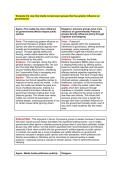
‘ Evaluate the view that media not pressure groups that has greater influence on
governments’
Agree ( The media has more influence Disagree ( pressure groups have more
on governments) Media shapes public influence on governments) Pressure
opinion groups directly influence policy through
expertise and lobbying
Point - The media has greater influence on Point -. Pressure/I
government because it shapes public I/ groups operate within the institutional
opinion and sets the political agenda more framework of governance, offering technical
broadly and immediately than pressure knowledge, policy proposals, and
groups. Through agenda-setting and stakeholder insight that ministers and civil
framing, media outlets determine which servants often depend upon to formulate
issues gain national attention and how they coherent legislation.
are perceived by the public. Evidence - For example, the British
Evidence - For example, during the 2019 Medical Association (BMA) plays a key role
general election, newspapers like The Sun in shaping NHS policy by offering advice
and The Daily Mail framed the debate based on medical expertise and real-world
around "Getting Brexit Done", amplifying experience. Demonstrating input in 2024,
the Conservative Party’s messaging and offering medical expertise regarding the
marginalising alternative voices. assisted dying bill. This kind of input helps
Explain - This not only influenced voter the government design more practical and
behaviour but forced opposition parties to informed policies, especially in areas like
respond on terms set by the media. . In this healthcare, education, or the environment.
way, the media can dictate the pace and Explain - Unlike the media, which often
focus of political discourse, making it a applies short-term pressure through
more powerful short-term influencer on headlines or scandals, insider pressure
government decision-making than most groups can influence the actual content of
pressure groups. This shows how media new laws and reforms. This shows that
outlets can control the parameters of pressure groups can have a quieter but
political debate, pushing governments to act stronger and more consistent influence on
on certain issues while ignoring others. how the government actually works, even if
they don’t make headlines like the media
does.
EVALUATION - This argument in favour of pressure groups is weaker because it assumes
that quiet, expert access always translates into significant political power—yet in reality,
governments often ignore or sideline pressure groups when it suits them politically. Insider
groups may offer advice, but that doesn’t guarantee their recommendations are followed,
especially if their views conflict with the government’s political agenda or public opinion. .
In contrast, the media has a more immediate and visible influence on government
behaviour because it shapes public opinion and voter perception, which politicians are
directly accountable to. Ministers are far more likely to respond quickly to media
pressure—especially during a scandal or election period—than to behind-the-scenes
lobbying.
Agree - Media holds politicians publicly Disagree -
, accountable
Point - The media plays a critical role in Point - Pressure groups can exert strong
holding governments publicly accountable, influence on government through mass
giving it greater influence than pressure mobilisation and direct action, often more
groups. Investigative journalism and effectively than media campaigns. Unlike
ongoing media scrutiny can expose the media, which primarily informs,
scandals, challenge government narratives, pressure groups have the ability to organise
and force ministers to respond quickly to large-scale protests, strikes, and campaigns
public outrage. that place direct pressure on policymakers.
Evidence - A key example is the Partygate Evidence- A recent example is the 2023
scandal, which was uncovered and National Education Union (NEU) strikes,
amplified by media outlets like ITV News where hundreds of thousands of teachers
and The Guardian. More recently For across England and Wales took industrial
example, The Guardian reported that action over pay and working conditions.
released government documents showed Explain - The strikes caused widespread
Starmer had been warned about disruption and led to formal negotiations
“reputational risk” before the appointment with the government, forcing ministers to
after the appointment of Lord Mandelson revise their stance on public sector
Explain - Continuous reporting not only pay.When a large group of workers—such
kept the issue in the public eye but also as teachers in this case—take collective
intensified pressure on the government, action by striking, it directly affects people's
leading to multiple resignations, including daily lives, which creates immediate
that of Prime Minister Boris Johnson and pressure on the government. education,
the resignation of Lord Mandelson in healthcare, or transportation. The visibility
Febuary 2026. Unlike pressure groups, and disruption caused by these actions
which often operate behind the scenes or push the issue to the top of the political
represent specific interests, the media agenda, making it harder for the
speaks directly to the public and can shape government to ignore or delay action, as
public opinion in real time.. The immediacy they risk alienating voters and undermining
and visibility of media scrutiny give it a their own political legitimacy.
unique power to drive political change,
especially in an age of viral content and
24-hour news cycles. This level of public
influence means that the media often has a
more direct and urgent impact on
government behaviour than pressure
groups, whose influence tends to be slower
and more targeted.
EVALUATION - The argument that pressure groups have more influence than the media
is weak because it overlooks the broader, long-term impact that the media has in
scrutinising the government. While pressure groups can create short-term disruption, the
media holds sustained power in exposing government wrongdoing, shaping public opinion,
and setting the political agenda. For instance, investigative reporting by outlets The media
can reach a far wider audience than pressure groups, maintaining continuous public
scrutiny of government actions. The media can reach a far wider audience than pressure
groups, maintaining continuous public scrutiny of government actions. the media affects
political discourse on a national scale.
governments’
Agree ( The media has more influence Disagree ( pressure groups have more
on governments) Media shapes public influence on governments) Pressure
opinion groups directly influence policy through
expertise and lobbying
Point - The media has greater influence on Point -. Pressure/I
government because it shapes public I/ groups operate within the institutional
opinion and sets the political agenda more framework of governance, offering technical
broadly and immediately than pressure knowledge, policy proposals, and
groups. Through agenda-setting and stakeholder insight that ministers and civil
framing, media outlets determine which servants often depend upon to formulate
issues gain national attention and how they coherent legislation.
are perceived by the public. Evidence - For example, the British
Evidence - For example, during the 2019 Medical Association (BMA) plays a key role
general election, newspapers like The Sun in shaping NHS policy by offering advice
and The Daily Mail framed the debate based on medical expertise and real-world
around "Getting Brexit Done", amplifying experience. Demonstrating input in 2024,
the Conservative Party’s messaging and offering medical expertise regarding the
marginalising alternative voices. assisted dying bill. This kind of input helps
Explain - This not only influenced voter the government design more practical and
behaviour but forced opposition parties to informed policies, especially in areas like
respond on terms set by the media. . In this healthcare, education, or the environment.
way, the media can dictate the pace and Explain - Unlike the media, which often
focus of political discourse, making it a applies short-term pressure through
more powerful short-term influencer on headlines or scandals, insider pressure
government decision-making than most groups can influence the actual content of
pressure groups. This shows how media new laws and reforms. This shows that
outlets can control the parameters of pressure groups can have a quieter but
political debate, pushing governments to act stronger and more consistent influence on
on certain issues while ignoring others. how the government actually works, even if
they don’t make headlines like the media
does.
EVALUATION - This argument in favour of pressure groups is weaker because it assumes
that quiet, expert access always translates into significant political power—yet in reality,
governments often ignore or sideline pressure groups when it suits them politically. Insider
groups may offer advice, but that doesn’t guarantee their recommendations are followed,
especially if their views conflict with the government’s political agenda or public opinion. .
In contrast, the media has a more immediate and visible influence on government
behaviour because it shapes public opinion and voter perception, which politicians are
directly accountable to. Ministers are far more likely to respond quickly to media
pressure—especially during a scandal or election period—than to behind-the-scenes
lobbying.
Agree - Media holds politicians publicly Disagree -
, accountable
Point - The media plays a critical role in Point - Pressure groups can exert strong
holding governments publicly accountable, influence on government through mass
giving it greater influence than pressure mobilisation and direct action, often more
groups. Investigative journalism and effectively than media campaigns. Unlike
ongoing media scrutiny can expose the media, which primarily informs,
scandals, challenge government narratives, pressure groups have the ability to organise
and force ministers to respond quickly to large-scale protests, strikes, and campaigns
public outrage. that place direct pressure on policymakers.
Evidence - A key example is the Partygate Evidence- A recent example is the 2023
scandal, which was uncovered and National Education Union (NEU) strikes,
amplified by media outlets like ITV News where hundreds of thousands of teachers
and The Guardian. More recently For across England and Wales took industrial
example, The Guardian reported that action over pay and working conditions.
released government documents showed Explain - The strikes caused widespread
Starmer had been warned about disruption and led to formal negotiations
“reputational risk” before the appointment with the government, forcing ministers to
after the appointment of Lord Mandelson revise their stance on public sector
Explain - Continuous reporting not only pay.When a large group of workers—such
kept the issue in the public eye but also as teachers in this case—take collective
intensified pressure on the government, action by striking, it directly affects people's
leading to multiple resignations, including daily lives, which creates immediate
that of Prime Minister Boris Johnson and pressure on the government. education,
the resignation of Lord Mandelson in healthcare, or transportation. The visibility
Febuary 2026. Unlike pressure groups, and disruption caused by these actions
which often operate behind the scenes or push the issue to the top of the political
represent specific interests, the media agenda, making it harder for the
speaks directly to the public and can shape government to ignore or delay action, as
public opinion in real time.. The immediacy they risk alienating voters and undermining
and visibility of media scrutiny give it a their own political legitimacy.
unique power to drive political change,
especially in an age of viral content and
24-hour news cycles. This level of public
influence means that the media often has a
more direct and urgent impact on
government behaviour than pressure
groups, whose influence tends to be slower
and more targeted.
EVALUATION - The argument that pressure groups have more influence than the media
is weak because it overlooks the broader, long-term impact that the media has in
scrutinising the government. While pressure groups can create short-term disruption, the
media holds sustained power in exposing government wrongdoing, shaping public opinion,
and setting the political agenda. For instance, investigative reporting by outlets The media
can reach a far wider audience than pressure groups, maintaining continuous public
scrutiny of government actions. The media can reach a far wider audience than pressure
groups, maintaining continuous public scrutiny of government actions. the media affects
political discourse on a national scale.


