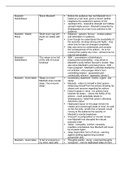
Macbeth - 'Brave Macbeth' Before the audience has met Macbeth he is
Noble/Brave hailed as a war hero, given a 'brave' epithet
Heightens the audience's opinion of him
Jacobean Era - masculine strength and military
strength highly prized - Macbeth presented by
Shakespeare as a man to be admired to the
audience.
Macbeth - Noble/ 'Shall never sag with Sibilance - passion, fervour - evokes pathos
Brave doubt nor shake with and admiration in audience
fear' Even though he understands the inevitability of
the outcome, he stays strong and fights - may
show how he has not changed completely
May also show he understands and accepts
the consequences of his actions - he is not
running from justice any more - (shows how he
may be remorseful)
Macbeth - 'Thy nature is too full 'Milk' - connotations of birth/baby's
Noble/Brave of the milk of human (hope/purity/vulnerability) - may allude to
kindness' Macbeth's purity before Duncan's murder. May
also show Macbeth's promising future - birth -
hope (poignant - Macbeth's potential dashed by
his ambition - discourages other's from
committing treason - gunpowder plot -
contextually relevant - appeases James I)
Macbeth - Guilt ridden 'Sleep no more! exclamatory statement - frantic, urgent - lost
Macbeth does murder sense.
sleep - the innocent Macbeth - refers to himself in third person -
sleep' distancing himself from his actions showing his
shame and remorse regarding his actions
Doesn't speak in verse - his actions have
lowered his status - shows the futility of his
actions - could potentially allude to
Shakespeare's belief that actions ultimately
determine status
Haphazard layout on the page mirrors his
chaotic and overwrought state of mind. As well
as this the jerky, erratic flow of speech would
convey to the audience the severity of
Macbeth's mental breakdown
'innocent' in juxtaposition to 'murder' shows
how Macbeth has disrupted the natural
peaceful order
'sleep' - tranquility, comfort, necessity -
repetition emphasises how Macbeth will never
be at peace again
sleep deprivation form of torture - warning
against plotting against king (context -
gunpowder plot)
Macbeth - Guilt ridden 'O full of scorpions is Thoughts painful - stung - poisoned thoughts
my mind, dear wife' 'scorpions' - mirrors haphazard state of mind
, (scuttling thoughts like scorpions) - emphasises
guilt and insanity
'Dear wife' - shows his love for LM has stayed
constant - not completely evil (still has the
capacity to love)
Juxtaposition of the idea of love and evil shows
the corruption of his thoughts and how guilt
permeates through every aspect of his life -
highlights the consequences of regicide and
the permanent guilt plagues perpetrator (deters
people from committing the same crime -
gunpowder plot)
Macbeth - Guilt ridden 'Will all great highlights the volume of blood - graphic (may
Neptune's oceans also be a metaphor for his guilt)
wash this blood clean He can never be 'clean' again - no return
from my hand? No my Neptune - God of the sea - not even God will
hand will rather turn forgive the crime of regicide (context -'divine
the multitudinous seas right of kings' and gunpowder plot)
incarnadine.' Incarnadine - crimson, like a dye - will stain his
hands forever - eternal guilt - no escape
Prose - emphasises Macbeth's sinking moral
status - shows futility of his actions (they have,
in fact, lowered his status)
Macbeth - Submissive 'Live a coward' Mocking/emasculating him
to LM 'letting "I dare not" wait shocks Jacobean audience - unorthodox
upon "I would"' balance of power - revelation that LM is
matriarch
Macbeth - Submissive 'When you durst do it 'When' - implying she knows he will concede
to LM then you were a man' suggesting he is not a man now
playing on his insecurities
men traditionally the leader of the household -
awkward balance of power surprises audience
Masculinity = very important in Jacobean era,
men expected to be brave and authoritative
Macbeth - Ambition 'Vaulting ambition' He acknowledges his only motive for murdering
'o'er leaps itself and Duncan is his overreaching ambition
falls on the other' 'vaulting' - active verb - emphasises the lengths
he would go to in order to become king (he
would actively commit regicide) - highlights how
his greed and ambition overrule his better
judgment and control his actions (overcome by
avarice)
Horse metaphor - 'o'er leaps itself and falls on
the other' - fails to take heed of his own
warning - instead hubristic and complacent -
foreshadows how Macbeth's ambition and thirst
for power will inevitably lead to his downfall and
may reinforce the idea that Macbeth represents
the 'tragic hero' who's harmartia of ambition will
ultimately lead to his own ruin - may show how
, he subconsciously knows it would be a mistake
to murder Duncan.
Macbeth - Ambition 'Stars hide your fires, May literally mean he wants to block out the
let not light see my light so he won't be seen committing the act -
black and deep shows he knows that what he is doing is wrong
desires' 'Stars' - heaven, purity, light - addressing
heavens directly - using imperatives to God
(shows hubris), wants them to hide evidence of
light and hop. However could also show how
he doesn't want heaven to be tainted by evil
'black and deep desires' - alliteration -
emphasises his yearning for power. 'desire' -
ambition to become king (instinctively jumps to
murder). 'deep' - innate, deeply rooted in his
heart
'black' and 'light' - idea of good in juxtaposition
with evil - shows how power will corrupt
Macbeth
soliloquy - allows the audience to see his true
desires and ambitions - allows the audience to
understand Macbeth's character more and also
externalises his internal conflict between
morality and ambition
Macbeth - Ambition 'A step on which I Instinct to jump to murder - may show he is an
must fall down or else inherently violent man and highlight how the
o'er leap' only difference in his behaviour to cause such a
decline was his allegiance to the king and his
ambition (harmartia) - deters others thinking of
committing treacherous acts against the
monarchy (gun powder plot)
soliloquy - allows the audience to see his true
desires and ambitions - allows the audience to
understand Macbeth's character more and also
externalises his internal conflict between
morality and ambition
Macbeth - iniquitous 'Against churches' Shows the development of Macbeth's evil
'Even till destruction nature - in act two his guilt prevented him from
sicken, answer me' saying 'amen', but now he would gladly go
'against churches', and therefore against God,
for his own selfish fear and desire.
Open rejection of the church - shows the
acceptance of his condemned soul - no longer
afflicted by guilt, he would let 'destruction
sicken' the country he has fought so hard to
rule - shows his desensitisation throughout the
course of the play.
'sicken' - sickness could lead to eventual death
- shows how he cares only for himself, he is
aware that his hunger for power may lead to
the demise of his country, he continues.
imperatives - 'answer me' - shows his
, desperation to know his futures
Shows the power of the witches - they have the
power to destroy a country, and could even
challenge God - portrayal of the witches in an
evil light - Jacobean audience strongly believed
that challenging God inevitably lead to going to
hell - this was a legitimate worry for many and
their lives revolved around religion.
Macbeth - iniquitous 'unseamed him from Brutal/ Graphic imagery
the nave to the chops' Violence on the battlefield celebrated as it is in
favour of the king - shows societal acceptance
of brutality and violence, however may also
warn that this acceptance only applies to those
fighting for the king - we see Macbeth's fall
from grace as he gradually succumbs to the
temptation of power and ambition. The
audience' view of Macbeth changes as his
allegiance changes and he becomes less
respected and more feared and disreputable -
Jacobean audience was particularly afraid of
Macbeth (stigma around the name [used
euphemism of 'the Scottish play' as it was
considered unlucky] - shows the terror this
instilled into the audience - Therefore Macbeth
may be regarded as a cautionary play to warn
people against challenging the monarchy)
Macbeth - iniquitous 'Give to the edge of reckless/heartless disregard for other human
the sword his wife, his life - shows the escalation of his violence and
babes' brutality
'babes' - reminds the audience that he is
condemning innocent children, makes the
audiences fear and disgust towards Macbeth
grow - actions appear more malignant
Macbeth- iniquitous 'Seyton - I am sick to 'Seyton' - homophone for Satan - devil - shows
the heart' how he is surrounded by evil
'heart' - used in conjunction with 'soul' - which is
said to be the "essence of a person" - shows
how his moral conscience has decayed and
become diseased
Macbeth - iniquitous 'This dead butcher' do not say his name - may show that he does
not deserve to be named - superstitious -
brings bad luck
'butcher' - shows the extent of violence he
brought to Scotland and his careless disregard
for human life towards the end of the play -
contrast from beginning of play 'brave Macbeth'
'dead' - emphasises finality of his reign
Macbeth - paranoid 'restless ecstasy' oxymoron - perturbed (may show how he
knows he doesn't belong to be in the position
['divine right'] and is continually worried it will
Noble/Brave hailed as a war hero, given a 'brave' epithet
Heightens the audience's opinion of him
Jacobean Era - masculine strength and military
strength highly prized - Macbeth presented by
Shakespeare as a man to be admired to the
audience.
Macbeth - Noble/ 'Shall never sag with Sibilance - passion, fervour - evokes pathos
Brave doubt nor shake with and admiration in audience
fear' Even though he understands the inevitability of
the outcome, he stays strong and fights - may
show how he has not changed completely
May also show he understands and accepts
the consequences of his actions - he is not
running from justice any more - (shows how he
may be remorseful)
Macbeth - 'Thy nature is too full 'Milk' - connotations of birth/baby's
Noble/Brave of the milk of human (hope/purity/vulnerability) - may allude to
kindness' Macbeth's purity before Duncan's murder. May
also show Macbeth's promising future - birth -
hope (poignant - Macbeth's potential dashed by
his ambition - discourages other's from
committing treason - gunpowder plot -
contextually relevant - appeases James I)
Macbeth - Guilt ridden 'Sleep no more! exclamatory statement - frantic, urgent - lost
Macbeth does murder sense.
sleep - the innocent Macbeth - refers to himself in third person -
sleep' distancing himself from his actions showing his
shame and remorse regarding his actions
Doesn't speak in verse - his actions have
lowered his status - shows the futility of his
actions - could potentially allude to
Shakespeare's belief that actions ultimately
determine status
Haphazard layout on the page mirrors his
chaotic and overwrought state of mind. As well
as this the jerky, erratic flow of speech would
convey to the audience the severity of
Macbeth's mental breakdown
'innocent' in juxtaposition to 'murder' shows
how Macbeth has disrupted the natural
peaceful order
'sleep' - tranquility, comfort, necessity -
repetition emphasises how Macbeth will never
be at peace again
sleep deprivation form of torture - warning
against plotting against king (context -
gunpowder plot)
Macbeth - Guilt ridden 'O full of scorpions is Thoughts painful - stung - poisoned thoughts
my mind, dear wife' 'scorpions' - mirrors haphazard state of mind
, (scuttling thoughts like scorpions) - emphasises
guilt and insanity
'Dear wife' - shows his love for LM has stayed
constant - not completely evil (still has the
capacity to love)
Juxtaposition of the idea of love and evil shows
the corruption of his thoughts and how guilt
permeates through every aspect of his life -
highlights the consequences of regicide and
the permanent guilt plagues perpetrator (deters
people from committing the same crime -
gunpowder plot)
Macbeth - Guilt ridden 'Will all great highlights the volume of blood - graphic (may
Neptune's oceans also be a metaphor for his guilt)
wash this blood clean He can never be 'clean' again - no return
from my hand? No my Neptune - God of the sea - not even God will
hand will rather turn forgive the crime of regicide (context -'divine
the multitudinous seas right of kings' and gunpowder plot)
incarnadine.' Incarnadine - crimson, like a dye - will stain his
hands forever - eternal guilt - no escape
Prose - emphasises Macbeth's sinking moral
status - shows futility of his actions (they have,
in fact, lowered his status)
Macbeth - Submissive 'Live a coward' Mocking/emasculating him
to LM 'letting "I dare not" wait shocks Jacobean audience - unorthodox
upon "I would"' balance of power - revelation that LM is
matriarch
Macbeth - Submissive 'When you durst do it 'When' - implying she knows he will concede
to LM then you were a man' suggesting he is not a man now
playing on his insecurities
men traditionally the leader of the household -
awkward balance of power surprises audience
Masculinity = very important in Jacobean era,
men expected to be brave and authoritative
Macbeth - Ambition 'Vaulting ambition' He acknowledges his only motive for murdering
'o'er leaps itself and Duncan is his overreaching ambition
falls on the other' 'vaulting' - active verb - emphasises the lengths
he would go to in order to become king (he
would actively commit regicide) - highlights how
his greed and ambition overrule his better
judgment and control his actions (overcome by
avarice)
Horse metaphor - 'o'er leaps itself and falls on
the other' - fails to take heed of his own
warning - instead hubristic and complacent -
foreshadows how Macbeth's ambition and thirst
for power will inevitably lead to his downfall and
may reinforce the idea that Macbeth represents
the 'tragic hero' who's harmartia of ambition will
ultimately lead to his own ruin - may show how
, he subconsciously knows it would be a mistake
to murder Duncan.
Macbeth - Ambition 'Stars hide your fires, May literally mean he wants to block out the
let not light see my light so he won't be seen committing the act -
black and deep shows he knows that what he is doing is wrong
desires' 'Stars' - heaven, purity, light - addressing
heavens directly - using imperatives to God
(shows hubris), wants them to hide evidence of
light and hop. However could also show how
he doesn't want heaven to be tainted by evil
'black and deep desires' - alliteration -
emphasises his yearning for power. 'desire' -
ambition to become king (instinctively jumps to
murder). 'deep' - innate, deeply rooted in his
heart
'black' and 'light' - idea of good in juxtaposition
with evil - shows how power will corrupt
Macbeth
soliloquy - allows the audience to see his true
desires and ambitions - allows the audience to
understand Macbeth's character more and also
externalises his internal conflict between
morality and ambition
Macbeth - Ambition 'A step on which I Instinct to jump to murder - may show he is an
must fall down or else inherently violent man and highlight how the
o'er leap' only difference in his behaviour to cause such a
decline was his allegiance to the king and his
ambition (harmartia) - deters others thinking of
committing treacherous acts against the
monarchy (gun powder plot)
soliloquy - allows the audience to see his true
desires and ambitions - allows the audience to
understand Macbeth's character more and also
externalises his internal conflict between
morality and ambition
Macbeth - iniquitous 'Against churches' Shows the development of Macbeth's evil
'Even till destruction nature - in act two his guilt prevented him from
sicken, answer me' saying 'amen', but now he would gladly go
'against churches', and therefore against God,
for his own selfish fear and desire.
Open rejection of the church - shows the
acceptance of his condemned soul - no longer
afflicted by guilt, he would let 'destruction
sicken' the country he has fought so hard to
rule - shows his desensitisation throughout the
course of the play.
'sicken' - sickness could lead to eventual death
- shows how he cares only for himself, he is
aware that his hunger for power may lead to
the demise of his country, he continues.
imperatives - 'answer me' - shows his
, desperation to know his futures
Shows the power of the witches - they have the
power to destroy a country, and could even
challenge God - portrayal of the witches in an
evil light - Jacobean audience strongly believed
that challenging God inevitably lead to going to
hell - this was a legitimate worry for many and
their lives revolved around religion.
Macbeth - iniquitous 'unseamed him from Brutal/ Graphic imagery
the nave to the chops' Violence on the battlefield celebrated as it is in
favour of the king - shows societal acceptance
of brutality and violence, however may also
warn that this acceptance only applies to those
fighting for the king - we see Macbeth's fall
from grace as he gradually succumbs to the
temptation of power and ambition. The
audience' view of Macbeth changes as his
allegiance changes and he becomes less
respected and more feared and disreputable -
Jacobean audience was particularly afraid of
Macbeth (stigma around the name [used
euphemism of 'the Scottish play' as it was
considered unlucky] - shows the terror this
instilled into the audience - Therefore Macbeth
may be regarded as a cautionary play to warn
people against challenging the monarchy)
Macbeth - iniquitous 'Give to the edge of reckless/heartless disregard for other human
the sword his wife, his life - shows the escalation of his violence and
babes' brutality
'babes' - reminds the audience that he is
condemning innocent children, makes the
audiences fear and disgust towards Macbeth
grow - actions appear more malignant
Macbeth- iniquitous 'Seyton - I am sick to 'Seyton' - homophone for Satan - devil - shows
the heart' how he is surrounded by evil
'heart' - used in conjunction with 'soul' - which is
said to be the "essence of a person" - shows
how his moral conscience has decayed and
become diseased
Macbeth - iniquitous 'This dead butcher' do not say his name - may show that he does
not deserve to be named - superstitious -
brings bad luck
'butcher' - shows the extent of violence he
brought to Scotland and his careless disregard
for human life towards the end of the play -
contrast from beginning of play 'brave Macbeth'
'dead' - emphasises finality of his reign
Macbeth - paranoid 'restless ecstasy' oxymoron - perturbed (may show how he
knows he doesn't belong to be in the position
['divine right'] and is continually worried it will