BTE2601 ASSIGNMENT 2 2026
DUE 28 JUNE 2026
QUESTION 1
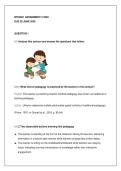
1.1 Analyse this cartoon and answer the questions that follow:
1.1.1 What kind of pedagogy is practiced by the teacher in the cartoon?
English-The teacher is practicing teacher-centred pedagogy also known as traditional or
banking pedagogy.
IsiZulu- Uthisha usebenzisa indlela yokufundisa egxile kuthisha (i-traditional pedagogy).
(Freire, 1970, in Gravett et al., 2018, p. 83-84)
1.1.2 Two observable actions showing this pedagogy
The teacher is standing at the front of the classroom facing the learners, delivering
information in a lecture-style manner while learners sit passively at their desks.
The teacher is writing on the chalkboard/whiteboard while learners are copying
notes, indicating one-way transmission of knowledge rather than interactive
engagement.
, (Gravett et al., 2018, p. 3-4 - teaching as transmission of knowledge)
1.1.3 Two reasons why such a pedagogy can influence the learner's emotional
well-being
Increased anxiety and fear of failure - In a teacher-centred classroom, learners may feel
pressured to provide the "correct" answer as determined solely by the teacher. This can
lead to performance anxiety, fear of being wrong in front of peers, and reduced self-
esteem (Gravett et al., 2018, p. 32).
Passivity and disengagement - When learners are treated as empty vessels to be filled
with information, they may become bored, disconnected, and develop negative attitudes
towards learning. This can lead to feelings of worthlessness and lack of motivation,
negatively impacting their emotional well-being.
(Freire's "banking concept" in Gravett et al., 2018, p. 83-84)
1.1.4 Two reasons why these actions might improve learner academic
participation
Clear structure and expectations - When the teacher provides direct instructions and
clear explanations, learners know exactly what is expected of them. This clarity can
reduce confusion and help learners feel more confident to participate, especially
those who struggle with open-ended tasks.
Modelling of correct responses - When the teacher demonstrates how to solve
problems or answer questions, learners can observe and imitate these behaviours.
This scaffolding can increase their willingness to attempt tasks independently,
thereby improving academic participation.
(Behaviourist principles in Gravett et al., 2018, p. 50-51)
1.1.5 Two other actions to ensure this pedagogy is carried through
DUE 28 JUNE 2026
QUESTION 1
1.1 Analyse this cartoon and answer the questions that follow:
1.1.1 What kind of pedagogy is practiced by the teacher in the cartoon?
English-The teacher is practicing teacher-centred pedagogy also known as traditional or
banking pedagogy.
IsiZulu- Uthisha usebenzisa indlela yokufundisa egxile kuthisha (i-traditional pedagogy).
(Freire, 1970, in Gravett et al., 2018, p. 83-84)
1.1.2 Two observable actions showing this pedagogy
The teacher is standing at the front of the classroom facing the learners, delivering
information in a lecture-style manner while learners sit passively at their desks.
The teacher is writing on the chalkboard/whiteboard while learners are copying
notes, indicating one-way transmission of knowledge rather than interactive
engagement.
, (Gravett et al., 2018, p. 3-4 - teaching as transmission of knowledge)
1.1.3 Two reasons why such a pedagogy can influence the learner's emotional
well-being
Increased anxiety and fear of failure - In a teacher-centred classroom, learners may feel
pressured to provide the "correct" answer as determined solely by the teacher. This can
lead to performance anxiety, fear of being wrong in front of peers, and reduced self-
esteem (Gravett et al., 2018, p. 32).
Passivity and disengagement - When learners are treated as empty vessels to be filled
with information, they may become bored, disconnected, and develop negative attitudes
towards learning. This can lead to feelings of worthlessness and lack of motivation,
negatively impacting their emotional well-being.
(Freire's "banking concept" in Gravett et al., 2018, p. 83-84)
1.1.4 Two reasons why these actions might improve learner academic
participation
Clear structure and expectations - When the teacher provides direct instructions and
clear explanations, learners know exactly what is expected of them. This clarity can
reduce confusion and help learners feel more confident to participate, especially
those who struggle with open-ended tasks.
Modelling of correct responses - When the teacher demonstrates how to solve
problems or answer questions, learners can observe and imitate these behaviours.
This scaffolding can increase their willingness to attempt tasks independently,
thereby improving academic participation.
(Behaviourist principles in Gravett et al., 2018, p. 50-51)
1.1.5 Two other actions to ensure this pedagogy is carried through