Moleculaire Biologie
H18 Control of Gene Expression
18.1 Bacteria often respond to environmental change by regulating transcription
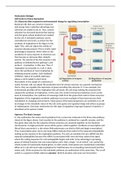
Bacterial cells that can conserve resources
and energy have a selective advantage over
cells that are unable to do so. Thus, natural
selection has favoured bacteria that express
only the genes whose products are needed
by the cell. A metabolic pathway can be
controlled on two levels, as shown for the
synthesis of tryptophan in the figure to the
right. First, cells can adjust the activity of
enzymes already present. This is a fairly rapid
physiological response, which relies on the
sensitivity of many enzymes to chemical cues
that increase or decrease their catalytic
activity. The activity of the first enzyme in the
pathway is inhibited by the pathway’s end
product – tryptophan, in this case. Thus, if
tryptophan accumulates in a cell, it shuts
down the synthesis of more tryptophan by
inhibiting enzyme activity. Such feedback
inhibition, typical of anabolic pathways,
allows a cell to adapt to short-term
fluctuations in the supply of a substance it
needs. Second, cells can adjust the production level of certain enzymes via a genetic mechanism;
that is, they can regulate the expression of genes encoding the enzymes. If, in our example, the
environment provides all the tryptophan the cell needs, the cell stops making the enzymes that
catalyze the synthesis of tryptophan. In this case, the control of enzyme production occurs at the
level of transcription, the synthesis of messenger RNA from the genes that code for these enzymes.
Regulation of the tryptophan synthesis pathways is just one example of how bacteria tune their
metabolism to changing environments. Many genes of the bacterial genome are switched on or off
by changes in the metabolic status of the cell; some genes are regulated singly and others as groups
of related genes. One basic mechanism for this type of regulation of groups of genes in bacteria, is
described as the operon model.
Operons: The Basic Concept
E. coly synthesizes the amino acid tryptophan from a precursor molecule in the three-step pathway
shown in the figure above. Each reaction in the pathway is catalysed by a specific enzyme, and the
five genes that code for the subunits of these enzymes are clustered together on the bacterial
chromosome. A single promoter serves all five genes, which together constitute a transcription unit.
(Recall that a promoter is a site where RNA polymerase can bind to DNA and begin transcription).
Thus, transcription gives rise to one long mRNA molecule that codes for five separate polypeptides
making up the enzymes in the tryptophan pathway. The cell can translate this one mRNA into five
separate polypeptides because the mRNA is punctuated with start and stop codons that signal
where the coding sequence for each polypeptide begins and ends. A key advantage in grouping
genes of related function into one transcription unit is that a single ‘’on-of switch’’ can control the
whole cluster of functionally related genes; in other words, these genes are coordinately controlled.
When an E. coli cell must make tryptophan for itself because its surrounding environment lack this
amino acid, all the enzymes for the metabolic pathway are synthesized at the same time. The on-off
switch is a segment of DNA called an operator. Both its location and name suit its function:
,Positioned within the promoter, or in some cases, between the promoter and the enzyme-coding
genes, the operator controls the access of RNA polymerase to the genes. Together, the operator the
promoter, and the genes they control – the entire stretch of DNA – required for enzyme production
for the tryptophan pathway – constitute an operon. The trp operon (trp for tryptophan) is one of
many operons in the E. coli genome. If the operator is the operon’s switch for controlling
transcription, how does this switch work? By itself, the trp operon is turned on; that is, RNA
polymerase can bind to the promoter and transcribe the genes. The trp operon can be switched off
by a protein that is called a trp repressor. A repressor binds to the operator, preventing RNA
polymerase from binding. A repressor protein is specific for the operator of a particular operon. A
repressor protein is encoded by a regulatory gene – in this case, a gene called trpR; trpR is located
some distance from the trp operon and has its own promoter. Regulatory genes are among the
bacterial genes that are expressed continuously although at a low rate, and a few trp repressor
molecules are always present in E. coli cells. Why, then, is the trp operon not switched off
permanently? First, the binding of repressors to operators is reversible. An operator alternates
between two states: one with the repressor bound and one without the repressor bound. The
relative duration of the repressor-bound state is higher when more active repressor molecules are
present. Second, the trp repressor, like most regulatory proteins, is an allosteric protein, with two
alternative shapes: active and inactive. The trp repressor is synthesized in the inactive form, which
has little affinity for the trp operator. Only when a tryptophan molecule binds to the trp repressor at
an allosteric site does the repressor protein change to the active form that can attach to the
operator, turning the operon off. Tryptophan functions in this system as a corepressor, a small
molecule that cooperates with a repressor protein to switch an operon off. As tryptophan
accumulates, more tryptophan molecules associate with trp repressor molecules, which can then
bind to the trp operator and shut down production of the tryptophan pathway enzymes. If the cell’s
tryptophan level drops, many fewer trp repressor proteins would have tryptophan bound, rendering
them inactive; they would dissociate from the operator, allowing transcription of the operon’s genes
to resume.
, Repressible and Inducible Operons: Two Types of Negative Gene Regulation
The trp operon is said to be a repressible operon because its transcription is usually on but can be
inhibited (repressed) when a specific molecule (in this case tryptophan) binds allosterically to a
regulatory protein. In contrast, an inducible operon is usually off but can be stimulated (induced) to
be on when a specific small molecule interacts with a different regulatory protein. The classic
example of an inducible operon is the lac operon. The disaccharide lactose is available to E. coli
when the bacterium is in contact with any dairy product. Lactose metabolism by E. coli begins with
hydrolysis of the disaccharide into its component monosaccharides, a reaction catalyzed by the
enzyme β-galactosidase. Only a few molecules of this enzyme are present in an E. coli growing in the
absence of lactose. If lactose is assed to the bacterium’s environment, however, the number of β-
galactosidase molecules in the cell increases. The gene for β-galactosidase (lacZ) is part of the lac
operon, which includes two other genes coding for enzymes that function in the use of lactose. The
entire transcription unit is under the command of one main operator and promoter. The regulatory
gene, lacI, located outside the lac operon, codes for an allosteric repressor protein that can switch
off the lac operon by binding to the lac operator. So far, this sounds just like the regulation of the trp
operon, but there is one important difference. Recall that the trp repressor protein is inactive by
itself and requires tryptophan as a corepressor in order to bind to the operator. The lac repressor, in
contrast, is active by itself, binding to the operator and switching the lac operon off. In this case, a
specific small molecule, called an inducer, inactivates the repressor. For the lac operon, the inducer
is allolactose, an isomer of lactose formed in small amounts from lactose that enters the cell. In the
absence of lactose, the lac repressor is in its active shape and binds to the operator; thus, the genes
of the lac operon are silenced. If
lactose is added to the cell’s
surroundings, allolactose binds
to the lac repressor and alters
its shape so the repressor can
no longer bind to the operator.
Without the lac repressor
bound, the lac operon is
transcribed into mRNA, and the
enzymes for using lactose are
made. In the context of gene
regulation, the enzymes of the
lactose pathway are referred to
as inducible enzymes because
their synthesis is induced by a
chemical signal. Analogously,
the enzymes for tryptophan
synthesis are said to be
repressible. Repressible
enzymes generally function in
anabolic pathways,, which
synthesize essential end
products from raw materials.
Regulation of both the trp and
lac operons involves the negative control of genes because the operons are switched off by the
active form of their respective repressor proteins. It may be easier to see this for the trp operon, but
it is also true for the lac operon. In the case of the lac operon, allolactose induces enzyme synthesis
not by directly activating the lac operon, but by freeing it from the negative effect of the repressor.
Gene regulation is said to be positive only when a regulatory protein interacts directly with the
genome to increase transcription.
H18 Control of Gene Expression
18.1 Bacteria often respond to environmental change by regulating transcription
Bacterial cells that can conserve resources
and energy have a selective advantage over
cells that are unable to do so. Thus, natural
selection has favoured bacteria that express
only the genes whose products are needed
by the cell. A metabolic pathway can be
controlled on two levels, as shown for the
synthesis of tryptophan in the figure to the
right. First, cells can adjust the activity of
enzymes already present. This is a fairly rapid
physiological response, which relies on the
sensitivity of many enzymes to chemical cues
that increase or decrease their catalytic
activity. The activity of the first enzyme in the
pathway is inhibited by the pathway’s end
product – tryptophan, in this case. Thus, if
tryptophan accumulates in a cell, it shuts
down the synthesis of more tryptophan by
inhibiting enzyme activity. Such feedback
inhibition, typical of anabolic pathways,
allows a cell to adapt to short-term
fluctuations in the supply of a substance it
needs. Second, cells can adjust the production level of certain enzymes via a genetic mechanism;
that is, they can regulate the expression of genes encoding the enzymes. If, in our example, the
environment provides all the tryptophan the cell needs, the cell stops making the enzymes that
catalyze the synthesis of tryptophan. In this case, the control of enzyme production occurs at the
level of transcription, the synthesis of messenger RNA from the genes that code for these enzymes.
Regulation of the tryptophan synthesis pathways is just one example of how bacteria tune their
metabolism to changing environments. Many genes of the bacterial genome are switched on or off
by changes in the metabolic status of the cell; some genes are regulated singly and others as groups
of related genes. One basic mechanism for this type of regulation of groups of genes in bacteria, is
described as the operon model.
Operons: The Basic Concept
E. coly synthesizes the amino acid tryptophan from a precursor molecule in the three-step pathway
shown in the figure above. Each reaction in the pathway is catalysed by a specific enzyme, and the
five genes that code for the subunits of these enzymes are clustered together on the bacterial
chromosome. A single promoter serves all five genes, which together constitute a transcription unit.
(Recall that a promoter is a site where RNA polymerase can bind to DNA and begin transcription).
Thus, transcription gives rise to one long mRNA molecule that codes for five separate polypeptides
making up the enzymes in the tryptophan pathway. The cell can translate this one mRNA into five
separate polypeptides because the mRNA is punctuated with start and stop codons that signal
where the coding sequence for each polypeptide begins and ends. A key advantage in grouping
genes of related function into one transcription unit is that a single ‘’on-of switch’’ can control the
whole cluster of functionally related genes; in other words, these genes are coordinately controlled.
When an E. coli cell must make tryptophan for itself because its surrounding environment lack this
amino acid, all the enzymes for the metabolic pathway are synthesized at the same time. The on-off
switch is a segment of DNA called an operator. Both its location and name suit its function:
,Positioned within the promoter, or in some cases, between the promoter and the enzyme-coding
genes, the operator controls the access of RNA polymerase to the genes. Together, the operator the
promoter, and the genes they control – the entire stretch of DNA – required for enzyme production
for the tryptophan pathway – constitute an operon. The trp operon (trp for tryptophan) is one of
many operons in the E. coli genome. If the operator is the operon’s switch for controlling
transcription, how does this switch work? By itself, the trp operon is turned on; that is, RNA
polymerase can bind to the promoter and transcribe the genes. The trp operon can be switched off
by a protein that is called a trp repressor. A repressor binds to the operator, preventing RNA
polymerase from binding. A repressor protein is specific for the operator of a particular operon. A
repressor protein is encoded by a regulatory gene – in this case, a gene called trpR; trpR is located
some distance from the trp operon and has its own promoter. Regulatory genes are among the
bacterial genes that are expressed continuously although at a low rate, and a few trp repressor
molecules are always present in E. coli cells. Why, then, is the trp operon not switched off
permanently? First, the binding of repressors to operators is reversible. An operator alternates
between two states: one with the repressor bound and one without the repressor bound. The
relative duration of the repressor-bound state is higher when more active repressor molecules are
present. Second, the trp repressor, like most regulatory proteins, is an allosteric protein, with two
alternative shapes: active and inactive. The trp repressor is synthesized in the inactive form, which
has little affinity for the trp operator. Only when a tryptophan molecule binds to the trp repressor at
an allosteric site does the repressor protein change to the active form that can attach to the
operator, turning the operon off. Tryptophan functions in this system as a corepressor, a small
molecule that cooperates with a repressor protein to switch an operon off. As tryptophan
accumulates, more tryptophan molecules associate with trp repressor molecules, which can then
bind to the trp operator and shut down production of the tryptophan pathway enzymes. If the cell’s
tryptophan level drops, many fewer trp repressor proteins would have tryptophan bound, rendering
them inactive; they would dissociate from the operator, allowing transcription of the operon’s genes
to resume.
, Repressible and Inducible Operons: Two Types of Negative Gene Regulation
The trp operon is said to be a repressible operon because its transcription is usually on but can be
inhibited (repressed) when a specific molecule (in this case tryptophan) binds allosterically to a
regulatory protein. In contrast, an inducible operon is usually off but can be stimulated (induced) to
be on when a specific small molecule interacts with a different regulatory protein. The classic
example of an inducible operon is the lac operon. The disaccharide lactose is available to E. coli
when the bacterium is in contact with any dairy product. Lactose metabolism by E. coli begins with
hydrolysis of the disaccharide into its component monosaccharides, a reaction catalyzed by the
enzyme β-galactosidase. Only a few molecules of this enzyme are present in an E. coli growing in the
absence of lactose. If lactose is assed to the bacterium’s environment, however, the number of β-
galactosidase molecules in the cell increases. The gene for β-galactosidase (lacZ) is part of the lac
operon, which includes two other genes coding for enzymes that function in the use of lactose. The
entire transcription unit is under the command of one main operator and promoter. The regulatory
gene, lacI, located outside the lac operon, codes for an allosteric repressor protein that can switch
off the lac operon by binding to the lac operator. So far, this sounds just like the regulation of the trp
operon, but there is one important difference. Recall that the trp repressor protein is inactive by
itself and requires tryptophan as a corepressor in order to bind to the operator. The lac repressor, in
contrast, is active by itself, binding to the operator and switching the lac operon off. In this case, a
specific small molecule, called an inducer, inactivates the repressor. For the lac operon, the inducer
is allolactose, an isomer of lactose formed in small amounts from lactose that enters the cell. In the
absence of lactose, the lac repressor is in its active shape and binds to the operator; thus, the genes
of the lac operon are silenced. If
lactose is added to the cell’s
surroundings, allolactose binds
to the lac repressor and alters
its shape so the repressor can
no longer bind to the operator.
Without the lac repressor
bound, the lac operon is
transcribed into mRNA, and the
enzymes for using lactose are
made. In the context of gene
regulation, the enzymes of the
lactose pathway are referred to
as inducible enzymes because
their synthesis is induced by a
chemical signal. Analogously,
the enzymes for tryptophan
synthesis are said to be
repressible. Repressible
enzymes generally function in
anabolic pathways,, which
synthesize essential end
products from raw materials.
Regulation of both the trp and
lac operons involves the negative control of genes because the operons are switched off by the
active form of their respective repressor proteins. It may be easier to see this for the trp operon, but
it is also true for the lac operon. In the case of the lac operon, allolactose induces enzyme synthesis
not by directly activating the lac operon, but by freeing it from the negative effect of the repressor.
Gene regulation is said to be positive only when a regulatory protein interacts directly with the
genome to increase transcription.