

Research Methods for Sports Science
1. Why do we Research?
Research – a systematic enquiry, involving the collection and analysis of data to further
knowledge and understanding of a phenomenon.
Research can provide solutions to problems. Research into Covid-19 and the development of
the vaccine helped reduce the death rate considerably, and there was a direct link between
vaccine rollout and a reduction in death rate.
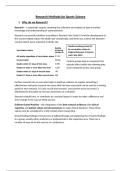
Deaths involving Covid-19
by vaccination status in
England between 2 January
and 2 July 2021.
Control groups help to counteract the
placebo effect whilst also allowing data
to be compared across each group.
Further research into an area also helps to build up evidence to support something’s
effectiveness and prior research into areas that has been successful can be used as a starting
point for new research. It is also crucial that research, once proven to be successful, is
distributed to the public to increase awareness on a situation.
Research should have, or contribute to a societal impact in order to make a difference and
drive change in the way we think and act.
Evidence-based Practise – the integration of the best research evidence with clinical
expertise and patient values and circumstances to make clinical decisions. These three
values must be considered in a SES context when researching.
Disseminating findings is the process of talking through and explaining the research/findings
to a group, usually other academics or professionals in the respective area. There are a
number of ways to do this such as at a conference.
, 2. Producers and Consumers of Research
1. Investigating/finding new information using a variety of methods and techniques. It
will have analysis of data, and it will have a systematic/methodological approach.
2. Good, effective research will have a large sample size, reliable testing, strong
background information, unbiased and it will be ethical.
3. An SES area that could be researched is why has there been such an increase in the
amount of ACL injuries in pro football over the last 5 years?
4. Producers of research could be Universities/academics, especially research institutes,
pharmaceutical companies, marketing companies and charity organisations.
5. Consumers of research could be professional clubs especially coaches and coaching
staff. They’d likely use this to increase the effectiveness of all aspects of training,
prevent injuries and increase overall performance. The local public are also
consumers of research use this decide what to buy.
Case control studies assess whether exposure us disproportionately distributed between the
cases and controls, which may indicate that the exposure is a risk factor for the health
outcome under study.
A cohort study can also be referred to as longitudinal studies because they follow groups of
people over time. Results from cohort studies can help people understand human health
and the environmental and social factors that influence it.
Randomised Control Study - Randomised controlled trials (RCTs) in sports injury research:
authors—please report the compliance with the intervention | British Journal of Sports
Medicine (bmj.com)
Strengths:
The study is effective in highlighting that a running programme intervention was less
effective than a shoe related intervention at ensuring participant compliance.
The method is rigorous and often collects data over a long period of time, in this case
24 weeks.
The random nature of the tests also reduces bias and can provide a reasonable
insight into causality.
They can help to highlight the most effective method for aspects being researched.
It’s quantitative research which gives numerical data which can be analysed.
The test can be easily controlled.
Weaknesses:
Researchers have to draw assumptions in regard to participant compliance which can
effect reliability.
A variation in the definition of compliancy was used depending on which
intervention was used. This again can affect reliability.
These trials are costly and time consuming.
Often, they can have a small sample size.
Doesn’t consider qualitative data.
1. Why do we Research?
Research – a systematic enquiry, involving the collection and analysis of data to further
knowledge and understanding of a phenomenon.
Research can provide solutions to problems. Research into Covid-19 and the development of
the vaccine helped reduce the death rate considerably, and there was a direct link between
vaccine rollout and a reduction in death rate.
Deaths involving Covid-19
by vaccination status in
England between 2 January
and 2 July 2021.
Control groups help to counteract the
placebo effect whilst also allowing data
to be compared across each group.
Further research into an area also helps to build up evidence to support something’s
effectiveness and prior research into areas that has been successful can be used as a starting
point for new research. It is also crucial that research, once proven to be successful, is
distributed to the public to increase awareness on a situation.
Research should have, or contribute to a societal impact in order to make a difference and
drive change in the way we think and act.
Evidence-based Practise – the integration of the best research evidence with clinical
expertise and patient values and circumstances to make clinical decisions. These three
values must be considered in a SES context when researching.
Disseminating findings is the process of talking through and explaining the research/findings
to a group, usually other academics or professionals in the respective area. There are a
number of ways to do this such as at a conference.
, 2. Producers and Consumers of Research
1. Investigating/finding new information using a variety of methods and techniques. It
will have analysis of data, and it will have a systematic/methodological approach.
2. Good, effective research will have a large sample size, reliable testing, strong
background information, unbiased and it will be ethical.
3. An SES area that could be researched is why has there been such an increase in the
amount of ACL injuries in pro football over the last 5 years?
4. Producers of research could be Universities/academics, especially research institutes,
pharmaceutical companies, marketing companies and charity organisations.
5. Consumers of research could be professional clubs especially coaches and coaching
staff. They’d likely use this to increase the effectiveness of all aspects of training,
prevent injuries and increase overall performance. The local public are also
consumers of research use this decide what to buy.
Case control studies assess whether exposure us disproportionately distributed between the
cases and controls, which may indicate that the exposure is a risk factor for the health
outcome under study.
A cohort study can also be referred to as longitudinal studies because they follow groups of
people over time. Results from cohort studies can help people understand human health
and the environmental and social factors that influence it.
Randomised Control Study - Randomised controlled trials (RCTs) in sports injury research:
authors—please report the compliance with the intervention | British Journal of Sports
Medicine (bmj.com)
Strengths:
The study is effective in highlighting that a running programme intervention was less
effective than a shoe related intervention at ensuring participant compliance.
The method is rigorous and often collects data over a long period of time, in this case
24 weeks.
The random nature of the tests also reduces bias and can provide a reasonable
insight into causality.
They can help to highlight the most effective method for aspects being researched.
It’s quantitative research which gives numerical data which can be analysed.
The test can be easily controlled.
Weaknesses:
Researchers have to draw assumptions in regard to participant compliance which can
effect reliability.
A variation in the definition of compliancy was used depending on which
intervention was used. This again can affect reliability.
These trials are costly and time consuming.
Often, they can have a small sample size.
Doesn’t consider qualitative data.


