

lOMoARcPSD|64109549
CC8 End of Unit Test Standard Mark
CC8Scheme
End of Unit
and Test
Assessment
StandardGuide_removed.pdf
Mark
CC8Scheme
End of Unit
and Test
Assessment
StandardGuide_removed.pdf
Mark Scheme and Assessment Guide_removed.pdf
End of Unit Test Standard
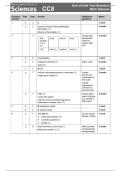
CC8 Mark Scheme
Question Part Step Answer Additional Marks
number guidance
1 a 3 C 1 mark
b 3 Symbol D means flammable/highly 2 marks
flammable. (1)
Ethanol is flammable. (1)
2 5 Accept dark 4 marks
Any (red) red (1) (red) blue/purple/
number violet for
1 to 3 bottom right
(1) box
(12) blue (1) (yellow) blue (1)
3 a 5 neutralisation 1 mark
b 7 potassium chloride (1) Either order 2 marks
water (1)
c 7 B HCl 1 mark
4 a 7 sodium carbonate/potassium carbonate (1) Accept 2 marks
magnesium sulfate (1) ammonium
carbonate for
first mark
Accept
magnesium
chloride for
second mark
b 7 Filter (1) Accept other 2 marks
(wash with water) ways of drying,
e.g. between
and then dry the residue/magnesium
filter paper
carbonate in a warm oven. (1)
5 a 7 B potassium nitrate 1 mark
b 5 A calcium oxide 1 mark
6 a 7 Any one of: Do not accept 1 mark
● measuring cylinder (1) beaker or flask
● volumetric pipette (1)
● burette (1)
b 8 State symbols: (s) and (aq) (1) Mark symbols 2 marks
Balancing number: 2 (1) and balancing
independently
© Pearson Education Ltd 2019. Copying permitted for
purchasing institution only. This material is not copyright free. 1
CC8 End of Unit Test Standard Mark
CC8Scheme
End of Unit
and Test messages.downloaded_by
Assessment
Standard
Guide_removed.pdf
Mark
CC8Scheme
End of Unit
and Test
Assessment
StandardGuide_removed.pdf
Mark Scheme and Assessment Guide_removed.pdf
, lOMoARcPSD|64109549
CC8 End of Unit Test Standard Mark
CC8Scheme
End of Unit
and Test
Assessment
StandardGuide_removed.pdf
Mark
CC8Scheme
End of Unit
and Test
Assessment
StandardGuide_removed.pdf
Mark Scheme and Assessment Guide_removed.pdf
End of Unit Test Standard
CC8 Mark Scheme
Question Part Step Answer Additional Marks
number guidance
c 7 The pH starts below 7/value less than 7 Accept other 3 marks
because hydrochloric acid is acidic. (1) suitable reasons
It increases to pH 7 when the acid is for each
neutralised/has reacted completely with the identified pH or
calcium oxide. (1) pH change
It increases above pH 7/value more than 7
because calcium oxide dissolves to give an
alkaline solution/is a base/is an alkali. (1)
7 a 7 copper oxide/copper(II) oxide Do not accept 1 mark
copper(I) oxide
b 8 so all the acid was used 1 mark
up/reacted/neutralised
c 8 Heat the solution to evaporate some of the If evaporated to 2 marks
water. (1) dryness do not
Leave to dry/place in a warm oven. (1) award second
mark
Accept other
ways of drying,
e.g. between
filter paper
d 8 copper carbonate + sulfuric acid Do not award 2 marks
copper sulfate + water (1) + carbon dioxide marks if the
(1) reactants and
products are
incorrect
8 8 Answers will be credited according to 6 marks
candidate’s deployment of knowledge and
understanding of the material in relation to the
qualities and skills outlined in the generic
mark scheme.
The indicative content below is not
prescriptive and candidates are not required
to include all the material which is indicated
as relevant. Additional content included in the
response must be scientific and relevant.
Indicative content AO1 (3 marks) and
AO2 (3 marks)
● (dilute) sulfuric acid
● sodium hydroxide (solution)
● named single indicator, e.g. methyl
orange or phenolphthalein (not universal
indicator)
● correct expected colour change given for
indicator
● Using a pipette, measure an accurate Allow method for
volume of sodium hydroxide. acid measured
with pipette and
● Add sodium hydroxide to a conical flask.
alkali in the
● Add a few drops of indicator to the burette
sodium hydroxide/flask.
● Fill the burette with sulfuric acid.
© Pearson Education Ltd 2019. Copying permitted for
purchasing institution only. This material is not copyright free. 2
CC8 End of Unit Test Standard Mark
CC8Scheme
End of Unit
and Test messages.downloaded_by
Assessment
Standard
Guide_removed.pdf
Mark
CC8Scheme
End of Unit
and Test
Assessment
StandardGuide_removed.pdf
Mark Scheme and Assessment Guide_removed.pdf
CC8 End of Unit Test Standard Mark
CC8Scheme
End of Unit
and Test
Assessment
StandardGuide_removed.pdf
Mark
CC8Scheme
End of Unit
and Test
Assessment
StandardGuide_removed.pdf
Mark Scheme and Assessment Guide_removed.pdf
End of Unit Test Standard
CC8 Mark Scheme
Question Part Step Answer Additional Marks
number guidance
1 a 3 C 1 mark
b 3 Symbol D means flammable/highly 2 marks
flammable. (1)
Ethanol is flammable. (1)
2 5 Accept dark 4 marks
Any (red) red (1) (red) blue/purple/
number violet for
1 to 3 bottom right
(1) box
(12) blue (1) (yellow) blue (1)
3 a 5 neutralisation 1 mark
b 7 potassium chloride (1) Either order 2 marks
water (1)
c 7 B HCl 1 mark
4 a 7 sodium carbonate/potassium carbonate (1) Accept 2 marks
magnesium sulfate (1) ammonium
carbonate for
first mark
Accept
magnesium
chloride for
second mark
b 7 Filter (1) Accept other 2 marks
(wash with water) ways of drying,
e.g. between
and then dry the residue/magnesium
filter paper
carbonate in a warm oven. (1)
5 a 7 B potassium nitrate 1 mark
b 5 A calcium oxide 1 mark
6 a 7 Any one of: Do not accept 1 mark
● measuring cylinder (1) beaker or flask
● volumetric pipette (1)
● burette (1)
b 8 State symbols: (s) and (aq) (1) Mark symbols 2 marks
Balancing number: 2 (1) and balancing
independently
© Pearson Education Ltd 2019. Copying permitted for
purchasing institution only. This material is not copyright free. 1
CC8 End of Unit Test Standard Mark
CC8Scheme
End of Unit
and Test messages.downloaded_by
Assessment
Standard
Guide_removed.pdf
Mark
CC8Scheme
End of Unit
and Test
Assessment
StandardGuide_removed.pdf
Mark Scheme and Assessment Guide_removed.pdf
, lOMoARcPSD|64109549
CC8 End of Unit Test Standard Mark
CC8Scheme
End of Unit
and Test
Assessment
StandardGuide_removed.pdf
Mark
CC8Scheme
End of Unit
and Test
Assessment
StandardGuide_removed.pdf
Mark Scheme and Assessment Guide_removed.pdf
End of Unit Test Standard
CC8 Mark Scheme
Question Part Step Answer Additional Marks
number guidance
c 7 The pH starts below 7/value less than 7 Accept other 3 marks
because hydrochloric acid is acidic. (1) suitable reasons
It increases to pH 7 when the acid is for each
neutralised/has reacted completely with the identified pH or
calcium oxide. (1) pH change
It increases above pH 7/value more than 7
because calcium oxide dissolves to give an
alkaline solution/is a base/is an alkali. (1)
7 a 7 copper oxide/copper(II) oxide Do not accept 1 mark
copper(I) oxide
b 8 so all the acid was used 1 mark
up/reacted/neutralised
c 8 Heat the solution to evaporate some of the If evaporated to 2 marks
water. (1) dryness do not
Leave to dry/place in a warm oven. (1) award second
mark
Accept other
ways of drying,
e.g. between
filter paper
d 8 copper carbonate + sulfuric acid Do not award 2 marks
copper sulfate + water (1) + carbon dioxide marks if the
(1) reactants and
products are
incorrect
8 8 Answers will be credited according to 6 marks
candidate’s deployment of knowledge and
understanding of the material in relation to the
qualities and skills outlined in the generic
mark scheme.
The indicative content below is not
prescriptive and candidates are not required
to include all the material which is indicated
as relevant. Additional content included in the
response must be scientific and relevant.
Indicative content AO1 (3 marks) and
AO2 (3 marks)
● (dilute) sulfuric acid
● sodium hydroxide (solution)
● named single indicator, e.g. methyl
orange or phenolphthalein (not universal
indicator)
● correct expected colour change given for
indicator
● Using a pipette, measure an accurate Allow method for
volume of sodium hydroxide. acid measured
with pipette and
● Add sodium hydroxide to a conical flask.
alkali in the
● Add a few drops of indicator to the burette
sodium hydroxide/flask.
● Fill the burette with sulfuric acid.
© Pearson Education Ltd 2019. Copying permitted for
purchasing institution only. This material is not copyright free. 2
CC8 End of Unit Test Standard Mark
CC8Scheme
End of Unit
and Test messages.downloaded_by
Assessment
Standard
Guide_removed.pdf
Mark
CC8Scheme
End of Unit
and Test
Assessment
StandardGuide_removed.pdf
Mark Scheme and Assessment Guide_removed.pdf


