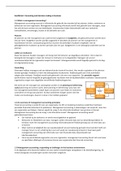
Molecular biology and recombinant DNA
L1 DNA structure
Macromolecular biosynthesis = how life makes itself
Central dogma of molecular biology:
Nucleotide = building block of DNA
- Sugar with 5 C-atoms (pentose)
- Phosphate group, 5’
- Base, 1’
3’ has the -OH group where the next nucleotide binds (with
phosphor group)
2’ carbon distinguishes RNA from DNA:
- DNA: 2x -H
- RNA: -H and -OH
Can change from linear to circular -> equilibrium
In DNA: β-D-furanose rings = base pointing up + righthanded + 6 th C-atom not in ring
Puckering = one C-atom is out of the plain of the ring,
endo = in same direction as 5’ C-atom; exo = in different direction as the 5’ C-atom
- 2’ endo: B-DNA
- 3’ endo: A-DNA and RNA
Base on 1’ can turn: anti = away from sugar, found in all DNA and RNA
Bases
How to recognise:
T = 1 ring, CH3 and 2x O
U = 1 ring, only O
C = 1 ring, NH2 and O
A = 2 rings, no O, NH2
G = 2 rings, NH2 and O
I = G without NH2, deamination of A
Are hydrophobic, because N are positively charged -> basic
Solves best in acidic solution
Bound to pentose (1’ C-atom) via glycosyl bond on 1’ N (pyrimidine) or 9’ N (purine)
T-A and C-G via hydroxy bonds, C-G is stronger
A:T, C:G, purine:pyrimidine is all 1:1
, Mutations:
- Transition = purine -> purine or pyrimidine -> pyrimidine
- Transversion = purine -> pyrimidine or pyrimidine -> purine
More rare
- Deamination = oxidation = amino group changed to O
Happens a lot in C -> U, gets repaired thanks to double strand
- Tautomerization = electron/protons change -> =O to -OH
- Alkaline hydrolysis/RNA shredding = in alkaline environment, -OH binds with phosphor to
form cyclic phosphor nucleotide
- Acid hydrolysis/depurination = in acidic environment, glycosyl bond between base and
pentose hydrolyses, happens mostly with purines (DNA), gets repaired easily
Lot of mutations are made by replication proteins -> solved by proofreading (coming soon)
Phosphate group = PO4
In most biological molecules: phosphor on 5’ C-atom (also in DNA/RNA)
1 = mono = α; 2 = di = α + β; 3 = tri = α + β + γ
ATP = adenosine triphosphate; GTP = guanine triphosphate, used for oa ribosomes, has more energy
Nucleobase = only base
Nucleoside = base + sugar
Nucleotide = base + sugar + phosphate
L1 DNA structure
Macromolecular biosynthesis = how life makes itself
Central dogma of molecular biology:
Nucleotide = building block of DNA
- Sugar with 5 C-atoms (pentose)
- Phosphate group, 5’
- Base, 1’
3’ has the -OH group where the next nucleotide binds (with
phosphor group)
2’ carbon distinguishes RNA from DNA:
- DNA: 2x -H
- RNA: -H and -OH
Can change from linear to circular -> equilibrium
In DNA: β-D-furanose rings = base pointing up + righthanded + 6 th C-atom not in ring
Puckering = one C-atom is out of the plain of the ring,
endo = in same direction as 5’ C-atom; exo = in different direction as the 5’ C-atom
- 2’ endo: B-DNA
- 3’ endo: A-DNA and RNA
Base on 1’ can turn: anti = away from sugar, found in all DNA and RNA
Bases
How to recognise:
T = 1 ring, CH3 and 2x O
U = 1 ring, only O
C = 1 ring, NH2 and O
A = 2 rings, no O, NH2
G = 2 rings, NH2 and O
I = G without NH2, deamination of A
Are hydrophobic, because N are positively charged -> basic
Solves best in acidic solution
Bound to pentose (1’ C-atom) via glycosyl bond on 1’ N (pyrimidine) or 9’ N (purine)
T-A and C-G via hydroxy bonds, C-G is stronger
A:T, C:G, purine:pyrimidine is all 1:1
, Mutations:
- Transition = purine -> purine or pyrimidine -> pyrimidine
- Transversion = purine -> pyrimidine or pyrimidine -> purine
More rare
- Deamination = oxidation = amino group changed to O
Happens a lot in C -> U, gets repaired thanks to double strand
- Tautomerization = electron/protons change -> =O to -OH
- Alkaline hydrolysis/RNA shredding = in alkaline environment, -OH binds with phosphor to
form cyclic phosphor nucleotide
- Acid hydrolysis/depurination = in acidic environment, glycosyl bond between base and
pentose hydrolyses, happens mostly with purines (DNA), gets repaired easily
Lot of mutations are made by replication proteins -> solved by proofreading (coming soon)
Phosphate group = PO4
In most biological molecules: phosphor on 5’ C-atom (also in DNA/RNA)
1 = mono = α; 2 = di = α + β; 3 = tri = α + β + γ
ATP = adenosine triphosphate; GTP = guanine triphosphate, used for oa ribosomes, has more energy
Nucleobase = only base
Nucleoside = base + sugar
Nucleotide = base + sugar + phosphate