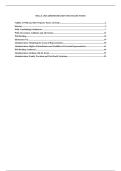
WILLS AND ADMINISTRATION OF ESTATES NOTES
Validity of Wills and How Property Passes on Death .........................................................................................2
Intestacy ..................................................................................................................................................................5
Wills: Establishing Entitlement ............................................................................................................................7
Wills: Revocation, Additions and Alterations ....................................................................................................12
Will Drafting .........................................................................................................................................................15
Inheritance Tax .....................................................................................................................................................19
Administration: Obtaining the Grant of Representation .................................................................................30
Administration: Rights of Beneficiaries and Liabilities of Personal Representatives ...................................41
Will Drafting continued .......................................................................................................................................46
Administration: Dealing with the Estate ...........................................................................................................51
Administration: Family Provision and Post-Death Variations ........................................................................59
,Validity of Wills and How Property Passes on Death
Property passing outside the will and intestacy rules – check!
• First step, identify assets passing independently of its terms/the intestacy rules
• Joint property – owned as beneficial joint tenants, a deceased person's share automatically passes to the
surviving joint owner(s) by the principle of survivorship
o Does not apply to TiC – passes under the deceased's will or intestacy rules – passes under the
deceased's will or intestacy rules
• Insurance policies – proceeds of a life assurance policy that has been written in trust or assigned to named
beneficiaries will be paid directly to those individuals
o Not in trust or assigned, proceeds to the deceased's PRs and form part of the estate
• Pension benefits – Death-in-service benefits from many pension schemes are typically paid out as a lump
sum at the discretion of the pension fund trustees
o Employee can leave a non-binding "letter of wishes" to guide the trustees' decision
o Benefits do not belong to the employee and pass outside the will
o Need to check – more similar to life insurance police
• Trust property - life interest in a trust ends on their death, passes to the next beneficiaries according to the
terms of the trust, not the deceased's will
• Order of distribution (to address deceased assets in):
o 1. Property passing outside the will.
o 2. Property passing under a valid will.
o 3. Any remaining property passing under intestacy rules.
Wills terminology
• Revocation Clause: A standard clause that cancels all previous wills and codicils
• Appointment of Executors: The naming of the person(s) (executor/executrix) who will administer the estate
o Duties include: collecting assets, paying debts, and distributing the remaining property to
beneficiaries
o Authority is confirmed by a grant of probate
• Types of Gifts:
o Special gift: gift of a particular, distinguished item owned by the testator
§ E.g., "the gold watch which I inherited from my father")
o General gift: gift of an item corresponding to a description, which executors must obtain for the
beneficiary if not owned by the testator at death
§ E.g., "100 shares in X plc"
o Demonstrative Gift: general gift paid from a specified fund
§ E.g., "£500... from my Nationwide savings account"
o Pecuniary Gift: A gift of money.
o Residuary Gift: A "sweeping-up" provision that gives away all remaining property after debts,
expenses, and other gifts have been paid.
§ E.g., to a charity etc.
The requirements for a valid will
• To be valid, a will must satisfy three essential requirements – capacity, intention and formalities
• A failure in any one of these will invalidate the entire will.
1. Capacity: The testator must have the necessary mental capacity.
• A testator must be aged 18 or over
• And possess "soundness of mind, memory and understanding," as defined in Banks v Goodfellow
o They must understand:
§ The nature of making a will and its effects.
§ The extent of their property.
§ The moral claims they ought to consider.
§ Additional detail – recall those who have claims on him and understand the nature of the
claims so that he can both include and exclude beneficiaries from the will
• ‘Golden Rule’: Solicitor should follow if testator's capacity is questionable (e.g., due to age or illness),
should obtain a written medical report confirming capacity and asking the doctor to witness the will.
• Burden of proof – a presumption of capacity if the will is rational on its face and the testator showed no
signs of mental confusion, though will's validity must prove it
, o Burden is on the person challenging the will to prove lack of capacity, if the presumption applies
• There is not always a presumption – not a presumption if questionable
• EXCEPTION in Parker v Feldgate
o Will is valid despite the lack of capacity at execution because the testator had capacity at the time
he gave instructions to his solicitor to draw up his will
o Testator need remember their instructions
o The time period is narrow – it was under a year (a month) in the case
2. Intention: The testator must intend to make the will, know and approve its contents at the time of execution.
• General intention: to draft a will AND
• Specific intention: to make this particular will
• Burden of Proof: presumption of knowledge and approval if the testator had capacity and executed the will
after reading it
• Presumption does not apply:
o Testator who is blind, illiterate, or had the will signed on their behalf
o Suspicious circumstances, such as when a major beneficiary prepares the will – the beneficiary
must prove the testator knew and approved of the contents
3. Formalities: The will must be executed according to the formalities laid down in the Wills Act 1837.
• S 9 Wills Act 1837, core requirements for a validly executed will
• In writing
o Can be types or handwritten
o Does not have to be paper, e.g., a will on an eggshell has been accepted
o Unlikely that will only in electronic format is considered ‘in writing’ – though this is under review
• Signed by the testator
o Or someone at their direction and in their presence – useful if cannot physically sign
o Any mark is an acceptable signature – e.g., thumbprint, cross, ‘your loving mother’ (In the Estate
of Cook)
o Signature must be made with the intention of giving effect to the will
§ E.g., name on envelope the will contained in, not valid
• Correctly witnessed
o Two stages to undermine fraud/coercion
o Signature must be made or acknowledged by the testator in the presence of two or more witnesses
present at the same time
o Each witness must then sign or acknowledge their signature in the testator’s presence (though not
necessarily in each other's presence)
o ‘presence’ = mental and physical presence
§ Mental – awareness that testator is signing a document, no need know that it is a will
§ Physical – must be able to see the witnesses signing – an unobstructed line of sight
o Acknowledgement of signature – not made in presence of witness, done later
§ E.g., if a testator signs with only one witness present, they can later acknowledge the
signature to a second witness with the first one also present. Both witnesses can then sign
in the testator's presence
o Remote witnessing – during Covid-19, temporary legislation to allow remote witnessing via
videoconference for wills made between 28 September 2020 and 31 January 2024
§ Temporary amendment to s 9 WA 1837
o Beneficiary as a witness, s 15 WA 1837
§ If beneficiary/their spouse/civil partner act as witness, the will itself remains valid
§ BUT the gift to that witness or their spouse/civil partner will fail
§ Solicitors have a duty to warn clients that beneficiaries (or their partners) should not be
witnesses
• Burden of proof – presumption of due execution if the will contains an attestation clause
o Attestation clause: a clause reciting that the s 9 formalities were followed
o Shifts the burden to the person challenging it’s execution
o Without this clause, HMCTS requires an affidavit of due execution from a witness may be required
• Privileged Wills, exception to s 9, under s 11 WA 1837
o Applies to will made by individuals on "actual military service" or by mariners at sea
o Will can be in any form, including a mere oral statement, as long as the person intended to dispose
of their property after death
• Solicitor’s duties – owes a duty of care to the potential beneficiaries to ensure drafted/executed correctly
, o Avoid negligence, best practice for solicitors to supervise the will's execution
o Humbleston v Martin Tolhurst Parntership
Undue influence
• Force, fear, fraud, and undue influence can invalidate a will
• Undue influence (in this context) = coercion or duress
o Testator’s freedom of choice was overcome by intolerable pressure, but without convincing their
judgement
• A very high standard to prove – presumption is that it is not present
• Must be proven by the challenger
• Any changes to a will need to be signed by the testator and two witesses
Validity of Wills and How Property Passes on Death .........................................................................................2
Intestacy ..................................................................................................................................................................5
Wills: Establishing Entitlement ............................................................................................................................7
Wills: Revocation, Additions and Alterations ....................................................................................................12
Will Drafting .........................................................................................................................................................15
Inheritance Tax .....................................................................................................................................................19
Administration: Obtaining the Grant of Representation .................................................................................30
Administration: Rights of Beneficiaries and Liabilities of Personal Representatives ...................................41
Will Drafting continued .......................................................................................................................................46
Administration: Dealing with the Estate ...........................................................................................................51
Administration: Family Provision and Post-Death Variations ........................................................................59
,Validity of Wills and How Property Passes on Death
Property passing outside the will and intestacy rules – check!
• First step, identify assets passing independently of its terms/the intestacy rules
• Joint property – owned as beneficial joint tenants, a deceased person's share automatically passes to the
surviving joint owner(s) by the principle of survivorship
o Does not apply to TiC – passes under the deceased's will or intestacy rules – passes under the
deceased's will or intestacy rules
• Insurance policies – proceeds of a life assurance policy that has been written in trust or assigned to named
beneficiaries will be paid directly to those individuals
o Not in trust or assigned, proceeds to the deceased's PRs and form part of the estate
• Pension benefits – Death-in-service benefits from many pension schemes are typically paid out as a lump
sum at the discretion of the pension fund trustees
o Employee can leave a non-binding "letter of wishes" to guide the trustees' decision
o Benefits do not belong to the employee and pass outside the will
o Need to check – more similar to life insurance police
• Trust property - life interest in a trust ends on their death, passes to the next beneficiaries according to the
terms of the trust, not the deceased's will
• Order of distribution (to address deceased assets in):
o 1. Property passing outside the will.
o 2. Property passing under a valid will.
o 3. Any remaining property passing under intestacy rules.
Wills terminology
• Revocation Clause: A standard clause that cancels all previous wills and codicils
• Appointment of Executors: The naming of the person(s) (executor/executrix) who will administer the estate
o Duties include: collecting assets, paying debts, and distributing the remaining property to
beneficiaries
o Authority is confirmed by a grant of probate
• Types of Gifts:
o Special gift: gift of a particular, distinguished item owned by the testator
§ E.g., "the gold watch which I inherited from my father")
o General gift: gift of an item corresponding to a description, which executors must obtain for the
beneficiary if not owned by the testator at death
§ E.g., "100 shares in X plc"
o Demonstrative Gift: general gift paid from a specified fund
§ E.g., "£500... from my Nationwide savings account"
o Pecuniary Gift: A gift of money.
o Residuary Gift: A "sweeping-up" provision that gives away all remaining property after debts,
expenses, and other gifts have been paid.
§ E.g., to a charity etc.
The requirements for a valid will
• To be valid, a will must satisfy three essential requirements – capacity, intention and formalities
• A failure in any one of these will invalidate the entire will.
1. Capacity: The testator must have the necessary mental capacity.
• A testator must be aged 18 or over
• And possess "soundness of mind, memory and understanding," as defined in Banks v Goodfellow
o They must understand:
§ The nature of making a will and its effects.
§ The extent of their property.
§ The moral claims they ought to consider.
§ Additional detail – recall those who have claims on him and understand the nature of the
claims so that he can both include and exclude beneficiaries from the will
• ‘Golden Rule’: Solicitor should follow if testator's capacity is questionable (e.g., due to age or illness),
should obtain a written medical report confirming capacity and asking the doctor to witness the will.
• Burden of proof – a presumption of capacity if the will is rational on its face and the testator showed no
signs of mental confusion, though will's validity must prove it
, o Burden is on the person challenging the will to prove lack of capacity, if the presumption applies
• There is not always a presumption – not a presumption if questionable
• EXCEPTION in Parker v Feldgate
o Will is valid despite the lack of capacity at execution because the testator had capacity at the time
he gave instructions to his solicitor to draw up his will
o Testator need remember their instructions
o The time period is narrow – it was under a year (a month) in the case
2. Intention: The testator must intend to make the will, know and approve its contents at the time of execution.
• General intention: to draft a will AND
• Specific intention: to make this particular will
• Burden of Proof: presumption of knowledge and approval if the testator had capacity and executed the will
after reading it
• Presumption does not apply:
o Testator who is blind, illiterate, or had the will signed on their behalf
o Suspicious circumstances, such as when a major beneficiary prepares the will – the beneficiary
must prove the testator knew and approved of the contents
3. Formalities: The will must be executed according to the formalities laid down in the Wills Act 1837.
• S 9 Wills Act 1837, core requirements for a validly executed will
• In writing
o Can be types or handwritten
o Does not have to be paper, e.g., a will on an eggshell has been accepted
o Unlikely that will only in electronic format is considered ‘in writing’ – though this is under review
• Signed by the testator
o Or someone at their direction and in their presence – useful if cannot physically sign
o Any mark is an acceptable signature – e.g., thumbprint, cross, ‘your loving mother’ (In the Estate
of Cook)
o Signature must be made with the intention of giving effect to the will
§ E.g., name on envelope the will contained in, not valid
• Correctly witnessed
o Two stages to undermine fraud/coercion
o Signature must be made or acknowledged by the testator in the presence of two or more witnesses
present at the same time
o Each witness must then sign or acknowledge their signature in the testator’s presence (though not
necessarily in each other's presence)
o ‘presence’ = mental and physical presence
§ Mental – awareness that testator is signing a document, no need know that it is a will
§ Physical – must be able to see the witnesses signing – an unobstructed line of sight
o Acknowledgement of signature – not made in presence of witness, done later
§ E.g., if a testator signs with only one witness present, they can later acknowledge the
signature to a second witness with the first one also present. Both witnesses can then sign
in the testator's presence
o Remote witnessing – during Covid-19, temporary legislation to allow remote witnessing via
videoconference for wills made between 28 September 2020 and 31 January 2024
§ Temporary amendment to s 9 WA 1837
o Beneficiary as a witness, s 15 WA 1837
§ If beneficiary/their spouse/civil partner act as witness, the will itself remains valid
§ BUT the gift to that witness or their spouse/civil partner will fail
§ Solicitors have a duty to warn clients that beneficiaries (or their partners) should not be
witnesses
• Burden of proof – presumption of due execution if the will contains an attestation clause
o Attestation clause: a clause reciting that the s 9 formalities were followed
o Shifts the burden to the person challenging it’s execution
o Without this clause, HMCTS requires an affidavit of due execution from a witness may be required
• Privileged Wills, exception to s 9, under s 11 WA 1837
o Applies to will made by individuals on "actual military service" or by mariners at sea
o Will can be in any form, including a mere oral statement, as long as the person intended to dispose
of their property after death
• Solicitor’s duties – owes a duty of care to the potential beneficiaries to ensure drafted/executed correctly
, o Avoid negligence, best practice for solicitors to supervise the will's execution
o Humbleston v Martin Tolhurst Parntership
Undue influence
• Force, fear, fraud, and undue influence can invalidate a will
• Undue influence (in this context) = coercion or duress
o Testator’s freedom of choice was overcome by intolerable pressure, but without convincing their
judgement
• A very high standard to prove – presumption is that it is not present
• Must be proven by the challenger
• Any changes to a will need to be signed by the testator and two witesses