

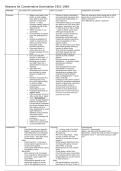
Reasons for Conservative Domination 1951-1964.
RANKING Successful for Conservatives NOT successful Justification of position …
Economy Wages rose faster than - Failure to direct investment Was the economy really doing well or did it
prices so that people into important industries like seem like it only because of the tax cuts
were able to buy more textiles and shipbuilding so before elections?
with the money they they declined Any different to Labour’s policies?
earned - In 1951, - Chancellors able to cut income
average weekly wage of tax before the 1955 and 1959
an adult was £8.30 by elections, reducing it by 2.5p
1964 £18.35. in 1955 and by 3.75p in 1959
500% increase in car – made a deficit more likely
ownership - Although industries like
TV ownership increases aircraft, cars and chemicals
from 4% population to were expanding, their
91% production costs were high
Greater availability of making the goods expensive
credit so improved LC – and uncompetitive in the
able to borrow money export market.
and make small - Rent act also led to rent rising
monthly payments with some tenants finding it
Consumer boom = harder to afford them
many able to go on - Their policies towards industry
foreign holidays for first and trade meant that the
time economy didn’t grow as
Gov built 354,000 quickly as that of other
houses in 1954 and 1.7 powers.
million while in office - Policies similar to Labour
Building new houses - Stagflation – industrial output
and 1957 Rent Act = declined but inflation
waiting lists for houses remained
reduced - Stop go approach as they
1957 Rent Act – responded to economic
abolished rent controls developments rather than
and resulted in more developing a strategy that
houses available for created constant growth
rent - High unemployment = never
Number of people who below 250,000
owned houses rose - Changes to education system:
from 25% before WW2 three tier secondary education
to 44% by 1964. system of grammar, technical
Increased borrowing and secondary modern
allowed gov schools had only served to
expenditure to rise reinforce class distinctions.
Increased spending on - Britain’s share of world trade shrank
welfare state from 25% to 15% while Germany’s
GDP rose from 16.1% in grew from 7% to 20%.
1951 to 19.3% in 1964.
Term ‘Butskellism’
coined; brough together
names and policies of
Conservative Chancellor
and Hugh Gaitskell from
the Labour party as
they attempted to avoid
high inflation or
deflation using interest
rates and import
controls to manage the
economy.
Less distinct classes
6,000 new schools built
11 universities built
Leadership Churchill Churchill Summarised
- Figurehead who was popular - 77 – victory more of a thank Churchill = figurehead
- Butler’s association with the you for getting the country Eden = all good until the Suez Crisis
1944 Education Act indicated through war Macmillan = done the best but then it flopped
that he was concerned with - More of a figurehead - 1953, Doughlas home = was never going to work
social issues - area that many he had a stroke and was out
Conservatives ignored. absent for some but he was
Eden missed.
- Called election = increased - Butler played significant role
Conservative majority due to in helping the party recover
his personal appeal, after 1945, ensuring
particularly with female voters development of new modern
and Butler’s work ideas.
Macmillan - It was Butler rather than
- Won election with increased Churchill who was responsible
Tory majority to 100 despite it for modernising the party and
being just 3 years after the helping Eden to secure victory
Suez Affair in 1955 election.
- His personal appeal to the Eden
electorate played a crucial - His administration was short-
role in his popularity as his lived due to the Suez Crisis of
, appearances on TV won him 1956.
much support and despite - Eden was heavily criticised by the
satirists mocking him as Labour party for his ‘mad venture’.
‘Super Mac’ he was able to - Although Britain was not defeated
turn this image to his militarily, Eden’s decision to
advantage with the famous withdraw was seen as lack of
comment: ‘Never had it so
political will.
good.’
- - Macmillan was a victim of - Most of the world condemned
circumstances beyond his British actions - clear sign that the
control. country was no longer a major
- - He realised that the British power.
Empire had to be dismantled, - Less than 3 months after the
despite protests from within incident, Eden stood down as the
the party. PM: official reason was ill-health
- - Made this clear in 1960 with which was true but his own
his call for the need to personal standings had been
recognise ‘the wind of change’ undermined by events and he was
blowing through Africa and replaced by Harold Macmillan.
grant independence to those
who wanted it.
Macmillan
- Got Britain closer to abolishing
- - not all the Conservative
the death penalty
success be attributed to
- Ended national conscription in
Macmillan.
1959
- - Work of Butler as home
Douglas-Home
secretary with the Homicide
- There was resentment among
Act gave the party
some party members, and
appearance of changing its
Enoch Powell and Iain Macleod
traditional and often
stated that they would not
reactionary attitudes.
serve under Douglas -Home.
- - By 1961, a balance of trade
- He faced a revitalised Labour
deficit was evidence of a
party with a new programme
downturn in the economy as
under the youthful and
the country was importing
dynamic leadership of Harold
more than it was exporting.
Wilson.
- - By 1962, unemployment was
- Number of unemployment
rising and the number of days
dropped from 900,000 in Feb
lost to strikes was increasing.
1963 to 300,000 by July 1964.
- - July 1962 - Macmillan
- Cut taxes in 1963 budget which
reshuffled his cabinet in order
contributed to a trade deficit of £800 to try to breathe new life into
million but also helped narrow the a tired government. Sacked
gap between the parties as earnings 1/3 of cabinet – Mac the Knife
rose. Douglas Home
- Douglas-Home was chosen by
an old-boy network which
included many old Etonians; a
clear sign to many that the
Conservative party hadn’t
changed its image.
- There was resentment among some
party members, and Enoch Powell
and Iain Macleod stated that they
would not serve under Douglas -
Home.
- He faced a revitalised Labour party
with a new programme under the
youthful and dynamic leadership of
Harold Wilson.
- Satirised in magazine: Private
Eye
- Satirised on TV as well
Labour - The Labour party was divided - Labour stood a chance of
divisions internally and less able to wining the 1959 election as
1951-1964 recover from the defeat in the election was only three
1951 than the Conservatives years after the Suez Crisis and
in 1945. the gov’s budgetary policies
- The split was between the appeared unsound.
supporters of Gaitskell (known - - Death of Gaitskell in 1963
as the Revisionists as they resulted in Harold Wilson
wanted to modernise the being elected as leader of the
party) and the supporters of Labour party. He represented
Aneurin Bevan (known as the a youthful and working class
Fundamentalists because they image which was a direct
wanted to maintain the contrast to Douglas-Home.
traditional principles of the - - He was able to dominate the
party). direction of the 1964 election
- The party was divided over campaign and stress the need
whether it wanted to move for modernisation of the
further to the left or right in economy with its emphasis on
British policies and Gaitskell ‘the white heat of technology.’
was unable to resolve this. - - Labour therefore entered the
- He failed to unite the party. election expecting to win.
- Left wanted nuclear
disarmament whereas
moderates opposed this
RANKING Successful for Conservatives NOT successful Justification of position …
Economy Wages rose faster than - Failure to direct investment Was the economy really doing well or did it
prices so that people into important industries like seem like it only because of the tax cuts
were able to buy more textiles and shipbuilding so before elections?
with the money they they declined Any different to Labour’s policies?
earned - In 1951, - Chancellors able to cut income
average weekly wage of tax before the 1955 and 1959
an adult was £8.30 by elections, reducing it by 2.5p
1964 £18.35. in 1955 and by 3.75p in 1959
500% increase in car – made a deficit more likely
ownership - Although industries like
TV ownership increases aircraft, cars and chemicals
from 4% population to were expanding, their
91% production costs were high
Greater availability of making the goods expensive
credit so improved LC – and uncompetitive in the
able to borrow money export market.
and make small - Rent act also led to rent rising
monthly payments with some tenants finding it
Consumer boom = harder to afford them
many able to go on - Their policies towards industry
foreign holidays for first and trade meant that the
time economy didn’t grow as
Gov built 354,000 quickly as that of other
houses in 1954 and 1.7 powers.
million while in office - Policies similar to Labour
Building new houses - Stagflation – industrial output
and 1957 Rent Act = declined but inflation
waiting lists for houses remained
reduced - Stop go approach as they
1957 Rent Act – responded to economic
abolished rent controls developments rather than
and resulted in more developing a strategy that
houses available for created constant growth
rent - High unemployment = never
Number of people who below 250,000
owned houses rose - Changes to education system:
from 25% before WW2 three tier secondary education
to 44% by 1964. system of grammar, technical
Increased borrowing and secondary modern
allowed gov schools had only served to
expenditure to rise reinforce class distinctions.
Increased spending on - Britain’s share of world trade shrank
welfare state from 25% to 15% while Germany’s
GDP rose from 16.1% in grew from 7% to 20%.
1951 to 19.3% in 1964.
Term ‘Butskellism’
coined; brough together
names and policies of
Conservative Chancellor
and Hugh Gaitskell from
the Labour party as
they attempted to avoid
high inflation or
deflation using interest
rates and import
controls to manage the
economy.
Less distinct classes
6,000 new schools built
11 universities built
Leadership Churchill Churchill Summarised
- Figurehead who was popular - 77 – victory more of a thank Churchill = figurehead
- Butler’s association with the you for getting the country Eden = all good until the Suez Crisis
1944 Education Act indicated through war Macmillan = done the best but then it flopped
that he was concerned with - More of a figurehead - 1953, Doughlas home = was never going to work
social issues - area that many he had a stroke and was out
Conservatives ignored. absent for some but he was
Eden missed.
- Called election = increased - Butler played significant role
Conservative majority due to in helping the party recover
his personal appeal, after 1945, ensuring
particularly with female voters development of new modern
and Butler’s work ideas.
Macmillan - It was Butler rather than
- Won election with increased Churchill who was responsible
Tory majority to 100 despite it for modernising the party and
being just 3 years after the helping Eden to secure victory
Suez Affair in 1955 election.
- His personal appeal to the Eden
electorate played a crucial - His administration was short-
role in his popularity as his lived due to the Suez Crisis of
, appearances on TV won him 1956.
much support and despite - Eden was heavily criticised by the
satirists mocking him as Labour party for his ‘mad venture’.
‘Super Mac’ he was able to - Although Britain was not defeated
turn this image to his militarily, Eden’s decision to
advantage with the famous withdraw was seen as lack of
comment: ‘Never had it so
political will.
good.’
- - Macmillan was a victim of - Most of the world condemned
circumstances beyond his British actions - clear sign that the
control. country was no longer a major
- - He realised that the British power.
Empire had to be dismantled, - Less than 3 months after the
despite protests from within incident, Eden stood down as the
the party. PM: official reason was ill-health
- - Made this clear in 1960 with which was true but his own
his call for the need to personal standings had been
recognise ‘the wind of change’ undermined by events and he was
blowing through Africa and replaced by Harold Macmillan.
grant independence to those
who wanted it.
Macmillan
- Got Britain closer to abolishing
- - not all the Conservative
the death penalty
success be attributed to
- Ended national conscription in
Macmillan.
1959
- - Work of Butler as home
Douglas-Home
secretary with the Homicide
- There was resentment among
Act gave the party
some party members, and
appearance of changing its
Enoch Powell and Iain Macleod
traditional and often
stated that they would not
reactionary attitudes.
serve under Douglas -Home.
- - By 1961, a balance of trade
- He faced a revitalised Labour
deficit was evidence of a
party with a new programme
downturn in the economy as
under the youthful and
the country was importing
dynamic leadership of Harold
more than it was exporting.
Wilson.
- - By 1962, unemployment was
- Number of unemployment
rising and the number of days
dropped from 900,000 in Feb
lost to strikes was increasing.
1963 to 300,000 by July 1964.
- - July 1962 - Macmillan
- Cut taxes in 1963 budget which
reshuffled his cabinet in order
contributed to a trade deficit of £800 to try to breathe new life into
million but also helped narrow the a tired government. Sacked
gap between the parties as earnings 1/3 of cabinet – Mac the Knife
rose. Douglas Home
- Douglas-Home was chosen by
an old-boy network which
included many old Etonians; a
clear sign to many that the
Conservative party hadn’t
changed its image.
- There was resentment among some
party members, and Enoch Powell
and Iain Macleod stated that they
would not serve under Douglas -
Home.
- He faced a revitalised Labour party
with a new programme under the
youthful and dynamic leadership of
Harold Wilson.
- Satirised in magazine: Private
Eye
- Satirised on TV as well
Labour - The Labour party was divided - Labour stood a chance of
divisions internally and less able to wining the 1959 election as
1951-1964 recover from the defeat in the election was only three
1951 than the Conservatives years after the Suez Crisis and
in 1945. the gov’s budgetary policies
- The split was between the appeared unsound.
supporters of Gaitskell (known - - Death of Gaitskell in 1963
as the Revisionists as they resulted in Harold Wilson
wanted to modernise the being elected as leader of the
party) and the supporters of Labour party. He represented
Aneurin Bevan (known as the a youthful and working class
Fundamentalists because they image which was a direct
wanted to maintain the contrast to Douglas-Home.
traditional principles of the - - He was able to dominate the
party). direction of the 1964 election
- The party was divided over campaign and stress the need
whether it wanted to move for modernisation of the
further to the left or right in economy with its emphasis on
British policies and Gaitskell ‘the white heat of technology.’
was unable to resolve this. - - Labour therefore entered the
- He failed to unite the party. election expecting to win.
- Left wanted nuclear
disarmament whereas
moderates opposed this


