

Principles of Exercise, Nutrition and Health
1. What is Health?
Health – a state of complete physical, mental and social well-being and not merely the
absence of disease or infirmity.
To achieve this completely, an individual or group must be able to identify and to
realise aspirations, to satisfy needs and to change or cop with the environment.
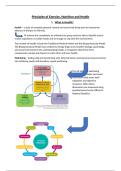
Two models of health include the Traditional Medical Model and the Biopsychosocial Model.
The Biopsychosocial Model was created by George Engel and considers biology, psychology,
and social environment into understanding health. It recognises that these three
components overlap and impact on each other and ones health.
Well-being – feeling well and functioning well. External factors and personal resources factor
into satisfying needs and therefore a good well-being.
The UK National well-being
Framework includes ten broad
dimensions that cover both
subjective and objective
measures. Often these
dimensions are measured using
questionnaires by the Office for
National Statistics.
, Physical well-being – the physiological capability to function optimally within your
environment (allostasis.) A healthy diet, sleeping well and exercise all benefit physical
health.
Mental health – a state of mental well-being in which the individual realises their ability to
learn and work well, and to contribute to their communities. It’s more than just the absence
of a mental disorder.
1. Mental health condition – a broad term covering mental disorders and psychosocial
disabilities. It also covers other mental states associated with significant distress.
2. Mental disorder – a syndrome characterised by cognition, emotional regulation, or
behaviour that reflects a dysfunction in the psychological, biological, or
developmental processes that underlie mental and behavioural functioning.
Mental health is equally as important as physical health and when we have mental health
we can cope with the stresses of life, realise our own abilities, learn, and work well and
contribute actively to our communities.
Between these constructs there is a lot of overlap and health, and well-being are considered
to work on a dual continuum model. This means people can co-exist within all constricts of
the model.
Social health – the degree of integration and social adaptation, or the capacity to perform
normal roles within society.
1. What is Health?
Health – a state of complete physical, mental and social well-being and not merely the
absence of disease or infirmity.
To achieve this completely, an individual or group must be able to identify and to
realise aspirations, to satisfy needs and to change or cop with the environment.
Two models of health include the Traditional Medical Model and the Biopsychosocial Model.
The Biopsychosocial Model was created by George Engel and considers biology, psychology,
and social environment into understanding health. It recognises that these three
components overlap and impact on each other and ones health.
Well-being – feeling well and functioning well. External factors and personal resources factor
into satisfying needs and therefore a good well-being.
The UK National well-being
Framework includes ten broad
dimensions that cover both
subjective and objective
measures. Often these
dimensions are measured using
questionnaires by the Office for
National Statistics.
, Physical well-being – the physiological capability to function optimally within your
environment (allostasis.) A healthy diet, sleeping well and exercise all benefit physical
health.
Mental health – a state of mental well-being in which the individual realises their ability to
learn and work well, and to contribute to their communities. It’s more than just the absence
of a mental disorder.
1. Mental health condition – a broad term covering mental disorders and psychosocial
disabilities. It also covers other mental states associated with significant distress.
2. Mental disorder – a syndrome characterised by cognition, emotional regulation, or
behaviour that reflects a dysfunction in the psychological, biological, or
developmental processes that underlie mental and behavioural functioning.
Mental health is equally as important as physical health and when we have mental health
we can cope with the stresses of life, realise our own abilities, learn, and work well and
contribute actively to our communities.
Between these constructs there is a lot of overlap and health, and well-being are considered
to work on a dual continuum model. This means people can co-exist within all constricts of
the model.
Social health – the degree of integration and social adaptation, or the capacity to perform
normal roles within society.


