

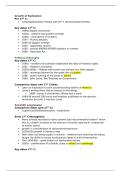
Growth of Radicalism
Pre 17th C:
Congregationalists emerge late 16th C (brownists/barrowists)
Key dates 17th C:
1600s Baptist movement
1620s – seekers and quakers emerge
1640s – emergence of levellers
1647 – Putney debates
1649-50 diggers emerge
1650 – apparently ranters
1660 – around 400000-600000 quakers in number
1689 – Toleration Act
Political philosophy
Key dates 17th C:
1640s – levellers had already established the idea of freeborn rights
1651 – Hobbes’s Leviathan
1650s/1660s – Hobbes well-known but earned very little support
1666 – leviathan blamed for the great fire of London
1666 – public burning of his books in oxford
1689 – John Locke, Two Treatises on Government
Comparison dates end 17th C/later:
Later an inspiration to John Locke/founding fathers of America
Locke’s writing likely had an impact on the Whigs
1688 – James II overthrown, Whigs had a hand
1689-94 around 200 tracts and treatises published on the glorious
revolution but only 3 mention Locke
Scientific progression
Comparison dates (pre-17th C):
Copernicus/Galileo/Descartes – empiricism
Early 17th C/throughout:
Many schools recorded to have opened (bad documentation doesn’t mean
this is a drastic increase to the amount of schools opening in comparison
to earlier years)
growth in consideration of rationalism/empiricism
1630s/50s growth in literacy rates
New ideas not being taught in schools – matters more that they are being
taught the skills to access revolutionary ideas in and of themselves
Post 1650/60s – great impact on fashionable society
1650s – proliferation of scientific clubs in oxford and cambridge
Key dates 17th C:
, 1614: logarithms created – John Napier, Descriptio, built upon by henry
briggs
1620s and 1630s – francis bacon synthesises
1660: royal society awarded a royal charter by Charles II
1665: Hooke's micrographia
1666 – French royal society
1668 – Charles II establishes a chair of mathematics at st Andrews but
other Scottish universities are slow to follow
1672: Newton's first published hypothesis on the spectrum of light
1682: Nehemiah Crew publishes his anatomy on plants – Grew's work
helps to establish modern biology
1685 – despite establishing an observatory at st Andrews, George
Sinclair’s best known work is “Satan’s invisible world discovered” in which
he attempted to prove witchcraft was real
1687: Principia – in it he formulated the laws of motion and universal
gravitation that dominated scientists' view of the physical universe for the
next three centuries
Comparison dates end 17th C/later:
1700 – 55% of men are signature-literate (more so in Scotland due to the
Calvanist education system + impact of the Quakers and Quaker schools)
1701 – Prussian academy of sciences berlin
1703: newton elected the 12th president of the royal society
1704 – Optiks – Newton's seminal work on the composition of light
Population growth
Comparison dates (pre-17th C):
Early 17th C/throughout:
Key dates 17th C:
1600s – Newcastle population of 12000
1601: poor relief act, outlines which of the poor are “deserving”
1660: Norwich/Bristol population > 10,000
National:
o 1600-1650 Significant increase, approximately 0.5% growth each
year
Average age of marriage 24/26 (W/M)
o 1520 - 1650, population doubles from 2.5m to 5m
o 1650s peaks at 5.281m
o 1650-1700: Population stagnates and even decreases
Marriage age 26/28 (W/M)
London:
o 1600-1650: Massive growth (200000-400000 - doubles in size)
o 1630s Covent garden developed and East end of london also fast
developing
o 1650-1700: Continues to grow rapidly but at a slightly slower rate,
expanded to the north and south/biggest city in western Europe
(400000-475000)
Pre 17th C:
Congregationalists emerge late 16th C (brownists/barrowists)
Key dates 17th C:
1600s Baptist movement
1620s – seekers and quakers emerge
1640s – emergence of levellers
1647 – Putney debates
1649-50 diggers emerge
1650 – apparently ranters
1660 – around 400000-600000 quakers in number
1689 – Toleration Act
Political philosophy
Key dates 17th C:
1640s – levellers had already established the idea of freeborn rights
1651 – Hobbes’s Leviathan
1650s/1660s – Hobbes well-known but earned very little support
1666 – leviathan blamed for the great fire of London
1666 – public burning of his books in oxford
1689 – John Locke, Two Treatises on Government
Comparison dates end 17th C/later:
Later an inspiration to John Locke/founding fathers of America
Locke’s writing likely had an impact on the Whigs
1688 – James II overthrown, Whigs had a hand
1689-94 around 200 tracts and treatises published on the glorious
revolution but only 3 mention Locke
Scientific progression
Comparison dates (pre-17th C):
Copernicus/Galileo/Descartes – empiricism
Early 17th C/throughout:
Many schools recorded to have opened (bad documentation doesn’t mean
this is a drastic increase to the amount of schools opening in comparison
to earlier years)
growth in consideration of rationalism/empiricism
1630s/50s growth in literacy rates
New ideas not being taught in schools – matters more that they are being
taught the skills to access revolutionary ideas in and of themselves
Post 1650/60s – great impact on fashionable society
1650s – proliferation of scientific clubs in oxford and cambridge
Key dates 17th C:
, 1614: logarithms created – John Napier, Descriptio, built upon by henry
briggs
1620s and 1630s – francis bacon synthesises
1660: royal society awarded a royal charter by Charles II
1665: Hooke's micrographia
1666 – French royal society
1668 – Charles II establishes a chair of mathematics at st Andrews but
other Scottish universities are slow to follow
1672: Newton's first published hypothesis on the spectrum of light
1682: Nehemiah Crew publishes his anatomy on plants – Grew's work
helps to establish modern biology
1685 – despite establishing an observatory at st Andrews, George
Sinclair’s best known work is “Satan’s invisible world discovered” in which
he attempted to prove witchcraft was real
1687: Principia – in it he formulated the laws of motion and universal
gravitation that dominated scientists' view of the physical universe for the
next three centuries
Comparison dates end 17th C/later:
1700 – 55% of men are signature-literate (more so in Scotland due to the
Calvanist education system + impact of the Quakers and Quaker schools)
1701 – Prussian academy of sciences berlin
1703: newton elected the 12th president of the royal society
1704 – Optiks – Newton's seminal work on the composition of light
Population growth
Comparison dates (pre-17th C):
Early 17th C/throughout:
Key dates 17th C:
1600s – Newcastle population of 12000
1601: poor relief act, outlines which of the poor are “deserving”
1660: Norwich/Bristol population > 10,000
National:
o 1600-1650 Significant increase, approximately 0.5% growth each
year
Average age of marriage 24/26 (W/M)
o 1520 - 1650, population doubles from 2.5m to 5m
o 1650s peaks at 5.281m
o 1650-1700: Population stagnates and even decreases
Marriage age 26/28 (W/M)
London:
o 1600-1650: Massive growth (200000-400000 - doubles in size)
o 1630s Covent garden developed and East end of london also fast
developing
o 1650-1700: Continues to grow rapidly but at a slightly slower rate,
expanded to the north and south/biggest city in western Europe
(400000-475000)


