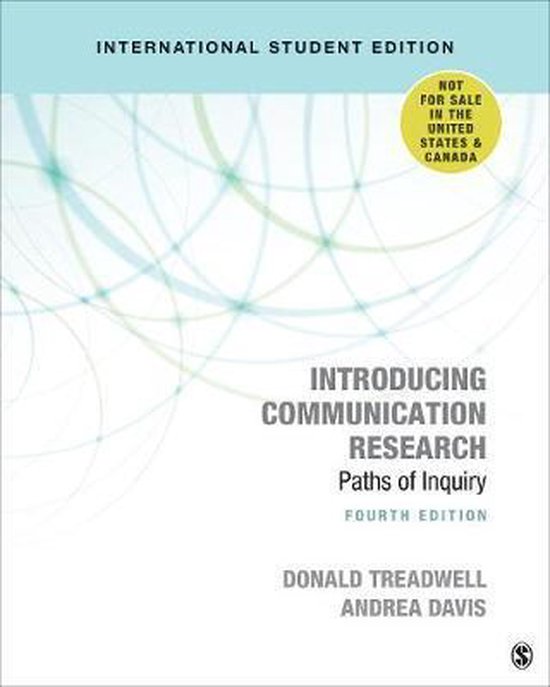
Research methodology Treadwell
& Davis
Chapter 1 Treadwell & Davis ‘Getting started’
Basic assumptions behind communication research
- Observations Capture/Do not capture an Underlying Reality
- Theories about human behaviour can/cannot be generalized
- Researchers should/should not distance themselves from their research participants
- Research should/should not be done for a specific purpose
- There is/is not one best position form which to observe human behaviour
o Source – the provider or initiator of content
o Massage or messages – the content of communication
o Channel or medium – the vehicle for communication content; for example, social
media
o Receiver(s) – the recipient(s) or consumer(s) of information
o Noise – extraneous information or distractions that can disrupt an interaction
o Context – the relationships between individuals, the situation in which the
interaction occurs, and the cultural norms around that interaction.
A series of unavoidable decisions:
- The field of the study – Wide or narrow?
- The researcher – Dispassionate or involved?
1
- The approach – Objective or subjective?
- The perspective – Your questions or their answers?
- The sample – Large or small?
- The data – Quantitative or qualitative?
- The report – Subjective or objective?
Chapter 2 Treadwell & Davis ‘First decisions’
Starting with basic beliefs and perspectives
Basic assumptions about human behaviour coalesce into broad worldviews or basic sets of beliefs
that underpin our perspective on communication research.
World View I
- Human communication is predictable, objectively measurable, generalizable, and can be
summarized in rules. “Nomothetic” approach.
Word View I can be associated with experiments
World View II
- Human communication is subjective, individualistic, unpredictable, and must be described as
such. “Idiographic” approach.
Four worldviews (Creswell and Creswell):
- Postpositive: challenges the notion of absolute truth but emphasizes cause and effect and
the idea that the world is governed by laws or theories that can be tested or verified. The
emphasis is on objective observation and measurement.
, - Constructivist: individuals seek understanting of the world in which they live and construct
their own views of it. Research is interpretive and qualitative, moving inductively from
observation to theory development
- Transformative: change oriented and argues for mixing research with politics to confront
social oppression and change lives for the better. The worldview ebraces a variety of
research interest, including action research and critical analyses
- Pragmatism: focuses on solutions to problems – what works – and using all possible
approaches to understanding these problems. Research decisions are based on what the
researchers want to do with the research – on why the are doing it.
Different traditions of communication research: Metatheory:
- Rhetorical: practical art of discourse
- Semiotic: interpretations of signs and symbols
- Phenomenological: experience of others
- Cybernetic: communication as information systems
- Socio-psychological: individuals influencing each other
- Socio-cultural: producing/reproducing social order
- Cirtical: power, oppression, emancipation
Foundational beliefs and arguments about human behaviour are issues ultimately of ontology, which
addresses the nature of what we study. Ontological questions deal with the nature of existence and
what language actually refer to.
Induction is reasoning from observations to a theory that might explain your observations.
2
Deduction moves from a theory to defining the observations you will make to test the theory; it
moves form the general to the specific. Deduction is in a sense more efficient than induction in that it
leads to a specific observation that will test your hypothesis – the statement about the relationships
you expect to find.
Abduction refers not to being kidnapped but rather to reasoning form an effect to possible causes.
With abduction, your starting point is an effect from which you reason back to possible causes.
Research questions: Less certainty; more room to move
Open-ended research questions: basically ask whether there is a relationship between variables.
Closed-ended research questions: focus on a direction of the relationship
Hypotheses: Statements of Prediction
Two-tailed hypotheses: state that there is a relationship between variables but do not specify the
direction of the relationship.
There is a relationship between level of involvement in video gaming and academic performance.
One-tailed hypotheses: require extra confidence because you commit to predicting the direction of
the relationship between the variables.
As time spent in video gaming increases, academic performance decreases.
Null Hypotheses: usually symbolized as Ho, specify that there is no relationship between variables.
There is no relationship between level of involvement in video gaming and academic performance.
If you are concerned with measurement and precision in your observations, getting started requires
that you identify key constructs and operationalize them. Consturcts are ideas or concepts.
Operationalizing them means to define them in such a way that they can be measured.
Starting with a purpose
, Exploration is curiosity-based research. At the beginning phase a researcher is more likely to be
writing broasd questions than specific hypotheses.
Description can be compelling reading.
Studies focus on explanation attempt to answer the “why” question. Generally, our explanations
have greater credibility if they are capable of prediction.
Method decisions are rooted in epistemology – the question of how we know what we know. We
might know as a result of tenacity – we’ve always done it or understood it that way; intuition – the
hunch or the gut insticht; authority – because a credible source said so; rationalism – logical
reasoning; or empiricism – observation.
Scientific methods typically combine empiricism, rationalism and positivism.
Chapter 3 Treadwell & Davis ‘Ethics’
Confederates are participants in a study who have been briefed to behave in a particular way. In
other words, they are “faking” and deceiving the speaker.
To protect the individuals who may be disclosing personal information, the researcher customarily
assures them of confidentiality. This means that you, the researcher, will not release any information
that identifies your participants even if you know what information each participant provided you.
Proprietary information is information that is owned, typically by corporations, and may not be
published without the owner’s permission. As a researcher, you may have access to proprietary 3
information, but publishing that information may be both an ethical and a legal violation.
Ethical Issues in Research
- Honesty - towards participants and readers
- Anonymity / confidentiality
- (not) making generalizations
- Debriefing
- Literature review
- Acknowledging others
- Appropriate language when communicating with research participants
- No plagiarism
Ethics Codes: Key points
- Do no harm
- Informed consent
- Voluntary participation
- Participants can leave at any time
- Debriefing after the study
- Anonymity or confidentiality
- Crediting other researchers
- Full reporting
Most points are typically addressed in an informed consent form
Nuremberg Code, the first international code that emphasize that
- Research subjects must consent to the research in which they are involved and
- The benefits of the research much outweigh the risk
& Davis
Chapter 1 Treadwell & Davis ‘Getting started’
Basic assumptions behind communication research
- Observations Capture/Do not capture an Underlying Reality
- Theories about human behaviour can/cannot be generalized
- Researchers should/should not distance themselves from their research participants
- Research should/should not be done for a specific purpose
- There is/is not one best position form which to observe human behaviour
o Source – the provider or initiator of content
o Massage or messages – the content of communication
o Channel or medium – the vehicle for communication content; for example, social
media
o Receiver(s) – the recipient(s) or consumer(s) of information
o Noise – extraneous information or distractions that can disrupt an interaction
o Context – the relationships between individuals, the situation in which the
interaction occurs, and the cultural norms around that interaction.
A series of unavoidable decisions:
- The field of the study – Wide or narrow?
- The researcher – Dispassionate or involved?
1
- The approach – Objective or subjective?
- The perspective – Your questions or their answers?
- The sample – Large or small?
- The data – Quantitative or qualitative?
- The report – Subjective or objective?
Chapter 2 Treadwell & Davis ‘First decisions’
Starting with basic beliefs and perspectives
Basic assumptions about human behaviour coalesce into broad worldviews or basic sets of beliefs
that underpin our perspective on communication research.
World View I
- Human communication is predictable, objectively measurable, generalizable, and can be
summarized in rules. “Nomothetic” approach.
Word View I can be associated with experiments
World View II
- Human communication is subjective, individualistic, unpredictable, and must be described as
such. “Idiographic” approach.
Four worldviews (Creswell and Creswell):
- Postpositive: challenges the notion of absolute truth but emphasizes cause and effect and
the idea that the world is governed by laws or theories that can be tested or verified. The
emphasis is on objective observation and measurement.
, - Constructivist: individuals seek understanting of the world in which they live and construct
their own views of it. Research is interpretive and qualitative, moving inductively from
observation to theory development
- Transformative: change oriented and argues for mixing research with politics to confront
social oppression and change lives for the better. The worldview ebraces a variety of
research interest, including action research and critical analyses
- Pragmatism: focuses on solutions to problems – what works – and using all possible
approaches to understanding these problems. Research decisions are based on what the
researchers want to do with the research – on why the are doing it.
Different traditions of communication research: Metatheory:
- Rhetorical: practical art of discourse
- Semiotic: interpretations of signs and symbols
- Phenomenological: experience of others
- Cybernetic: communication as information systems
- Socio-psychological: individuals influencing each other
- Socio-cultural: producing/reproducing social order
- Cirtical: power, oppression, emancipation
Foundational beliefs and arguments about human behaviour are issues ultimately of ontology, which
addresses the nature of what we study. Ontological questions deal with the nature of existence and
what language actually refer to.
Induction is reasoning from observations to a theory that might explain your observations.
2
Deduction moves from a theory to defining the observations you will make to test the theory; it
moves form the general to the specific. Deduction is in a sense more efficient than induction in that it
leads to a specific observation that will test your hypothesis – the statement about the relationships
you expect to find.
Abduction refers not to being kidnapped but rather to reasoning form an effect to possible causes.
With abduction, your starting point is an effect from which you reason back to possible causes.
Research questions: Less certainty; more room to move
Open-ended research questions: basically ask whether there is a relationship between variables.
Closed-ended research questions: focus on a direction of the relationship
Hypotheses: Statements of Prediction
Two-tailed hypotheses: state that there is a relationship between variables but do not specify the
direction of the relationship.
There is a relationship between level of involvement in video gaming and academic performance.
One-tailed hypotheses: require extra confidence because you commit to predicting the direction of
the relationship between the variables.
As time spent in video gaming increases, academic performance decreases.
Null Hypotheses: usually symbolized as Ho, specify that there is no relationship between variables.
There is no relationship between level of involvement in video gaming and academic performance.
If you are concerned with measurement and precision in your observations, getting started requires
that you identify key constructs and operationalize them. Consturcts are ideas or concepts.
Operationalizing them means to define them in such a way that they can be measured.
Starting with a purpose
, Exploration is curiosity-based research. At the beginning phase a researcher is more likely to be
writing broasd questions than specific hypotheses.
Description can be compelling reading.
Studies focus on explanation attempt to answer the “why” question. Generally, our explanations
have greater credibility if they are capable of prediction.
Method decisions are rooted in epistemology – the question of how we know what we know. We
might know as a result of tenacity – we’ve always done it or understood it that way; intuition – the
hunch or the gut insticht; authority – because a credible source said so; rationalism – logical
reasoning; or empiricism – observation.
Scientific methods typically combine empiricism, rationalism and positivism.
Chapter 3 Treadwell & Davis ‘Ethics’
Confederates are participants in a study who have been briefed to behave in a particular way. In
other words, they are “faking” and deceiving the speaker.
To protect the individuals who may be disclosing personal information, the researcher customarily
assures them of confidentiality. This means that you, the researcher, will not release any information
that identifies your participants even if you know what information each participant provided you.
Proprietary information is information that is owned, typically by corporations, and may not be
published without the owner’s permission. As a researcher, you may have access to proprietary 3
information, but publishing that information may be both an ethical and a legal violation.
Ethical Issues in Research
- Honesty - towards participants and readers
- Anonymity / confidentiality
- (not) making generalizations
- Debriefing
- Literature review
- Acknowledging others
- Appropriate language when communicating with research participants
- No plagiarism
Ethics Codes: Key points
- Do no harm
- Informed consent
- Voluntary participation
- Participants can leave at any time
- Debriefing after the study
- Anonymity or confidentiality
- Crediting other researchers
- Full reporting
Most points are typically addressed in an informed consent form
Nuremberg Code, the first international code that emphasize that
- Research subjects must consent to the research in which they are involved and
- The benefits of the research much outweigh the risk