

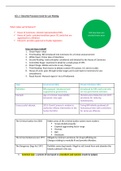
AC1.1- Describe Processes Used for Law Making
What makes up Parliament?
House of Commons- elected representatives/MPs 100 new laws are
House of Lords- contains hereditary peers (92 Lords that are created every year.
appointed for a lifetime)
Monarch- provides approval to finalise legislation
How are laws created?
1. Green Paper- ideas
2. First Reading- Bill introduced into Commons for a formal announcement
3. White Paper- firmer plan of intentions
4. Second Reading- main principles considered and debated by the House of Commons
5. Committee Stage- examined in detail by a small group of MPs
6. Report Stage- debate and vote on any changes
7. Third Reading- final chance to debate content (if it passes, it is sent to Lords)
8. House of Lords- goes through similar stages and is sent back to Commons for any
amendments
9. Royal Assent- Monarch signs it= Act of Parliament
Type Government Bills Private Members’ Bills
Definition Bill proposed, introduced and Introduced by MPs and Lords who
supported by government. are not government ministers.
Example Age of criminal responsibility Homelessness Reduction Act 2017-
(proposal: raise age). provisions for reducing
homelessness.
Unsuccessful attempt 2013- David Cameron’s motion to Turing Bill initially pardoned all
authorise military intervention in the homosexual men with convictions
Syrian Civil War. for same-sex offences.
The Criminal Justice Act 2003 Makes areas of the criminal justice system more modern:
Scraps double jeopardy
Expands aggravating factor range
Hearsay
Bail
Disclosure
The Crime (Sentences) Act 1997 Obligatory minimum sentences for drug trafficking etc.
Changes relating to mentally ill and juvenile offenders.
The Dangerous Dogs Act 1991 Prohibits some dog breeds- illegal to sell, breed from and abandon the
breeds outlined in this law.
Common Law- a system of law based on precedent and customs (made by judges)
, It is constantly changing
Fluid way in which judges interpret law through knowledge of the legal system
Exceptions to precedent:
1. Overruling a previous case- precedents gain increased authority over time which means that
judges are usually reluctant to overrule.
2. Distinguishing facts from a previous case- main device for avoiding precedent is by
distinguishing material facts (not binding).
Domestic sources of law:
Parliament Courts- statutory
interpretation and system of
precedent.
Statutory law and delegated The Literal Rule: given ordinary
legislation. and natural meaning (don’t
need to be further analysed).
The Golden Rule- prevent
inconsistency and absurdity
when literally interpreting an
Act.
The Mischief Rule- statutes
can be defined more broadly
to deal with unforeseen
ambiguity.
AC1.2- Describe the Organisation of the Criminal Justice System in England and Wales
, Main elements of the criminal justice system (CJS):
Law creation and administration
Law enforcement (police)
Courts (decides outcome)
Punishing offenders (prison and probation)
Agencies Role Relationships between agencies
Police Arrest and charge suspects Courts- protection for vulnerable
and enforce the law. witnesses, transporting to and from
court.
CPS- after arresting suspects, the
police receive advice from CPS
regarding charging and prosecution.
HM Prison and Probation- arrest for
breaching licence and watch out for
the welfare of prisoners.
Crown Prosecution Service (CPS) Advise police and collect Police- advises police on charges and
evidence to build a solid enquiry lines.
case.
Courts- collect evidence to build a
solid case that passes the Full Code
Test.
HM Courts and Tribunals Supervise the efficient Courts, prisons, probation- supervise
running of court processes. those on licence.
Police- guidelines to prevent police
from abusing authority.
HM Prison and Probation Prison service- holds Courts- supports courts and helps
prisoners, attend court and offenders lead law-abiding lives.
arrange video recordings etc.
Police- keep those sentenced to prison
in custody.
Probation- provide daily support.
Voluntary organisations- victim
support.
Campaigns- INQUEST (1981)-
expertise on state related death,
pressures public bodies.
National Probation Service Probation- monitor progress Prison and parole- supervise those on
What makes up Parliament?
House of Commons- elected representatives/MPs 100 new laws are
House of Lords- contains hereditary peers (92 Lords that are created every year.
appointed for a lifetime)
Monarch- provides approval to finalise legislation
How are laws created?
1. Green Paper- ideas
2. First Reading- Bill introduced into Commons for a formal announcement
3. White Paper- firmer plan of intentions
4. Second Reading- main principles considered and debated by the House of Commons
5. Committee Stage- examined in detail by a small group of MPs
6. Report Stage- debate and vote on any changes
7. Third Reading- final chance to debate content (if it passes, it is sent to Lords)
8. House of Lords- goes through similar stages and is sent back to Commons for any
amendments
9. Royal Assent- Monarch signs it= Act of Parliament
Type Government Bills Private Members’ Bills
Definition Bill proposed, introduced and Introduced by MPs and Lords who
supported by government. are not government ministers.
Example Age of criminal responsibility Homelessness Reduction Act 2017-
(proposal: raise age). provisions for reducing
homelessness.
Unsuccessful attempt 2013- David Cameron’s motion to Turing Bill initially pardoned all
authorise military intervention in the homosexual men with convictions
Syrian Civil War. for same-sex offences.
The Criminal Justice Act 2003 Makes areas of the criminal justice system more modern:
Scraps double jeopardy
Expands aggravating factor range
Hearsay
Bail
Disclosure
The Crime (Sentences) Act 1997 Obligatory minimum sentences for drug trafficking etc.
Changes relating to mentally ill and juvenile offenders.
The Dangerous Dogs Act 1991 Prohibits some dog breeds- illegal to sell, breed from and abandon the
breeds outlined in this law.
Common Law- a system of law based on precedent and customs (made by judges)
, It is constantly changing
Fluid way in which judges interpret law through knowledge of the legal system
Exceptions to precedent:
1. Overruling a previous case- precedents gain increased authority over time which means that
judges are usually reluctant to overrule.
2. Distinguishing facts from a previous case- main device for avoiding precedent is by
distinguishing material facts (not binding).
Domestic sources of law:
Parliament Courts- statutory
interpretation and system of
precedent.
Statutory law and delegated The Literal Rule: given ordinary
legislation. and natural meaning (don’t
need to be further analysed).
The Golden Rule- prevent
inconsistency and absurdity
when literally interpreting an
Act.
The Mischief Rule- statutes
can be defined more broadly
to deal with unforeseen
ambiguity.
AC1.2- Describe the Organisation of the Criminal Justice System in England and Wales
, Main elements of the criminal justice system (CJS):
Law creation and administration
Law enforcement (police)
Courts (decides outcome)
Punishing offenders (prison and probation)
Agencies Role Relationships between agencies
Police Arrest and charge suspects Courts- protection for vulnerable
and enforce the law. witnesses, transporting to and from
court.
CPS- after arresting suspects, the
police receive advice from CPS
regarding charging and prosecution.
HM Prison and Probation- arrest for
breaching licence and watch out for
the welfare of prisoners.
Crown Prosecution Service (CPS) Advise police and collect Police- advises police on charges and
evidence to build a solid enquiry lines.
case.
Courts- collect evidence to build a
solid case that passes the Full Code
Test.
HM Courts and Tribunals Supervise the efficient Courts, prisons, probation- supervise
running of court processes. those on licence.
Police- guidelines to prevent police
from abusing authority.
HM Prison and Probation Prison service- holds Courts- supports courts and helps
prisoners, attend court and offenders lead law-abiding lives.
arrange video recordings etc.
Police- keep those sentenced to prison
in custody.
Probation- provide daily support.
Voluntary organisations- victim
support.
Campaigns- INQUEST (1981)-
expertise on state related death,
pressures public bodies.
National Probation Service Probation- monitor progress Prison and parole- supervise those on



