

NR571 Midterm Exam Review Guide Actual
Exam 2026/2027 | Complex Diagnosis &
Management in Acute Care with Detailed
Rationales | Pass Guaranteed – A+ Graded
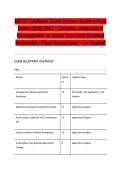
EXAM BLUEPRINT OVERVIEW
Table
Section Questio Cognitive Level
ns
Hemodynamic Monitoring & Shock 14 20% Recall / 50% Application / 30%
Syndromes Analysis
Mechanical Ventilation & Respiratory Failure 12 Application/Analysis
Acute Cardiac Conditions (ACS, Arrhythmias, 16 Application/Analysis
HF)
Sepsis & Infectious Disease Emergencies 10 Application/Analysis
Acute Kidney Injury & Renal Replacement 8 Application/Analysis
Therapy
, Neurologic Emergencies (Stroke, Seizures, 12 Application/Analysis
ICP)
Endocrine Emergencies (DKA, HHS, Adrenal 8 Application/Analysis
Crisis)
Gastrointestinal Emergencies 8 Application/Analysis
Hematologic & Oncologic Emergencies 6 Application/Analysis
Toxicology & Overdose Management 6 Application/Analysis
Multisystem Organ Failure & Critical Care 10 Application/Analysis
Pharmacology
Integrative Case-Based Scenarios 10 Analysis
TOTAL 120
SECTION 1: HEMODYNAMIC MONITORING & SHOCK SYNDROMES
(Questions 1–14)
Q1: A patient in the ICU has a pulmonary artery catheter in place. Hemodynamic values:
CVP 2 mmHg, PAP 18/8 mmHg, PCWP 4 mmHg, CO 3.2 L/min, SVR 1800
dynes/sec/cm⁻⁵, BP 82/48 mmHg, HR 128 bpm. Which type of shock is MOST
consistent with these findings?
,A. Cardiogenic shock
B. Distributive shock [CORRECT]
C. Hypovolemic shock
D. Obstructive shock
Correct Answer: B
Rationale: Distributive shock (septic, anaphylactic, neurogenic) presents with low PCWP
(preload), low CO, low SVR (afterload), and low BP. Cardiogenic shock has high PCWP
(>18); hypovolemic shock has low PCWP but high SVR (>1400 initially) as
compensation; obstructive shock has high CVP/PCWP with low CO (tamponade, PE).
Q2: A patient with septic shock is receiving norepinephrine 0.3 mcg/kg/min. MAP
remains 58 mmHg. Which vasopressor should be added NEXT per current guidelines?
A. Epinephrine
B. Vasopressin 0.03 units/min [CORRECT]
C. Phenylephrine
D. Dopamine
Correct Answer: B
Rationale: Vasopressin is the recommended second-line vasopressor for septic shock
when norepinephrine requirements escalate. Fixed-dose vasopressin at 0.03 units/min
reduces norepinephrine requirements and may improve outcomes when added early.
, Q3: A patient with cardiogenic shock after acute MI has the following hemodynamics:
BP 78/50, HR 110, PCWP 24 mmHg, CI 1.8 L/min/m². Which medication is MOST
appropriate?
A. Norepinephrine alone
B. Dobutamine with norepinephrine [CORRECT]
C. Vasopressin alone
D. Phenylephrine alone
Correct Answer: B
Rationale: Cardiogenic shock requires both inotropic support (dobutamine to increase
contractility and cardiac output) and vasopressor support (norepinephrine to maintain
MAP >65). Dobutamine alone may cause hypotension due to vasodilation;
norepinephrine alone does not address the primary pump failure.
Q4: A patient with hemorrhagic shock from trauma has received 4 units of PRBCs and 2
liters of crystalloid. BP remains 82/60, HR 125, lactate 6.2. Which blood product should
be administered NEXT?
A. Additional crystalloid 2 liters
B. Fresh frozen plasma (FFP) in 1:1 ratio with PRBCs [CORRECT]
C. Platelets only
D. Albumin 5%
Correct Answer: B
Rationale: Massive transfusion protocol requires balanced resuscitation with PRBCs,
FFP, and platelets in approximately 1:1:1 ratio to prevent dilutional coagulopathy.
Exam 2026/2027 | Complex Diagnosis &
Management in Acute Care with Detailed
Rationales | Pass Guaranteed – A+ Graded
EXAM BLUEPRINT OVERVIEW
Table
Section Questio Cognitive Level
ns
Hemodynamic Monitoring & Shock 14 20% Recall / 50% Application / 30%
Syndromes Analysis
Mechanical Ventilation & Respiratory Failure 12 Application/Analysis
Acute Cardiac Conditions (ACS, Arrhythmias, 16 Application/Analysis
HF)
Sepsis & Infectious Disease Emergencies 10 Application/Analysis
Acute Kidney Injury & Renal Replacement 8 Application/Analysis
Therapy
, Neurologic Emergencies (Stroke, Seizures, 12 Application/Analysis
ICP)
Endocrine Emergencies (DKA, HHS, Adrenal 8 Application/Analysis
Crisis)
Gastrointestinal Emergencies 8 Application/Analysis
Hematologic & Oncologic Emergencies 6 Application/Analysis
Toxicology & Overdose Management 6 Application/Analysis
Multisystem Organ Failure & Critical Care 10 Application/Analysis
Pharmacology
Integrative Case-Based Scenarios 10 Analysis
TOTAL 120
SECTION 1: HEMODYNAMIC MONITORING & SHOCK SYNDROMES
(Questions 1–14)
Q1: A patient in the ICU has a pulmonary artery catheter in place. Hemodynamic values:
CVP 2 mmHg, PAP 18/8 mmHg, PCWP 4 mmHg, CO 3.2 L/min, SVR 1800
dynes/sec/cm⁻⁵, BP 82/48 mmHg, HR 128 bpm. Which type of shock is MOST
consistent with these findings?
,A. Cardiogenic shock
B. Distributive shock [CORRECT]
C. Hypovolemic shock
D. Obstructive shock
Correct Answer: B
Rationale: Distributive shock (septic, anaphylactic, neurogenic) presents with low PCWP
(preload), low CO, low SVR (afterload), and low BP. Cardiogenic shock has high PCWP
(>18); hypovolemic shock has low PCWP but high SVR (>1400 initially) as
compensation; obstructive shock has high CVP/PCWP with low CO (tamponade, PE).
Q2: A patient with septic shock is receiving norepinephrine 0.3 mcg/kg/min. MAP
remains 58 mmHg. Which vasopressor should be added NEXT per current guidelines?
A. Epinephrine
B. Vasopressin 0.03 units/min [CORRECT]
C. Phenylephrine
D. Dopamine
Correct Answer: B
Rationale: Vasopressin is the recommended second-line vasopressor for septic shock
when norepinephrine requirements escalate. Fixed-dose vasopressin at 0.03 units/min
reduces norepinephrine requirements and may improve outcomes when added early.
, Q3: A patient with cardiogenic shock after acute MI has the following hemodynamics:
BP 78/50, HR 110, PCWP 24 mmHg, CI 1.8 L/min/m². Which medication is MOST
appropriate?
A. Norepinephrine alone
B. Dobutamine with norepinephrine [CORRECT]
C. Vasopressin alone
D. Phenylephrine alone
Correct Answer: B
Rationale: Cardiogenic shock requires both inotropic support (dobutamine to increase
contractility and cardiac output) and vasopressor support (norepinephrine to maintain
MAP >65). Dobutamine alone may cause hypotension due to vasodilation;
norepinephrine alone does not address the primary pump failure.
Q4: A patient with hemorrhagic shock from trauma has received 4 units of PRBCs and 2
liters of crystalloid. BP remains 82/60, HR 125, lactate 6.2. Which blood product should
be administered NEXT?
A. Additional crystalloid 2 liters
B. Fresh frozen plasma (FFP) in 1:1 ratio with PRBCs [CORRECT]
C. Platelets only
D. Albumin 5%
Correct Answer: B
Rationale: Massive transfusion protocol requires balanced resuscitation with PRBCs,
FFP, and platelets in approximately 1:1:1 ratio to prevent dilutional coagulopathy.


