

Week 3 Homework
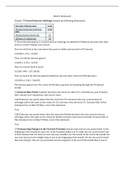
Chapter 7) Covered Interest Arbitrage Assume the following information:
Spot rate of Mexican peso $.100
180-day forward rate of Mexican $.098
peso
180-day Mexican interest rate 6%
180-day U.S. interest rate 5%
7) Given this information, is covered interest arbitrage worthwhile for Mexican investors who have
pesos to invest? Explain your answer.
First we will look at the conversion from peso to dollar and invested at US interest,
100,000 x .100 = 10,000
Then we add the interest gained
10,000 x (1.05)= 10,500
Now we convert back to pesos
10,500/.098 = 107,142.86
Now we look at the interest gained in Mexican currency then converted 180 days later.
100,000 x (1.06)= 106,000
The interest gained over the course of 180 days is greater by investing through the US instead
locally.
13) Interest Rate Parity Consider investors who invest in either U.S. or British one-year Treasury
bills. Assume zero transaction costs and no taxes.
13a) If interest rate parity exists, then the return for U.S. investors who use covered interest
arbitrage will be the same as the return for U.S. investors who invest in U.S. Treasury bills. Is this
statement true or false? If false, correct the statement.
True
13b) If interest rate parity exists, then the return for British investors who use covered interest
arbitrage will be the same as the return for British investors who invest in British Treasury bills. Is
this statement true or false? If false, correct the statement.
True
27) Interpreting Changes in the Forward Premium Assume that interest rate parity holds. At the
beginning of the month, the spot rate of the Canadian dollar is $.70, while the one-year forward rate
is $.68. Assume that U.S. interest rates increase steadily over the month. At the end of the month, the
one-year forward rate is higher than it was at the beginning of the month. Yet the one-year forward
discount is larger (the one-year premium is more negative) at the end of the month than it was at
Chapter 7) Covered Interest Arbitrage Assume the following information:
Spot rate of Mexican peso $.100
180-day forward rate of Mexican $.098
peso
180-day Mexican interest rate 6%
180-day U.S. interest rate 5%
7) Given this information, is covered interest arbitrage worthwhile for Mexican investors who have
pesos to invest? Explain your answer.
First we will look at the conversion from peso to dollar and invested at US interest,
100,000 x .100 = 10,000
Then we add the interest gained
10,000 x (1.05)= 10,500
Now we convert back to pesos
10,500/.098 = 107,142.86
Now we look at the interest gained in Mexican currency then converted 180 days later.
100,000 x (1.06)= 106,000
The interest gained over the course of 180 days is greater by investing through the US instead
locally.
13) Interest Rate Parity Consider investors who invest in either U.S. or British one-year Treasury
bills. Assume zero transaction costs and no taxes.
13a) If interest rate parity exists, then the return for U.S. investors who use covered interest
arbitrage will be the same as the return for U.S. investors who invest in U.S. Treasury bills. Is this
statement true or false? If false, correct the statement.
True
13b) If interest rate parity exists, then the return for British investors who use covered interest
arbitrage will be the same as the return for British investors who invest in British Treasury bills. Is
this statement true or false? If false, correct the statement.
True
27) Interpreting Changes in the Forward Premium Assume that interest rate parity holds. At the
beginning of the month, the spot rate of the Canadian dollar is $.70, while the one-year forward rate
is $.68. Assume that U.S. interest rates increase steadily over the month. At the end of the month, the
one-year forward rate is higher than it was at the beginning of the month. Yet the one-year forward
discount is larger (the one-year premium is more negative) at the end of the month than it was at


