
BASIC STRUCTURE AND FUNCTION OF THE RENAL SYSTEM
LO’s:
● Understand the basic anatomy and physiology of the human renal (urinary system)
● To appreciate the relationship between structure and function in the renal system
● To appreciate how the renal system works in concert with other systems, such as the
respiratory system, in order to maintain homeostasis
● To understand how knowledge of normal kidney function could assist in the diagnosis
and thus treatment of abnormalities (pathologies) associated with the renal system
● FUNCTIONS OF THE KIDNEY:
● Regulating blood volume and blood pressure (adjusting water loss in the urine) (renin-
angiotensin system)
● Regulating plasma concentration of ions (controlling quantities lost in the urine)
● Maintaining pH (controlling loss of H+ and HCO3- ions in the urine)
● Conserving valuable nutrients (preventing excretion of glucose and amino acids)
● Eliminating toxic/unwanted substances (eliminating organic waste products like urea and
uric acid)
● Vitamin D synthesis/activation
● BASIC ANATOMY OF RENAL SYSTEM/KIDNEY:
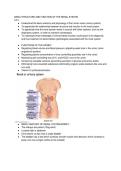
● The kidneys are paired (150g each)
● Located high in abdomen
● Urine drains via two îinto a single bladder
● The bladder has a wall which contains smooth muscle (the detrusor) which contacts to
pass urine via a single urethra to the outside)
,● KIDNEY
● The kidney has a pale outer region called the cortex and a darker inner region called the
medulla
, ● The medulla is divided into conical regions, called the renal pyramids
● The cortex and the medulla are made up of nephrons, which are functional units of the
kidney
● Each kidney contains over 1 million nephrons
● NEPHRONS:
● The nephron is the functional unit of the kidney responsible for filtration of the blood and
reabsorption or secretion of products in the subsequent filtrate
● In 24hrs the nephrons filter approximately 180 L of blood plasma though their glomeruli
into the tubules
● Each nephron is made up of:
➔ Glomerulus/ bowman's capsule
➔ Proximal convoluted tubule
➔ Loop of henle
➔ Distal convoluted tubule
➔ Collecting duct
● URINE FORMATION:
LO’s:
● Understand the basic anatomy and physiology of the human renal (urinary system)
● To appreciate the relationship between structure and function in the renal system
● To appreciate how the renal system works in concert with other systems, such as the
respiratory system, in order to maintain homeostasis
● To understand how knowledge of normal kidney function could assist in the diagnosis
and thus treatment of abnormalities (pathologies) associated with the renal system
● FUNCTIONS OF THE KIDNEY:
● Regulating blood volume and blood pressure (adjusting water loss in the urine) (renin-
angiotensin system)
● Regulating plasma concentration of ions (controlling quantities lost in the urine)
● Maintaining pH (controlling loss of H+ and HCO3- ions in the urine)
● Conserving valuable nutrients (preventing excretion of glucose and amino acids)
● Eliminating toxic/unwanted substances (eliminating organic waste products like urea and
uric acid)
● Vitamin D synthesis/activation
● BASIC ANATOMY OF RENAL SYSTEM/KIDNEY:
● The kidneys are paired (150g each)
● Located high in abdomen
● Urine drains via two îinto a single bladder
● The bladder has a wall which contains smooth muscle (the detrusor) which contacts to
pass urine via a single urethra to the outside)
,● KIDNEY
● The kidney has a pale outer region called the cortex and a darker inner region called the
medulla
, ● The medulla is divided into conical regions, called the renal pyramids
● The cortex and the medulla are made up of nephrons, which are functional units of the
kidney
● Each kidney contains over 1 million nephrons
● NEPHRONS:
● The nephron is the functional unit of the kidney responsible for filtration of the blood and
reabsorption or secretion of products in the subsequent filtrate
● In 24hrs the nephrons filter approximately 180 L of blood plasma though their glomeruli
into the tubules
● Each nephron is made up of:
➔ Glomerulus/ bowman's capsule
➔ Proximal convoluted tubule
➔ Loop of henle
➔ Distal convoluted tubule
➔ Collecting duct
● URINE FORMATION:


