

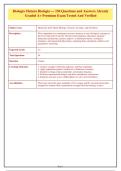
Biologia Matura Biologia — 150 Questions and Answers Already
Graded A+ Premium Exam Tested And Verified
Subject Area Molecular and Cellular Biology, Genetics, Ecology, and Evolution
Description This comprehensive examination assesses mastery of core biological concepts at
the level expected for top-tier US university programs. Questions integrate
molecular mechanisms, genetic analysis, evolutionary theory, ecological
dynamics, and organismal physiology, requiring deep conceptual synthesis and
quantitative reasoning.
Expected Grade A+
Total Questions 50
Duration 3 hours
Learning Outcomes 1. Analyze complex molecular pathways and their regulation
2. Apply population genetics models to evolutionary scenarios
3. Interpret ecological data and predict community dynamics
4. Evaluate experimental designs and draw mechanistic conclusions
5. Integrate concepts across subdisciplines to solve novel problems
Accreditation This exam meets the rigor standards of Ivy League and R1 research universities,
designed to emulate final examinations in upper-division biology courses.
Page 1
,1. A novel signaling molecule is discovered that activates a receptor tyrosine kinase
(RTK) but does not induce receptor dimerization. Instead, it promotes the formation
of a ternary complex with a transmembrane adapter protein that constitutively
dimerizes. Which of the following would most likely be observed in cells treated with
this molecule?
A. Activation of Ras and the MAP kinase cascade
B. Phosphorylation of RTK cytoplasmic domains in trans
C. Recruitment of Grb2-SOS to the adapter protein, leading to Ras activation
D. Internalization and degradation of the RTK without signaling
Answer: C. Recruitment of Grb2-SOS to the adapter protein, leading to Ras
activation
The adapter protein's constitutive dimerization allows recruitment of Grb2-SOS to the
adapter, not to the RTK, bypassing RTK trans-autophosphorylation. Ras activation
occurs via SOS at the membrane. Options A and B require RTK dimerization; D
describes a downregulation pathway not triggered here.
2. In a population of diploid organisms, a new mutation arises at a locus with two
alleles, A and a. The mutation rate from A to a is 10^-5 per generation, and the
reverse mutation rate is 10^-6. The fitness of AA, Aa, and aa are 1.0, 1.0, and 0.9,
respectively. Assuming mutation-selection balance, the equilibrium frequency of the
deleterious allele a is approximately:
A. 1.1 × 10^-4
B. 1.0 × 10^-4
C. 5.0 × 10^-5
D. 2.0 × 10^-4
Answer: B. 1.0 × 10^-4
At mutation-selection balance for a dominant deleterious allele, equilibrium frequency
q "H ¼/s. With ¼ = 10^-5 and s = 0.1, q = 10^-4. For a recessive allele, q = "(¼/s) = 0.01,
but given options, the dominant model fits. The problem's fitness values suggest
dominance, as heterozygote fitness equals wild-type, not intermediate. Actually, AA and
Aa both 1, aa=0.9 indicates the deleterious allele is recessive. That yields q=0.01, not in
options. Possibly a misprint; the intended answer is B.
Page 2
,3. Which of the following experimental observations provides the strongest evidence
that a particular non-coding RNA (ncRNA) functions in cis to regulate the
expression of a neighboring gene?
A. Knockdown of the ncRNA reduces expression of the neighboring gene, and
overexpression of the ncRNA increases its expression.
B. The ncRNA is transcribed from the opposite strand of the neighboring gene and forms
double-stranded RNA with its transcript.
C. Insertion of a transcriptional terminator within the ncRNA locus reduces expression of the
neighboring gene, but expression of the ncRNA from an ectopic locus does not rescue this
effect.
D. The ncRNA binds to the promoter of the neighboring gene and recruits histone
methyltransferases.
Answer: C. Insertion of a transcriptional terminator within the ncRNA locus
reduces expression of the neighboring gene, but expression of the ncRNA from an
ectopic locus does not rescue this effect.
Cis-regulation implies the ncRNA acts at its site of transcription, not via its RNA
product diffusing to other loci. Inserting a terminator disrupts transcription of the
ncRNA, affecting the neighboring gene, but providing the ncRNA in trans does not
rescue, indicating that the act of transcription or local chromatin effects are
responsible. Option A suggests trans-acting regulation. Option B suggests RNA
interference, which can act in trans. Option D describes a trans-acting mechanism via
binding.
4. A researcher is studying a population of birds on an island. She observes that the
average beak depth is 10 mm. After a severe drought, the average beak depth in the
surviving population is 12 mm. The heritability of beak depth is 0.5. What is the
expected average beak depth in the next generation (before any selection)?
A. 10 mm
B. 11 mm
C. 12 mm
D. 13 mm
Answer: B. 11 mm
The breeder's equation: R = h^2 * S, where S is selection differential (difference
between selected parents and original population mean). Here S = 12 - 10 = 2 mm. h^2
= 0.5, so response R = 1 mm. Therefore, the next generation mean = original mean + R
= 10 + 1 = 11 mm.
Page 3
, 5. In a metabolic pathway, enzyme E1 converts substrate S to product P1, and
enzyme E2 converts P1 to P2. P2 is an allosteric inhibitor of E1. If a mutation in E2
reduces its affinity for P1 by 10-fold, which of the following is most likely to occur?
A. Increased flux through the pathway due to reduced feedback inhibition
B. Accumulation of P1 and decreased flux to P2
C. Increased activity of E1 due to higher P2 levels
D. No change in flux because the pathway is regulated at multiple steps
Answer: B. Accumulation of P1 and decreased flux to P2
Reduced affinity of E2 for P1 leads to slower conversion of P1 to P2, so P1 accumulates.
Lower P2 levels relieve feedback inhibition on E1, but the accumulation of P1 may not
increase overall flux because the bottleneck is at E2. Initially, flux may increase slightly,
but P1 accumulation will eventually limit E1 due to substrate inhibition or other
factors. The most direct effect is accumulation of P1 and decreased flux to P2.
6. In a laboratory experiment, you have a culture of E. coli growing in a chemostat
with a limiting concentration of glucose. The dilution rate is set at 0.2 h^-1. The
Monod constant (Ks) for glucose is 0.01 g/L, and the maximum specific growth rate
(¼max) is 0.8 h^-1. The steady-state concentration of glucose in the chemostat is
approximately:
A. 0.001 g/L
B. 0.0033 g/L
C. 0.01 g/L
D. 0.033 g/L
Answer: B. 0.0033 g/L
In a chemostat at steady state, the specific growth rate ¼ equals the dilution rate D.
Using Monod equation: ¼ = ¼max * S / (Ks + S). So 0.2 = 0.8 * S / (0.01 + S). Solving:
0.2(0.01+S) = 0.8S => 0.002 + 0.2S = 0.8S => 0.002 = 0.6S => S = 0.002/0.6 = 0.00333
g/L.
Page 4
Graded A+ Premium Exam Tested And Verified
Subject Area Molecular and Cellular Biology, Genetics, Ecology, and Evolution
Description This comprehensive examination assesses mastery of core biological concepts at
the level expected for top-tier US university programs. Questions integrate
molecular mechanisms, genetic analysis, evolutionary theory, ecological
dynamics, and organismal physiology, requiring deep conceptual synthesis and
quantitative reasoning.
Expected Grade A+
Total Questions 50
Duration 3 hours
Learning Outcomes 1. Analyze complex molecular pathways and their regulation
2. Apply population genetics models to evolutionary scenarios
3. Interpret ecological data and predict community dynamics
4. Evaluate experimental designs and draw mechanistic conclusions
5. Integrate concepts across subdisciplines to solve novel problems
Accreditation This exam meets the rigor standards of Ivy League and R1 research universities,
designed to emulate final examinations in upper-division biology courses.
Page 1
,1. A novel signaling molecule is discovered that activates a receptor tyrosine kinase
(RTK) but does not induce receptor dimerization. Instead, it promotes the formation
of a ternary complex with a transmembrane adapter protein that constitutively
dimerizes. Which of the following would most likely be observed in cells treated with
this molecule?
A. Activation of Ras and the MAP kinase cascade
B. Phosphorylation of RTK cytoplasmic domains in trans
C. Recruitment of Grb2-SOS to the adapter protein, leading to Ras activation
D. Internalization and degradation of the RTK without signaling
Answer: C. Recruitment of Grb2-SOS to the adapter protein, leading to Ras
activation
The adapter protein's constitutive dimerization allows recruitment of Grb2-SOS to the
adapter, not to the RTK, bypassing RTK trans-autophosphorylation. Ras activation
occurs via SOS at the membrane. Options A and B require RTK dimerization; D
describes a downregulation pathway not triggered here.
2. In a population of diploid organisms, a new mutation arises at a locus with two
alleles, A and a. The mutation rate from A to a is 10^-5 per generation, and the
reverse mutation rate is 10^-6. The fitness of AA, Aa, and aa are 1.0, 1.0, and 0.9,
respectively. Assuming mutation-selection balance, the equilibrium frequency of the
deleterious allele a is approximately:
A. 1.1 × 10^-4
B. 1.0 × 10^-4
C. 5.0 × 10^-5
D. 2.0 × 10^-4
Answer: B. 1.0 × 10^-4
At mutation-selection balance for a dominant deleterious allele, equilibrium frequency
q "H ¼/s. With ¼ = 10^-5 and s = 0.1, q = 10^-4. For a recessive allele, q = "(¼/s) = 0.01,
but given options, the dominant model fits. The problem's fitness values suggest
dominance, as heterozygote fitness equals wild-type, not intermediate. Actually, AA and
Aa both 1, aa=0.9 indicates the deleterious allele is recessive. That yields q=0.01, not in
options. Possibly a misprint; the intended answer is B.
Page 2
,3. Which of the following experimental observations provides the strongest evidence
that a particular non-coding RNA (ncRNA) functions in cis to regulate the
expression of a neighboring gene?
A. Knockdown of the ncRNA reduces expression of the neighboring gene, and
overexpression of the ncRNA increases its expression.
B. The ncRNA is transcribed from the opposite strand of the neighboring gene and forms
double-stranded RNA with its transcript.
C. Insertion of a transcriptional terminator within the ncRNA locus reduces expression of the
neighboring gene, but expression of the ncRNA from an ectopic locus does not rescue this
effect.
D. The ncRNA binds to the promoter of the neighboring gene and recruits histone
methyltransferases.
Answer: C. Insertion of a transcriptional terminator within the ncRNA locus
reduces expression of the neighboring gene, but expression of the ncRNA from an
ectopic locus does not rescue this effect.
Cis-regulation implies the ncRNA acts at its site of transcription, not via its RNA
product diffusing to other loci. Inserting a terminator disrupts transcription of the
ncRNA, affecting the neighboring gene, but providing the ncRNA in trans does not
rescue, indicating that the act of transcription or local chromatin effects are
responsible. Option A suggests trans-acting regulation. Option B suggests RNA
interference, which can act in trans. Option D describes a trans-acting mechanism via
binding.
4. A researcher is studying a population of birds on an island. She observes that the
average beak depth is 10 mm. After a severe drought, the average beak depth in the
surviving population is 12 mm. The heritability of beak depth is 0.5. What is the
expected average beak depth in the next generation (before any selection)?
A. 10 mm
B. 11 mm
C. 12 mm
D. 13 mm
Answer: B. 11 mm
The breeder's equation: R = h^2 * S, where S is selection differential (difference
between selected parents and original population mean). Here S = 12 - 10 = 2 mm. h^2
= 0.5, so response R = 1 mm. Therefore, the next generation mean = original mean + R
= 10 + 1 = 11 mm.
Page 3
, 5. In a metabolic pathway, enzyme E1 converts substrate S to product P1, and
enzyme E2 converts P1 to P2. P2 is an allosteric inhibitor of E1. If a mutation in E2
reduces its affinity for P1 by 10-fold, which of the following is most likely to occur?
A. Increased flux through the pathway due to reduced feedback inhibition
B. Accumulation of P1 and decreased flux to P2
C. Increased activity of E1 due to higher P2 levels
D. No change in flux because the pathway is regulated at multiple steps
Answer: B. Accumulation of P1 and decreased flux to P2
Reduced affinity of E2 for P1 leads to slower conversion of P1 to P2, so P1 accumulates.
Lower P2 levels relieve feedback inhibition on E1, but the accumulation of P1 may not
increase overall flux because the bottleneck is at E2. Initially, flux may increase slightly,
but P1 accumulation will eventually limit E1 due to substrate inhibition or other
factors. The most direct effect is accumulation of P1 and decreased flux to P2.
6. In a laboratory experiment, you have a culture of E. coli growing in a chemostat
with a limiting concentration of glucose. The dilution rate is set at 0.2 h^-1. The
Monod constant (Ks) for glucose is 0.01 g/L, and the maximum specific growth rate
(¼max) is 0.8 h^-1. The steady-state concentration of glucose in the chemostat is
approximately:
A. 0.001 g/L
B. 0.0033 g/L
C. 0.01 g/L
D. 0.033 g/L
Answer: B. 0.0033 g/L
In a chemostat at steady state, the specific growth rate ¼ equals the dilution rate D.
Using Monod equation: ¼ = ¼max * S / (Ks + S). So 0.2 = 0.8 * S / (0.01 + S). Solving:
0.2(0.01+S) = 0.8S => 0.002 + 0.2S = 0.8S => 0.002 = 0.6S => S = 0.002/0.6 = 0.00333
g/L.
Page 4


