Aliya Hussain
Unit 8.3- Digestion assignment
P5: physiological processes of digestion, absorption and the assimilation of
nutrients.
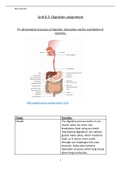
BTEC applied science student book 1 2016
Organ Function
Mouth The digestive process starts in our
mouth when we chew and
breakdown food using our teeth
(mechanical digestion). our salivary
glands make saliva, which moistens
food, so it moves more easily
through our esophagus into your
stomach. Saliva also contains
hydrolytic enzymes which help break
down large molecules.
1
,Aliya Hussain
Pharynx The tongue rolls and pushes the food
into the pharynx. Splitting off the
pharynx is the oesophagus, which
carries food to the stomach.
Oesophagus The oesohpagus is a muscular tube
that leads from the throat to the
stomach. the oesophagus contains
four layers—the mucosa, submucosa,
muscularis, and tunica adventitia.
The mucosa membrane produces
mucus, so food is able to pass
smoothly. The submucosa holds the
mucosa membrane in place. The
muscularis is a thick layer of muscle
that composed of an inner layer, in
which the fibres are circular, and an
outer layer of longitudinal fibres. The
tunica adventitial acts as a protective
covering.
Stomach The main function of the stomach is
to breakdown food by contraction
and relaxation. The stomach is lined
with epithelial cells which produce
gastric juice containing acid and
enzymes. The acid and enzymes
breakdown help the food.
Gall bladder The gall bladder is a muscular sac
which stored bile that is made in the
liver. The gall bladder releases bile by
the use of bile ducts, into the
duodenum at the sphincter of Oddi.
Bile helps with digestion as it breaks
down fats into fatty acids.
Liver The liver produces bile which is
stored in the gall bladder until
needed. Bile does not contain
enzymes, however it contains:
-salts that emulsify fats to increase
their surface area for digestion
-hydrogencarbonate ions to
2
, Aliya Hussain
neutralise acidic chyme.
-products of broken down red blood
cells and cholesterol.
Pancreas The pancreas is a gland which
produces pancreatic juices called
enzymes. These enzymes break down
sugars, fats, and starches.
Large intestine – caecum, appendix, The purpose of the large intestine is
colon, rectum, anal canal to absorb water and salts from the
material that has not been digested
as food, and get rid of any waste
products left over.
Caecum- The internal wall of the
cecum is composed of a thick
mucous membrane, through which
water and salts are absorbed.
Appendix- The appendix protects the
good bacteria in the gut and cleans
out the intestines after illnesses. The
good bacteria in the appendix can
also affect the digestive system.
Colon- the colon is responsible for
handling waste so that emptying the
bowels is easy. It's a 6-foot long
muscular tube that connects the
small intestine to the rectum.
Rectum- The rectum's job is to
receive stool from the colon, and to
hold the stool until removal happens.
anal canal- The anal canal is the final
segment of the gastrointestinal tract.
It has an important role in defecation
and maintaining faecal continence.
Anus When the rectum is full, your body
feels the urge to have a bowel
movement. The internal anal
sphincter relaxes and pushes the
stool from the rectum into the anal
canal.
Small intestines – duodenum, The small intestine carries out most
3
Unit 8.3- Digestion assignment
P5: physiological processes of digestion, absorption and the assimilation of
nutrients.
BTEC applied science student book 1 2016
Organ Function
Mouth The digestive process starts in our
mouth when we chew and
breakdown food using our teeth
(mechanical digestion). our salivary
glands make saliva, which moistens
food, so it moves more easily
through our esophagus into your
stomach. Saliva also contains
hydrolytic enzymes which help break
down large molecules.
1
,Aliya Hussain
Pharynx The tongue rolls and pushes the food
into the pharynx. Splitting off the
pharynx is the oesophagus, which
carries food to the stomach.
Oesophagus The oesohpagus is a muscular tube
that leads from the throat to the
stomach. the oesophagus contains
four layers—the mucosa, submucosa,
muscularis, and tunica adventitia.
The mucosa membrane produces
mucus, so food is able to pass
smoothly. The submucosa holds the
mucosa membrane in place. The
muscularis is a thick layer of muscle
that composed of an inner layer, in
which the fibres are circular, and an
outer layer of longitudinal fibres. The
tunica adventitial acts as a protective
covering.
Stomach The main function of the stomach is
to breakdown food by contraction
and relaxation. The stomach is lined
with epithelial cells which produce
gastric juice containing acid and
enzymes. The acid and enzymes
breakdown help the food.
Gall bladder The gall bladder is a muscular sac
which stored bile that is made in the
liver. The gall bladder releases bile by
the use of bile ducts, into the
duodenum at the sphincter of Oddi.
Bile helps with digestion as it breaks
down fats into fatty acids.
Liver The liver produces bile which is
stored in the gall bladder until
needed. Bile does not contain
enzymes, however it contains:
-salts that emulsify fats to increase
their surface area for digestion
-hydrogencarbonate ions to
2
, Aliya Hussain
neutralise acidic chyme.
-products of broken down red blood
cells and cholesterol.
Pancreas The pancreas is a gland which
produces pancreatic juices called
enzymes. These enzymes break down
sugars, fats, and starches.
Large intestine – caecum, appendix, The purpose of the large intestine is
colon, rectum, anal canal to absorb water and salts from the
material that has not been digested
as food, and get rid of any waste
products left over.
Caecum- The internal wall of the
cecum is composed of a thick
mucous membrane, through which
water and salts are absorbed.
Appendix- The appendix protects the
good bacteria in the gut and cleans
out the intestines after illnesses. The
good bacteria in the appendix can
also affect the digestive system.
Colon- the colon is responsible for
handling waste so that emptying the
bowels is easy. It's a 6-foot long
muscular tube that connects the
small intestine to the rectum.
Rectum- The rectum's job is to
receive stool from the colon, and to
hold the stool until removal happens.
anal canal- The anal canal is the final
segment of the gastrointestinal tract.
It has an important role in defecation
and maintaining faecal continence.
Anus When the rectum is full, your body
feels the urge to have a bowel
movement. The internal anal
sphincter relaxes and pushes the
stool from the rectum into the anal
canal.
Small intestines – duodenum, The small intestine carries out most
3