

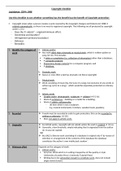
Copyright Checklist
Legislation: CDPA 1988
Use this checklist to see whether something has the benefit has the benefit of Copyright protection:
Copyright arises when a person creates a work covered by the Copyright, Designs and Patents Act 1988. It
subsists automatically, so there is no need to registered copyright. The following are all protected by copyright
under s.1 (1):
- Does the © subsist? – original/minimum effort.
- Ownership and duration?
- Infringement (primary/secondary)
- Defences
- Remedies
1. Identify the category of a. Literary works:
work Any work other than a dramatic or musical work, which is written spoken or
sung (s3 (1)). This includes
A table or compilation (i.e. collection of information) other than a database;
A computer program;
Preparatory design material for a computer program; and
A database.
b. Dramatic work
Dance or mine (film script has dramatic not literal copyright)
c. Musical work
Work consisting of music (Eg. the tune of a song), but exclusive of any words or
action (eg. lyrics to a song) – which would be separately protected as a literary
work.
d. Artistic works
Graphic works, photographs, sculptures or collages (s4 (1) (a);
Work of architecture – building or a model for a building;
Work of artistic craftsmanship.
- 3D item which is not a sculpture.
- E.g. musical instruments, furniture, wooden boats, jewellery.
2. Recorded A work must be recorded in order to gain protection, this can be recorded in
writing or otherwise. (s3 (2)).
Does not apply to artistic work.
3. Originality For LDMA works, copyright will not subsist unless the work is original s1 (1) (a).
Generally, a low threshold, simply indicating that it originated from the author
(ie. It was not copied).
NB:
By s3A(2) a literary work consisting of a database is original only if ‘by reason of
selection or arrangement of the contents of the database the database
constitutes the author’s own intellectual creation’.
4. Minimum effort Depends on the category of work.
a. Literary works
Very low. Work which is in writing irrespective of the quality or style.
(University of London Press v University Tutorial Press)
Writing has to be substantial enough to constitute work, does not include
single words (Exxon).
, Compilation s (ie. Collections of information) can attract literary copyright, but
now database rights exist, unlikely to meet the minimum effort requirement
for literary copyright.
b. Artistic works
Graphic works, photographs, sculptures or collages (s4 (1) (a );
- Protected irrespective of artistic quality. Therefore, the minimum effort
is very low.
Architecture – Needs artistic merits
- Something more than common stock (Cornish and Llewelyn).
Works of artistic craftsmanship (3D item).
- Significant degree of artistic merit is required.
- Key factor in deciding whether it’s met, is to ask whether the author
consciously intended to create a work of art.
5. Duration The length of protection varies depending on the category of work:
s.12: Life of the author + 70 years from the end of the year in which the author
dies.
- If copyright vests in employer, because author is an employee, the
duration is employee’s life +70 years.
Computer generated – 50 years from creation (s12 (7) CDPA)).
Unknown works – 70 years from end of year of creation (S12 (3) CDPA))
6. Ownership The first owner of copyright is generally the author (s11 (1)). The author of a
work is a person who created it – s9(1).
On the facts, is the author an employee? If so, was the work done in the course
of employment? If so, then the employer is the owner.
Has work been commissioned? If it has been, state that the work will still be
owned by the creator and not the commissioning party. (S11 (1).
- Then make the point that the commissioning party should ensure the
agreement provides for an assignment or license of the copyright to the
commissioner.
- In the absence of a clause, a license is usually implied (Blair v Alan S
Tomkins).
7. Conclude: who owns the
work? What rights do
they have?
Legislation: CDPA 1988
Use this checklist to see whether something has the benefit has the benefit of Copyright protection:
Copyright arises when a person creates a work covered by the Copyright, Designs and Patents Act 1988. It
subsists automatically, so there is no need to registered copyright. The following are all protected by copyright
under s.1 (1):
- Does the © subsist? – original/minimum effort.
- Ownership and duration?
- Infringement (primary/secondary)
- Defences
- Remedies
1. Identify the category of a. Literary works:
work Any work other than a dramatic or musical work, which is written spoken or
sung (s3 (1)). This includes
A table or compilation (i.e. collection of information) other than a database;
A computer program;
Preparatory design material for a computer program; and
A database.
b. Dramatic work
Dance or mine (film script has dramatic not literal copyright)
c. Musical work
Work consisting of music (Eg. the tune of a song), but exclusive of any words or
action (eg. lyrics to a song) – which would be separately protected as a literary
work.
d. Artistic works
Graphic works, photographs, sculptures or collages (s4 (1) (a);
Work of architecture – building or a model for a building;
Work of artistic craftsmanship.
- 3D item which is not a sculpture.
- E.g. musical instruments, furniture, wooden boats, jewellery.
2. Recorded A work must be recorded in order to gain protection, this can be recorded in
writing or otherwise. (s3 (2)).
Does not apply to artistic work.
3. Originality For LDMA works, copyright will not subsist unless the work is original s1 (1) (a).
Generally, a low threshold, simply indicating that it originated from the author
(ie. It was not copied).
NB:
By s3A(2) a literary work consisting of a database is original only if ‘by reason of
selection or arrangement of the contents of the database the database
constitutes the author’s own intellectual creation’.
4. Minimum effort Depends on the category of work.
a. Literary works
Very low. Work which is in writing irrespective of the quality or style.
(University of London Press v University Tutorial Press)
Writing has to be substantial enough to constitute work, does not include
single words (Exxon).
, Compilation s (ie. Collections of information) can attract literary copyright, but
now database rights exist, unlikely to meet the minimum effort requirement
for literary copyright.
b. Artistic works
Graphic works, photographs, sculptures or collages (s4 (1) (a );
- Protected irrespective of artistic quality. Therefore, the minimum effort
is very low.
Architecture – Needs artistic merits
- Something more than common stock (Cornish and Llewelyn).
Works of artistic craftsmanship (3D item).
- Significant degree of artistic merit is required.
- Key factor in deciding whether it’s met, is to ask whether the author
consciously intended to create a work of art.
5. Duration The length of protection varies depending on the category of work:
s.12: Life of the author + 70 years from the end of the year in which the author
dies.
- If copyright vests in employer, because author is an employee, the
duration is employee’s life +70 years.
Computer generated – 50 years from creation (s12 (7) CDPA)).
Unknown works – 70 years from end of year of creation (S12 (3) CDPA))
6. Ownership The first owner of copyright is generally the author (s11 (1)). The author of a
work is a person who created it – s9(1).
On the facts, is the author an employee? If so, was the work done in the course
of employment? If so, then the employer is the owner.
Has work been commissioned? If it has been, state that the work will still be
owned by the creator and not the commissioning party. (S11 (1).
- Then make the point that the commissioning party should ensure the
agreement provides for an assignment or license of the copyright to the
commissioner.
- In the absence of a clause, a license is usually implied (Blair v Alan S
Tomkins).
7. Conclude: who owns the
work? What rights do
they have?


