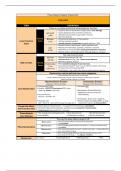
ATI MENTAL HEALTH 2021
UPDATED NOTES
,ATI Mental Health
LOC
Alert: responsive, answer questions appropriately, opens eyes spontaneously.
Lethargic: open their eyes, can answer questions but easily falls asleep.
Stupor: barely responds to painful stimuli (like rubbing the patients’ sternum)
Comatose: unconscious/does not respond to painful stimuli
Decorticate: flexion/ internal rotation of upper extremities, joints and legs
Decerebrate: neck/elbows extension, wrist and finger flexion
Torts: unintentional torts- negligence: forgetting to set the bed alarm for a patient who is at risk for
falling and falls out of bed.
Malpractice- giving the wrong medication to the patient, error that harms the patient.
Intentional torts:
Assault vs Battery:
Assault is if you threaten someone, “If you do not take this pill, I will smack you.”
Battery: when you actually hurt someone, “You actually act by smacking the patient.”
False imprisonment: Nurse will purposely restrain the patient or give them a chemical to a pt.
for the nurse convenience, instead of doing alternatives techniques.
Six Ethical Principles
Beneficence – Doing good by the patient, what is best for the patient. Making the patient feel
safe in the environment that their in.
Autonomy- respecting their rights by what they decide for their health care. Clients making
decisions but the patient must accept consequences of those decisions.
*Veracity- truthfulness “Being honest with the patient’s treatment”
Justice- fair/equal rights for everyone.
*Fidelity- being loyal to the patient, keeping promises.
Non-maleficence: Doing No Harm
Legal Rights of the patients in Mental Health
Pt has the right to refuse treatment even if they’re in a mental health facility.
Pts confidentiality: HIPPA: cannot be released without the consent of the patient
If someone calls the unit asking about the patient refer them to contact the patient’s
family regarding the patient well being
Over hear a conversation in a public place: tell them to go have the conversation in a
private setting.
Mandated that abuse is reported, with a child or an older adult.
Our duty to warn third parties if they’re at risk for harm.
, Informed Consent: Provider:
Communicate the purpose of the procedure
Give a clear description of the procedure in the patient primary language.
Explain the risks vs the benefits
Other options in treating the condition
RN Role:
make sure the provider gives this information to the patient.
Pt is competent in receiving the information, they must be an adult or an emancipated
child, THERE CAN BE NO IMPAIRMENTS!
If they do not understand the information then we do not answer the questions, have
the provider answer the questions.
Restraints:
Physical- vest, belt, and mittens. LAST RESORT
Chemical- sedative/antipsychotic medications
Alternatives before restraints: verbal interventions, calm/quiet environment, diversions.
Prescriptions must be written
Write an order for restraints to be placed on patient. If the orders need to be renewed it has to
be renewed within 24 hours.
Care for the Patient:
Assessing the patient vital signs q 15 mins
Offer them food and fluid- Every hour
Make sure they get the chance to toilet- Every hour
Monitor vital signs.
Emergency Restraints Placed:
get an order from the doctor within 15-30 mins
Time limits: 18 and older: 4 hours, 9-17: 2 hours, 8 and under= 1-hour, extra documentation:
event that caused the restraints to be placed, alternative interventions that were attempted,
time treatment began, med administered, patient assessment including current behavior, v/s,
pain. Pts care provided: food, helping them to the bathroom.
Therapeutic Communication:
*Always try to get more information from the patient. You never want to shut down
communication between you and the patient. *“Always go for tell me more response”
Intrapersonal communication: self-talk, thinking thoughts, not verbalizing them.
Interpersonal communication: one on one communication with another person.
UPDATED NOTES
,ATI Mental Health
LOC
Alert: responsive, answer questions appropriately, opens eyes spontaneously.
Lethargic: open their eyes, can answer questions but easily falls asleep.
Stupor: barely responds to painful stimuli (like rubbing the patients’ sternum)
Comatose: unconscious/does not respond to painful stimuli
Decorticate: flexion/ internal rotation of upper extremities, joints and legs
Decerebrate: neck/elbows extension, wrist and finger flexion
Torts: unintentional torts- negligence: forgetting to set the bed alarm for a patient who is at risk for
falling and falls out of bed.
Malpractice- giving the wrong medication to the patient, error that harms the patient.
Intentional torts:
Assault vs Battery:
Assault is if you threaten someone, “If you do not take this pill, I will smack you.”
Battery: when you actually hurt someone, “You actually act by smacking the patient.”
False imprisonment: Nurse will purposely restrain the patient or give them a chemical to a pt.
for the nurse convenience, instead of doing alternatives techniques.
Six Ethical Principles
Beneficence – Doing good by the patient, what is best for the patient. Making the patient feel
safe in the environment that their in.
Autonomy- respecting their rights by what they decide for their health care. Clients making
decisions but the patient must accept consequences of those decisions.
*Veracity- truthfulness “Being honest with the patient’s treatment”
Justice- fair/equal rights for everyone.
*Fidelity- being loyal to the patient, keeping promises.
Non-maleficence: Doing No Harm
Legal Rights of the patients in Mental Health
Pt has the right to refuse treatment even if they’re in a mental health facility.
Pts confidentiality: HIPPA: cannot be released without the consent of the patient
If someone calls the unit asking about the patient refer them to contact the patient’s
family regarding the patient well being
Over hear a conversation in a public place: tell them to go have the conversation in a
private setting.
Mandated that abuse is reported, with a child or an older adult.
Our duty to warn third parties if they’re at risk for harm.
, Informed Consent: Provider:
Communicate the purpose of the procedure
Give a clear description of the procedure in the patient primary language.
Explain the risks vs the benefits
Other options in treating the condition
RN Role:
make sure the provider gives this information to the patient.
Pt is competent in receiving the information, they must be an adult or an emancipated
child, THERE CAN BE NO IMPAIRMENTS!
If they do not understand the information then we do not answer the questions, have
the provider answer the questions.
Restraints:
Physical- vest, belt, and mittens. LAST RESORT
Chemical- sedative/antipsychotic medications
Alternatives before restraints: verbal interventions, calm/quiet environment, diversions.
Prescriptions must be written
Write an order for restraints to be placed on patient. If the orders need to be renewed it has to
be renewed within 24 hours.
Care for the Patient:
Assessing the patient vital signs q 15 mins
Offer them food and fluid- Every hour
Make sure they get the chance to toilet- Every hour
Monitor vital signs.
Emergency Restraints Placed:
get an order from the doctor within 15-30 mins
Time limits: 18 and older: 4 hours, 9-17: 2 hours, 8 and under= 1-hour, extra documentation:
event that caused the restraints to be placed, alternative interventions that were attempted,
time treatment began, med administered, patient assessment including current behavior, v/s,
pain. Pts care provided: food, helping them to the bathroom.
Therapeutic Communication:
*Always try to get more information from the patient. You never want to shut down
communication between you and the patient. *“Always go for tell me more response”
Intrapersonal communication: self-talk, thinking thoughts, not verbalizing them.
Interpersonal communication: one on one communication with another person.