

Atoms, elements & compounds
Element :
pure substance cannot be divided into a simpler form & consists
of only cannot
one type of atom & it be separated by
' '
physical means
↳ physical methods
Compound :
pure substance that consists of two more types of elements in a
fixed ratio & can be separated only by chemical methods
↳ specific
proportion
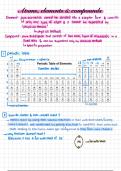
1 periodic table
+1 O
- Group number = Valency non-metals
I +2 +
3 -
y -
3 -
2 -
1
Transition metals
2
I &
3
4
.
5
6
period number
↳ metals
2 How do metals & non-metals react ?
>
- metals react by losing their valence electrons in their outermost shells forming
tions (cations) non-metals react by electrons to complete their outermost
,
gaining
shells leading to electronic noble
gas configuration & they form -
ions (Anions (
Hellium doesn't react ?
>
- Why
O
Because it has a full outershell of ze-
He >
- full outershell
O
, 3 Atoms -> smallest particle that can take part in chemical reactions
Why do atoms have an
> electrons
-
-
overall charge of zero ?
>Protona
-
- electrons are located in
-
Number of protons =
the orbits around the atom
Numberof electrons
in it& their charge is
revolving -
-
protons are located inside the atom
& they're the number of - & their is
equal to charge +
- Neutrons are located inside the atom &
their relative charge is zero
↑ Metals reactions & non-metals
>
- Metals react by bonding ionic compounds ,
in which they react with a non-metal to become
stable ,
the metal loses electrons & the electrons are transferred to the non-metal ,
metals
form positive ions , non-metals form negative ions
5 lonic compounds >
- They're strong electrostatic forces of attraction between
oppositely charged atoms due to transfer of electrons
-
g OX
>
- shows valence electrons only
A
X Cl * lons : electrically charged
particle formed by the
loss & gain of electrons
XX
- sodium has one electron at its
+
-
-
-
-
00
-
outershell , while Chlorine needs
X
one more electron to become
O
G Nag & C Stable
So , they both react together to
00 XX form
- - - -
an ionic compound Where
L S electrons are transferred from
>
-
NACI sodium Chloride metals to non-metals
>
-
Between oppositely charged atoms
Element :
pure substance cannot be divided into a simpler form & consists
of only cannot
one type of atom & it be separated by
' '
physical means
↳ physical methods
Compound :
pure substance that consists of two more types of elements in a
fixed ratio & can be separated only by chemical methods
↳ specific
proportion
1 periodic table
+1 O
- Group number = Valency non-metals
I +2 +
3 -
y -
3 -
2 -
1
Transition metals
2
I &
3
4
.
5
6
period number
↳ metals
2 How do metals & non-metals react ?
>
- metals react by losing their valence electrons in their outermost shells forming
tions (cations) non-metals react by electrons to complete their outermost
,
gaining
shells leading to electronic noble
gas configuration & they form -
ions (Anions (
Hellium doesn't react ?
>
- Why
O
Because it has a full outershell of ze-
He >
- full outershell
O
, 3 Atoms -> smallest particle that can take part in chemical reactions
Why do atoms have an
> electrons
-
-
overall charge of zero ?
>Protona
-
- electrons are located in
-
Number of protons =
the orbits around the atom
Numberof electrons
in it& their charge is
revolving -
-
protons are located inside the atom
& they're the number of - & their is
equal to charge +
- Neutrons are located inside the atom &
their relative charge is zero
↑ Metals reactions & non-metals
>
- Metals react by bonding ionic compounds ,
in which they react with a non-metal to become
stable ,
the metal loses electrons & the electrons are transferred to the non-metal ,
metals
form positive ions , non-metals form negative ions
5 lonic compounds >
- They're strong electrostatic forces of attraction between
oppositely charged atoms due to transfer of electrons
-
g OX
>
- shows valence electrons only
A
X Cl * lons : electrically charged
particle formed by the
loss & gain of electrons
XX
- sodium has one electron at its
+
-
-
-
-
00
-
outershell , while Chlorine needs
X
one more electron to become
O
G Nag & C Stable
So , they both react together to
00 XX form
- - - -
an ionic compound Where
L S electrons are transferred from
>
-
NACI sodium Chloride metals to non-metals
>
-
Between oppositely charged atoms


