Biomolecules: The Building Blocks of Life
Biomolecules are organic molecules that form the building blocks of living
organisms and control their biological processes. They are primarily composed
of carbon (C), hydrogen (H), oxygen (O), nitrogen (N), phosphorus (P),
and sulfur (S).
These molecules are generally categorized into four major classes:
Carbohydrates, Proteins, Lipids, and Nucleic Acids.
1. Carbohydrates
Carbohydrates are polyhydroxy aldehydes or ketones, also called
saccharides. They serve as primary energy sources and structural components.
Structure:
• Monosaccharides: Simple sugars like glucose (C6H12O6). Can exist in
open-chain or cyclic (Haworth) forms.
• Disaccharides: Two monosaccharide units joined by a glycosidic
linkage (e.g., sucrose, lactose).
• Polysaccharides: Long chains such as starch, glycogen, and
cellulose.
Properties:
• Physical: Monosaccharides and disaccharides are usually crystalline
solids, soluble in water, and sweet to taste.
• Chemical Reactions:
• Oxidation: Reducing sugars (like glucose) react with Tollen’s
reagent or Fehling’s solution to form gluconic acid.
• Hydrolysis: Polysaccharides break down into monosaccharides in
the presence of water and enzymes.
• Acetylation: Reaction with acetic anhydride forms
pentaacetates, indicating five hydroxyl (-OH) groups.
2. Proteins
Proteins are polymers of amino acids linked by peptide bonds. They are
essential for structure, catalysis (enzymes), and transport.
Structure:
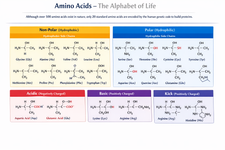
• Amino Acids: Contain an amino group (-NH2), a carboxyl group (-COOH),
and a variable side chain (R).
• Levels of Organization:
• Primary: Linear sequence of amino acids.
, • Secondary: α-helices and β-pleated sheets stabilized by
hydrogen bonds.
• Tertiary/Quaternary: Complex 3D folding and multi-subunit
assemblies.
Properties:
• Physical: Proteins can be fibrous (insoluble, e.g., keratin) or globular
(soluble, e.g., albumin). They exhibit amphoteric behavior due to both
acidic and basic groups.
• Chemical Reactions:
• Denaturation: Loss of 3D structure by heat, pH changes, or
chemicals → loss of biological activity.
• Ninhydrin Reaction: Produces a purple color, used to detect
proteins.
• Xanthoproteic Reaction: Reaction with concentrated nitric acid
produces yellow color, indicating aromatic amino acids.
3. Lipids
Lipids are hydrophobic molecules including fats, oils, waxes, and steroids.
Structure:
• Triglycerides: One glycerol molecule + three fatty acids joined by ester
linkages.
• Phospholipids: Two fatty acids + a phosphate group; they are
amphipathic (hydrophilic head and hydrophobic tail).
Properties:
• Physical: Insoluble in water but soluble in organic solvents (ether,
chloroform). Fats are solid at room temperature; oils are liquid.
• Chemical Reactions:
• Saponification: Hydrolysis of triglycerides with alkali (NaOH) →
glycerol + soap (fatty acid salts).
• Hydrogenation: Addition of hydrogen to unsaturated fats (oils) →
saturated fats (solid), used in margarine production.
• Rancidification: Oxidation of unsaturated fatty acids → unpleasant
odors.
4. Nucleic Acids
Nucleic acids (DNA and RNA) are the genetic blueprints of life, composed of
monomers called nucleotides.
Structure: Each nucleotide has:
1. Pentose Sugar: Deoxyribose (DNA) or Ribose (RNA).
2. Phosphate Group
, 3. Nitrogenous Base: Adenine (A), Guanine (G), Cytosine (C), Thymine (T
in DNA) or Uracil (U in RNA)
Properties:
• Physical: Highly viscous in solution; absorbs UV light at 260 nm.
• Chemical Reactions:
• Hydrolysis: Complete hydrolysis yields sugar, phosphoric acid,
and nitrogenous bases.
• Hydrogen Bonding: Specific base pairing (A with T/U, C with G)
stabilizes the double helix and allows accurate replication.
Monosaccharides: The Simplest Carbohydrates
Monosaccharides are simple sugars that cannot be hydrolyzed into smaller
carbohydrates. They are the basic building blocks of carbohydrates and are
chemically defined by a single polyhydroxy aldehyde or ketone chain.
General Characteristics
• General Formula: (CH2O)n (where n ≥ 3)
• Functional Groups:
• One carbonyl group (C=O)
• Multiple hydroxyl groups (-OH)
• Classification:
• Aldoses: Aldehyde group at C1
• Ketoses: Ketone group, usually at C2
Common Monosaccharides
Monosaccharides are mainly hexoses (C6H12O6) and pentoses (C5H10O5).
1. Glucose (Aldohexose)
• Function: Primary energy source for cells; product of photosynthesis.
• Molecular Formula: C6H12O6
• Open-Chain Structure (Fischer Projection):
CHO
|
H-C-OH
|
HO-C-H
|
H-C-OH
|
H-C-OH
|
, CH2OH
2. Fructose (Ketohexose)
• Function: Sweetest natural sugar; isomer of glucose.
• Molecular Formula: C6H12O6
• Open-Chain Structure (Fischer Projection):
CH2OH
|
C=O
|
HO-C-H
|
H-C-OH
|
H-C-OH
|
CH2OH
3. Galactose (Aldohexose)
• Function: Component of lactose (milk sugar); C4-epimer of glucose.
• Molecular Formula: C6H12O6
• Open-Chain Structure (Fischer Projection):
CHO
|
H-C-OH
|
HO-C-H
|
HO-C-H ← differs from glucose at C4
|
H-C-OH
|
CH2OH
4. Ribose (Aldopentose)
• Function: Structural component of RNA and ATP.
• Molecular Formula: C5H10O5
• Open-Chain Structure (Fischer Projection):
CHO
|
H-C-OH
|
H-C-OH
|
H-C-OH
|
CH2OH
Biomolecules are organic molecules that form the building blocks of living
organisms and control their biological processes. They are primarily composed
of carbon (C), hydrogen (H), oxygen (O), nitrogen (N), phosphorus (P),
and sulfur (S).
These molecules are generally categorized into four major classes:
Carbohydrates, Proteins, Lipids, and Nucleic Acids.
1. Carbohydrates
Carbohydrates are polyhydroxy aldehydes or ketones, also called
saccharides. They serve as primary energy sources and structural components.
Structure:
• Monosaccharides: Simple sugars like glucose (C6H12O6). Can exist in
open-chain or cyclic (Haworth) forms.
• Disaccharides: Two monosaccharide units joined by a glycosidic
linkage (e.g., sucrose, lactose).
• Polysaccharides: Long chains such as starch, glycogen, and
cellulose.
Properties:
• Physical: Monosaccharides and disaccharides are usually crystalline
solids, soluble in water, and sweet to taste.
• Chemical Reactions:
• Oxidation: Reducing sugars (like glucose) react with Tollen’s
reagent or Fehling’s solution to form gluconic acid.
• Hydrolysis: Polysaccharides break down into monosaccharides in
the presence of water and enzymes.
• Acetylation: Reaction with acetic anhydride forms
pentaacetates, indicating five hydroxyl (-OH) groups.
2. Proteins
Proteins are polymers of amino acids linked by peptide bonds. They are
essential for structure, catalysis (enzymes), and transport.
Structure:
• Amino Acids: Contain an amino group (-NH2), a carboxyl group (-COOH),
and a variable side chain (R).
• Levels of Organization:
• Primary: Linear sequence of amino acids.
, • Secondary: α-helices and β-pleated sheets stabilized by
hydrogen bonds.
• Tertiary/Quaternary: Complex 3D folding and multi-subunit
assemblies.
Properties:
• Physical: Proteins can be fibrous (insoluble, e.g., keratin) or globular
(soluble, e.g., albumin). They exhibit amphoteric behavior due to both
acidic and basic groups.
• Chemical Reactions:
• Denaturation: Loss of 3D structure by heat, pH changes, or
chemicals → loss of biological activity.
• Ninhydrin Reaction: Produces a purple color, used to detect
proteins.
• Xanthoproteic Reaction: Reaction with concentrated nitric acid
produces yellow color, indicating aromatic amino acids.
3. Lipids
Lipids are hydrophobic molecules including fats, oils, waxes, and steroids.
Structure:
• Triglycerides: One glycerol molecule + three fatty acids joined by ester
linkages.
• Phospholipids: Two fatty acids + a phosphate group; they are
amphipathic (hydrophilic head and hydrophobic tail).
Properties:
• Physical: Insoluble in water but soluble in organic solvents (ether,
chloroform). Fats are solid at room temperature; oils are liquid.
• Chemical Reactions:
• Saponification: Hydrolysis of triglycerides with alkali (NaOH) →
glycerol + soap (fatty acid salts).
• Hydrogenation: Addition of hydrogen to unsaturated fats (oils) →
saturated fats (solid), used in margarine production.
• Rancidification: Oxidation of unsaturated fatty acids → unpleasant
odors.
4. Nucleic Acids
Nucleic acids (DNA and RNA) are the genetic blueprints of life, composed of
monomers called nucleotides.
Structure: Each nucleotide has:
1. Pentose Sugar: Deoxyribose (DNA) or Ribose (RNA).
2. Phosphate Group
, 3. Nitrogenous Base: Adenine (A), Guanine (G), Cytosine (C), Thymine (T
in DNA) or Uracil (U in RNA)
Properties:
• Physical: Highly viscous in solution; absorbs UV light at 260 nm.
• Chemical Reactions:
• Hydrolysis: Complete hydrolysis yields sugar, phosphoric acid,
and nitrogenous bases.
• Hydrogen Bonding: Specific base pairing (A with T/U, C with G)
stabilizes the double helix and allows accurate replication.
Monosaccharides: The Simplest Carbohydrates
Monosaccharides are simple sugars that cannot be hydrolyzed into smaller
carbohydrates. They are the basic building blocks of carbohydrates and are
chemically defined by a single polyhydroxy aldehyde or ketone chain.
General Characteristics
• General Formula: (CH2O)n (where n ≥ 3)
• Functional Groups:
• One carbonyl group (C=O)
• Multiple hydroxyl groups (-OH)
• Classification:
• Aldoses: Aldehyde group at C1
• Ketoses: Ketone group, usually at C2
Common Monosaccharides
Monosaccharides are mainly hexoses (C6H12O6) and pentoses (C5H10O5).
1. Glucose (Aldohexose)
• Function: Primary energy source for cells; product of photosynthesis.
• Molecular Formula: C6H12O6
• Open-Chain Structure (Fischer Projection):
CHO
|
H-C-OH
|
HO-C-H
|
H-C-OH
|
H-C-OH
|
, CH2OH
2. Fructose (Ketohexose)
• Function: Sweetest natural sugar; isomer of glucose.
• Molecular Formula: C6H12O6
• Open-Chain Structure (Fischer Projection):
CH2OH
|
C=O
|
HO-C-H
|
H-C-OH
|
H-C-OH
|
CH2OH
3. Galactose (Aldohexose)
• Function: Component of lactose (milk sugar); C4-epimer of glucose.
• Molecular Formula: C6H12O6
• Open-Chain Structure (Fischer Projection):
CHO
|
H-C-OH
|
HO-C-H
|
HO-C-H ← differs from glucose at C4
|
H-C-OH
|
CH2OH
4. Ribose (Aldopentose)
• Function: Structural component of RNA and ATP.
• Molecular Formula: C5H10O5
• Open-Chain Structure (Fischer Projection):
CHO
|
H-C-OH
|
H-C-OH
|
H-C-OH
|
CH2OH