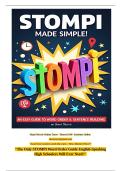
Shani Morris Online Tutor– Tutored 100+ Students Online
“Learn how to place words like a pro – Time, Manner, Place!”
"The Only STOMPI Word Order Guide English-Speaking
High Schoolers Will Ever Need!"
, Table of Contents
1. What is a Simple Sentence? (Enkelvoudige sin)
2. Emphasis, Questions, Imperatives and Sentence Types
3. Adding Adverbial Phrases (Bywoordelike bepalings)
4. Word Order with Adverbs (T/M/P Rule)
5. How to Identify and Use Adverbial Phrases (Bywoordelike bepalings)
6. Practice Exercise
7. Summary of Key Points
8. Die infinitief (infinitive)
9. What is “STOMPI”? (Explained Simply)
10. How Does Stompi Work?
11.The Basic Stompi Rule:
12. Quick Tips to Remember.?
13. Why is it called "Stompi"?
14. What is "Stompi"?
15. How Does Stompi Work?
🎵🎶
16. The Stompi Rule in Action:
17. The STOMPI Song (Fun Learning Rhyme) ♪ ♫ 𝄞♬
18. How to Remember STOMPI
19. Common Stompi mistakes
20. LET’S Practise COMMON MISTAKES AGAIN! This is
important!
, 1. What is a Simple Sentence? (Enkelvoudige sin)
In Afrikaans, a simple sentence consists of three main components:
Subject–Verb–Object word order
• Onderwerp (Subject)
• Werkwoord (Verb)
• Voorwerp (Object)
Example:
• Die man eet die appel. (The man eats the apple.)
• Onderwerp (Subject): Die man (The man)
• Werkwoord (Verb): eet (eats)
• Voorwerp (Object): die appel (the apple)
In Afrikaans grammar, the subject and object follow a straightforward Subject-Verb-Object (SVO)
structure similar to English, making them easy to spot in simple sentences.
Subject (Onderwerp)
The subject is the person, animal, or thing performing the action of the verb. It typically comes first
in declarative sentences and can be a noun (e.g., "Die hond" = The Dog) or pronoun (e.g., "Ek" = I,
"Hy" = he).
To identify it, ask "Who or what is doing the action?" For example, in "Die kind eet die appel" (The
child eats the apple), "Die kind" is the subject because it performs the eating.
Object (Voorwerp)
The object is the person, animal, or thing receiving the action of the verb, usually coming right after
the verb. It can be a noun (e.g., "die bal" = the ball) or pronoun (e.g., "hom" = him, "haar" = her).
To identify it, ask "What or whom is the action done to?" In "Ek sien die boek" (I see the book),
"die boek" is the object because it's being seen.
Werkwoord en Gesegte (Verb and Predicte)
A verb (werkwoord) is the heart of the predicate. It shows action, possession, state or occurrence,
e.g., "hardloop" (run) or "eet" (eat).
The predicate (gesegde) is the full phrase with the verb(s) plus any extras, giving the sentence's key
message.
Key Difference
A verbal predicate (gesegte) uses all the verbs in the sentence to show what happens, e.g., "She ran"
Sy het gehardloop - het gehardloop is the predicate (gesegte)
Think of the verb (werkwoord) as one player; the predicate (gesegte) is the whole team.
“Learn how to place words like a pro – Time, Manner, Place!”
"The Only STOMPI Word Order Guide English-Speaking
High Schoolers Will Ever Need!"
, Table of Contents
1. What is a Simple Sentence? (Enkelvoudige sin)
2. Emphasis, Questions, Imperatives and Sentence Types
3. Adding Adverbial Phrases (Bywoordelike bepalings)
4. Word Order with Adverbs (T/M/P Rule)
5. How to Identify and Use Adverbial Phrases (Bywoordelike bepalings)
6. Practice Exercise
7. Summary of Key Points
8. Die infinitief (infinitive)
9. What is “STOMPI”? (Explained Simply)
10. How Does Stompi Work?
11.The Basic Stompi Rule:
12. Quick Tips to Remember.?
13. Why is it called "Stompi"?
14. What is "Stompi"?
15. How Does Stompi Work?
🎵🎶
16. The Stompi Rule in Action:
17. The STOMPI Song (Fun Learning Rhyme) ♪ ♫ 𝄞♬
18. How to Remember STOMPI
19. Common Stompi mistakes
20. LET’S Practise COMMON MISTAKES AGAIN! This is
important!
, 1. What is a Simple Sentence? (Enkelvoudige sin)
In Afrikaans, a simple sentence consists of three main components:
Subject–Verb–Object word order
• Onderwerp (Subject)
• Werkwoord (Verb)
• Voorwerp (Object)
Example:
• Die man eet die appel. (The man eats the apple.)
• Onderwerp (Subject): Die man (The man)
• Werkwoord (Verb): eet (eats)
• Voorwerp (Object): die appel (the apple)
In Afrikaans grammar, the subject and object follow a straightforward Subject-Verb-Object (SVO)
structure similar to English, making them easy to spot in simple sentences.
Subject (Onderwerp)
The subject is the person, animal, or thing performing the action of the verb. It typically comes first
in declarative sentences and can be a noun (e.g., "Die hond" = The Dog) or pronoun (e.g., "Ek" = I,
"Hy" = he).
To identify it, ask "Who or what is doing the action?" For example, in "Die kind eet die appel" (The
child eats the apple), "Die kind" is the subject because it performs the eating.
Object (Voorwerp)
The object is the person, animal, or thing receiving the action of the verb, usually coming right after
the verb. It can be a noun (e.g., "die bal" = the ball) or pronoun (e.g., "hom" = him, "haar" = her).
To identify it, ask "What or whom is the action done to?" In "Ek sien die boek" (I see the book),
"die boek" is the object because it's being seen.
Werkwoord en Gesegte (Verb and Predicte)
A verb (werkwoord) is the heart of the predicate. It shows action, possession, state or occurrence,
e.g., "hardloop" (run) or "eet" (eat).
The predicate (gesegde) is the full phrase with the verb(s) plus any extras, giving the sentence's key
message.
Key Difference
A verbal predicate (gesegte) uses all the verbs in the sentence to show what happens, e.g., "She ran"
Sy het gehardloop - het gehardloop is the predicate (gesegte)
Think of the verb (werkwoord) as one player; the predicate (gesegte) is the whole team.