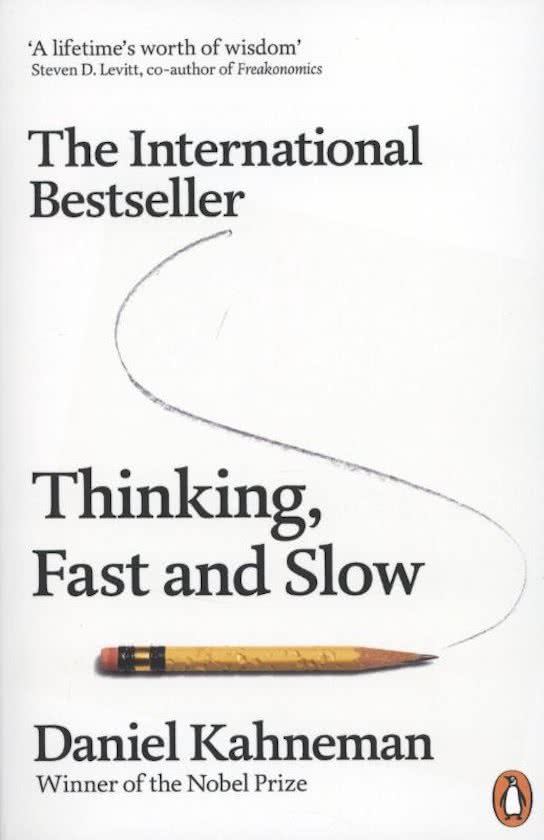
Thinking, Fast and Slow
Part 1: Two system
Chapter 1 – The characters of the story
There are two systems whilst thinking, System 1 and System 2.
System 1: operates automatically and quickly, with little or no effort and no sense of
voluntarily control.
System 2: allocates attention to the effortful mental activities that demand it, including
complex computations, it demands concentration.
System 2 takes actions ‘suggested’ by system 1.
Limitations:
You don’t know where System 1 and 2 start/end
Limited predictive power
Not clear where each system is in the body
Chapter 2 – Attention and effort
System 1 causes you to see visual- or cognitive illusions, and you have to use system 2 to
know that it is an illusion and thus not real.
The pupil of the eye widens when you are using System 2 (window to the soul), your heart
rate also goes up.
System 2 has a limited capacity, and it tries to stop itself from overflowing by dividing a task
up into smaller tasks. In an emergency, when there is no time System 1 takes over all actions
to self-protect.
Practicing an action lowers the amount of mental energy it needs (executive control). And
switching rapidly from different tasks requires more mental energy.
Chapter 3 – The lazy controller
Walking or other physical activities cost mental energy, and might be stopped when having
to use System 2. Deliberate thought and self-control draws from our limited budget pool.
Being disciplined for a longer period of time can be very tiring, unless you are in the flow, in
which case you can expand considerable effort for a longer period of time without having to
exert willpower, this can happened whilst painting, writing, or playing chess.
, When System 2 is busy, System 1 can take over decisions but it has less self-control, causing
you to have a sweet tooth, use sexist language or be more selfish.
If you are less willing to do something, it takes more energy and discipline to do so, you are
then less willing do to another task that requires discipline or self-control. (ego depletion).
Hunger and tiredness can also cause ego depletion.
When involved in cognitive reasoning, your nervous system uses glucose, lowering your
glucose level, consuming glucose might counteract ego depletion.
How closely does System 2 monitor System 1’s suggestions? When people believe something
is true, they will look for any kind of ‘evidence’ that supports it. When System 1 is involved,
conclusions come first and arguments follow.
Even though most people can solve easy riddles, because people can be lazy, they will accept
the quickest and easiest option, without thinking about it with System 2.
Chapter 4 – The associative machine
Seeing a disgusting word such as vomit causes System 1 to create memories, which causes
emotions, which causes a facial look, increasing the emotions ever more, this is called
associatively coherent. You think with your body, not only with your brain, our brain is
cognition embodied.
In our associative memory network, each word is linked to others lime -> green, pear -> fruit.
Most of the associative thinking is silent, only a few words make it to our consciousness.
The priming effect states that words such as SOUP prime from EAT and WASH from SOAP.
With the word EAT in your head, you are more likely to hear the words such as FOOD, KNIFE,
SOUP and others in a crowd or as a whisper.
We are not aware that out behavior is affected.
We cannot consciously remember the original encounter.
The ‘Florida effect’ involves 2 stages of priming, first words such as grey, or bold, which
prima from old, and then they prime into behavior, such as walking slowly. (ideomotor
effect). It also works the in reverse, smiling makes you happier.
The ‘lady Macbeth effect suggests’ that people wants to cleanse themselves ones their soul
has been stained. This is body part specific.
Priming phenomena arise unconsciously in System 1, causing our System 2 to think that we
are not subjective to priming, even though we all are.
Chapter 6 – Norms, surprises, and causes
When something abnormal happens, other consequential following abnormalities will now
be more normal, because they are valued in conjunction with the original occurrence.
Part 1: Two system
Chapter 1 – The characters of the story
There are two systems whilst thinking, System 1 and System 2.
System 1: operates automatically and quickly, with little or no effort and no sense of
voluntarily control.
System 2: allocates attention to the effortful mental activities that demand it, including
complex computations, it demands concentration.
System 2 takes actions ‘suggested’ by system 1.
Limitations:
You don’t know where System 1 and 2 start/end
Limited predictive power
Not clear where each system is in the body
Chapter 2 – Attention and effort
System 1 causes you to see visual- or cognitive illusions, and you have to use system 2 to
know that it is an illusion and thus not real.
The pupil of the eye widens when you are using System 2 (window to the soul), your heart
rate also goes up.
System 2 has a limited capacity, and it tries to stop itself from overflowing by dividing a task
up into smaller tasks. In an emergency, when there is no time System 1 takes over all actions
to self-protect.
Practicing an action lowers the amount of mental energy it needs (executive control). And
switching rapidly from different tasks requires more mental energy.
Chapter 3 – The lazy controller
Walking or other physical activities cost mental energy, and might be stopped when having
to use System 2. Deliberate thought and self-control draws from our limited budget pool.
Being disciplined for a longer period of time can be very tiring, unless you are in the flow, in
which case you can expand considerable effort for a longer period of time without having to
exert willpower, this can happened whilst painting, writing, or playing chess.
, When System 2 is busy, System 1 can take over decisions but it has less self-control, causing
you to have a sweet tooth, use sexist language or be more selfish.
If you are less willing to do something, it takes more energy and discipline to do so, you are
then less willing do to another task that requires discipline or self-control. (ego depletion).
Hunger and tiredness can also cause ego depletion.
When involved in cognitive reasoning, your nervous system uses glucose, lowering your
glucose level, consuming glucose might counteract ego depletion.
How closely does System 2 monitor System 1’s suggestions? When people believe something
is true, they will look for any kind of ‘evidence’ that supports it. When System 1 is involved,
conclusions come first and arguments follow.
Even though most people can solve easy riddles, because people can be lazy, they will accept
the quickest and easiest option, without thinking about it with System 2.
Chapter 4 – The associative machine
Seeing a disgusting word such as vomit causes System 1 to create memories, which causes
emotions, which causes a facial look, increasing the emotions ever more, this is called
associatively coherent. You think with your body, not only with your brain, our brain is
cognition embodied.
In our associative memory network, each word is linked to others lime -> green, pear -> fruit.
Most of the associative thinking is silent, only a few words make it to our consciousness.
The priming effect states that words such as SOUP prime from EAT and WASH from SOAP.
With the word EAT in your head, you are more likely to hear the words such as FOOD, KNIFE,
SOUP and others in a crowd or as a whisper.
We are not aware that out behavior is affected.
We cannot consciously remember the original encounter.
The ‘Florida effect’ involves 2 stages of priming, first words such as grey, or bold, which
prima from old, and then they prime into behavior, such as walking slowly. (ideomotor
effect). It also works the in reverse, smiling makes you happier.
The ‘lady Macbeth effect suggests’ that people wants to cleanse themselves ones their soul
has been stained. This is body part specific.
Priming phenomena arise unconsciously in System 1, causing our System 2 to think that we
are not subjective to priming, even though we all are.
Chapter 6 – Norms, surprises, and causes
When something abnormal happens, other consequential following abnormalities will now
be more normal, because they are valued in conjunction with the original occurrence.