Atoms, elements and compounds
3.1 Atomic structure and the Periodic Table
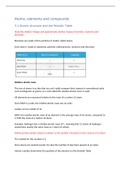
State the relative charges and approximate relative masses of protons, neutrons and
electrons
Elements are made of tiny particles of matter called atoms.
Each atom is made of subatomic particles called protons, neutrons and electrons.
Relative atomic mass
The size of atoms is so tiny that we can’t really compare their masses in conventional units
such as kilograms or grams, so a unit called the relative atomic mass is used.
All elements are measured relative to the mass of a carbon-12 atom.
Since RAM is a ratio, the relative atomic mass has no units.
Carbon-12 has a RAM of 12.
RAM: the relative atomic mass of an element is the average mass of its atoms, compared to
1/12th the mass of a carbon-12 atom.
Example: hydrogen has a relative atomic mass of 1, meaning that 12 atoms of hydrogen
would have exactly the same mass as 1 atom of carbon.
Define proton number (atomic number) as the number of protons in the nucleus of an atom
The symbol for this number is Z.
Since atoms are neutral overall, it is also the number of electrons present in an atom.
Atomic number determines the position of the element on the Periodic Table.
,Define nucleon number (mass number) as the total number of protons and neutrons in the
nucleus of an atom
The symbol for this number is A.
The nucleon number minus the proton number gives you the number of neutrons of an
atom.
Note that protons and neutrons can collectively be called nucleons.
Use proton number and the simple structure of atoms to explain the basis of the Periodic
Table (see section 9), with special reference to the elements of proton number 1 to 20
Elements are arranged on the Periodic table in order of increasing atomic number where
each element has one proton more than the element preceding it.
The table is arranged in vertical columns called Groups numbered I – VIII and in rows called
Periods.
Elements in the same group have the same number of electrons in their outer shell, which
gives them similar chemical properties.
, Define isotopes as atoms of the same element which have the same proton number but a
different nucleon number
Isotopes are atoms of the same element that contain the same number of protons and
electrons but a different number of neutrons.
The symbol for an isotope is the chemical symbol (or word) followed by a dash and then the
mass number.
Example: C-14 is the isotope of carbon which contains 6 protons, 6 electrons and 14 – 6 = 8
neutrons.
3.1 Atomic structure and the Periodic Table
State the relative charges and approximate relative masses of protons, neutrons and
electrons
Elements are made of tiny particles of matter called atoms.
Each atom is made of subatomic particles called protons, neutrons and electrons.
Relative atomic mass
The size of atoms is so tiny that we can’t really compare their masses in conventional units
such as kilograms or grams, so a unit called the relative atomic mass is used.
All elements are measured relative to the mass of a carbon-12 atom.
Since RAM is a ratio, the relative atomic mass has no units.
Carbon-12 has a RAM of 12.
RAM: the relative atomic mass of an element is the average mass of its atoms, compared to
1/12th the mass of a carbon-12 atom.
Example: hydrogen has a relative atomic mass of 1, meaning that 12 atoms of hydrogen
would have exactly the same mass as 1 atom of carbon.
Define proton number (atomic number) as the number of protons in the nucleus of an atom
The symbol for this number is Z.
Since atoms are neutral overall, it is also the number of electrons present in an atom.
Atomic number determines the position of the element on the Periodic Table.
,Define nucleon number (mass number) as the total number of protons and neutrons in the
nucleus of an atom
The symbol for this number is A.
The nucleon number minus the proton number gives you the number of neutrons of an
atom.
Note that protons and neutrons can collectively be called nucleons.
Use proton number and the simple structure of atoms to explain the basis of the Periodic
Table (see section 9), with special reference to the elements of proton number 1 to 20
Elements are arranged on the Periodic table in order of increasing atomic number where
each element has one proton more than the element preceding it.
The table is arranged in vertical columns called Groups numbered I – VIII and in rows called
Periods.
Elements in the same group have the same number of electrons in their outer shell, which
gives them similar chemical properties.
, Define isotopes as atoms of the same element which have the same proton number but a
different nucleon number
Isotopes are atoms of the same element that contain the same number of protons and
electrons but a different number of neutrons.
The symbol for an isotope is the chemical symbol (or word) followed by a dash and then the
mass number.
Example: C-14 is the isotope of carbon which contains 6 protons, 6 electrons and 14 – 6 = 8
neutrons.