Gas exchange in humans
11.1 Gas exchange in humans
List the features of gas exchange surfaces in humans, limited to large surface area, thin
surface, good blood supply and good ventilation with air
The surfaces where gas exchange occurs in an organism are very different and different
organisms have evolved different mechanisms for getting the gases to the gas exchange
surface depending on size, where they live etc.
All gas exchange surfaces have features in common.
These features allow the maximum amount of gases to be exchanged across the surface in
the smallest amount of time.
They include:
Large surface area to allow faster diffusion of gases across the surface
Thin walls to ensure diffusion distances remain short
Good ventilation with air so that diffusion gradients can be maintained
Good blood supply to maintain a high concentration gradient so diffusion occurs
faster
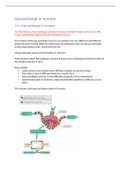
The alveolus is the gas exchange surface in humans:
, Name and identify the lungs, diaphragm, ribs, intercostal muscles, larynx, trachea, bronchi,
bronchioles, alveoli and associated capillaries
11.1 Gas exchange in humans
List the features of gas exchange surfaces in humans, limited to large surface area, thin
surface, good blood supply and good ventilation with air
The surfaces where gas exchange occurs in an organism are very different and different
organisms have evolved different mechanisms for getting the gases to the gas exchange
surface depending on size, where they live etc.
All gas exchange surfaces have features in common.
These features allow the maximum amount of gases to be exchanged across the surface in
the smallest amount of time.
They include:
Large surface area to allow faster diffusion of gases across the surface
Thin walls to ensure diffusion distances remain short
Good ventilation with air so that diffusion gradients can be maintained
Good blood supply to maintain a high concentration gradient so diffusion occurs
faster
The alveolus is the gas exchange surface in humans:
, Name and identify the lungs, diaphragm, ribs, intercostal muscles, larynx, trachea, bronchi,
bronchioles, alveoli and associated capillaries