Transport in plants
8.1 Transport in plants
State the functions of xylem and phloem
Plants contain two types of transport vessel:
Xylem vessels – transport water and minerals from the roots to the stem and leaves
Phloem vessels – transport food materials (mainly sucrose and amino acids) made by
the plant from photosynthesising leaves to non-photosynthesising regions in the
roots and stem
Identify the position of xylem and phloem as seen in sections of roots, stems and leaves,
limited to non-woody dicotyledonous plants
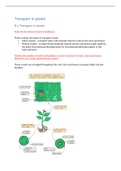
These vessels are arranged throughout the root, stem and leaves in groups called vascular
bundles:
, NOTE if you are asked to identify the xylem or phloem in a diagram showing a cross-section
of a root, stem or leaf just remember that xylem is always on the inside and phloem is
always on the outside.
8.2 Water uptake
Identify root hair cells, as seen under the light microscope, and state their functions
Explain that the large surface area of root hairs increases the rate of the absorption of water
by osmosis and ions by active transport
Root hairs are single-celled extensions of epidermis cells in the root
They grow between soil particles and absorb water and minerals from the soil
Water enters the root hair cells by osmosis
This happens because soil water has a higher water potential than the cytoplasm of
the root hair cell
Importance of large SA: the root hair increases the surface area of the cells significantly. This
large surface area is important as it increases the rate of the absorption of water by osmosis
and mineral ions by active transport
State the pathway taken by water through root, stem and leaf as root hair cells, root cortex
cells, xylem and mesophyll cells
8.1 Transport in plants
State the functions of xylem and phloem
Plants contain two types of transport vessel:
Xylem vessels – transport water and minerals from the roots to the stem and leaves
Phloem vessels – transport food materials (mainly sucrose and amino acids) made by
the plant from photosynthesising leaves to non-photosynthesising regions in the
roots and stem
Identify the position of xylem and phloem as seen in sections of roots, stems and leaves,
limited to non-woody dicotyledonous plants
These vessels are arranged throughout the root, stem and leaves in groups called vascular
bundles:
, NOTE if you are asked to identify the xylem or phloem in a diagram showing a cross-section
of a root, stem or leaf just remember that xylem is always on the inside and phloem is
always on the outside.
8.2 Water uptake
Identify root hair cells, as seen under the light microscope, and state their functions
Explain that the large surface area of root hairs increases the rate of the absorption of water
by osmosis and ions by active transport
Root hairs are single-celled extensions of epidermis cells in the root
They grow between soil particles and absorb water and minerals from the soil
Water enters the root hair cells by osmosis
This happens because soil water has a higher water potential than the cytoplasm of
the root hair cell
Importance of large SA: the root hair increases the surface area of the cells significantly. This
large surface area is important as it increases the rate of the absorption of water by osmosis
and mineral ions by active transport
State the pathway taken by water through root, stem and leaf as root hair cells, root cortex
cells, xylem and mesophyll cells