
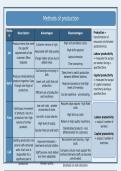
Methods of production
Metho
Description: Advantages: Disadvantages: Production =
d:
transformation of
High unit and labour costs. resources into finished
Produce items that meet Customer service is high.
goods/services.
the specific High skills required.
Job requirements of the Associated with high quality.
Labour productivity
customer. Often Charge higher prices due to Labour-intensive. = measures the output
bespoke. added value. Time-consuming. per worker during a
specified time.
Cost savings via buying in
Takes time to switch production
Produce similar/identical bulk. Capital productivity
between different batches.
products together. Goes Lower unit costs than job = measures the output
Batch Requires business to hold high of capital employed
through one stage of production.
levels of inventory. machinery) during a
production.
Efficient use of production specified time.
Can be repetitive – unmotivating.
and machinery.
Requires large spaces - high fixed
Low unit costs - greater
Continuous movement costs.
economies of scale.
of products. Use of a High start-up costs.
Flow production line. High Low skill, so low salaries. Labour productivity
volume of similar Reliant on high quality machinery. = output / number of
High level of output.
products. workers
Standardised products – less
Quicker than job and batch.
differentiation for customers. Capital productivity
Recruitment and training – high = output / number of
Splitting production into Improved motivation –
costs. machines
several self-contained teamwork and job rotation.
units. Each unit is Company culture must support the
Cell Staff become multi-skilled
responsible for a method otherwise staff can become
and more adaptable.
significant part of unmotivated.
production. Greater quality.
Emphasis on work allocation.
, Link between competition and productivity:
Factors influencing productivity
As productivity increases, business costs decrease,
o Motivation – motivated staff tend to be more meaning businesses can either lower prices or have higher
productive. profit margins. Competitive businesses are likely to have
more financial resources to continue investing in improving
o Training – educated staff are more able to make their productivity.
useful contributions to improve productivity.
o Investments in new technology – improved
automation can improve levels of output and
quality.
o Production method – the type of production
Efficiency - and factors affecting it
Training – educated staff can lead to greater productivity, which Efficiency = ability of a business to use its
in turn can lead to increase efficiency. production resources as cost-effectively as
possible.
Investment in capital equipment – improving machinery and
technology can increase productivity, which can improve o Measured in terms of the average cost per
efficiency. unit.
Relocation – cheaper or smaller locations can reduce fixed costs. o Maximum efficiency = average cost per unit
Lower labour costs and reduced foxed costs will lead to greater at its lowest.
efficiency.
Average cost per unit = total costs / number
Lean production techniques - involves reduction of wastage of units
(time, resources and space).
Most efficient level of production,
Standardisation of production process – when all staff use when:
the same components and techniques.
o Economies of scale maximised
Training minimised - Bulk buying reduces variable costs
Metho
Description: Advantages: Disadvantages: Production =
d:
transformation of
High unit and labour costs. resources into finished
Produce items that meet Customer service is high.
goods/services.
the specific High skills required.
Job requirements of the Associated with high quality.
Labour productivity
customer. Often Charge higher prices due to Labour-intensive. = measures the output
bespoke. added value. Time-consuming. per worker during a
specified time.
Cost savings via buying in
Takes time to switch production
Produce similar/identical bulk. Capital productivity
between different batches.
products together. Goes Lower unit costs than job = measures the output
Batch Requires business to hold high of capital employed
through one stage of production.
levels of inventory. machinery) during a
production.
Efficient use of production specified time.
Can be repetitive – unmotivating.
and machinery.
Requires large spaces - high fixed
Low unit costs - greater
Continuous movement costs.
economies of scale.
of products. Use of a High start-up costs.
Flow production line. High Low skill, so low salaries. Labour productivity
volume of similar Reliant on high quality machinery. = output / number of
High level of output.
products. workers
Standardised products – less
Quicker than job and batch.
differentiation for customers. Capital productivity
Recruitment and training – high = output / number of
Splitting production into Improved motivation –
costs. machines
several self-contained teamwork and job rotation.
units. Each unit is Company culture must support the
Cell Staff become multi-skilled
responsible for a method otherwise staff can become
and more adaptable.
significant part of unmotivated.
production. Greater quality.
Emphasis on work allocation.
, Link between competition and productivity:
Factors influencing productivity
As productivity increases, business costs decrease,
o Motivation – motivated staff tend to be more meaning businesses can either lower prices or have higher
productive. profit margins. Competitive businesses are likely to have
more financial resources to continue investing in improving
o Training – educated staff are more able to make their productivity.
useful contributions to improve productivity.
o Investments in new technology – improved
automation can improve levels of output and
quality.
o Production method – the type of production
Efficiency - and factors affecting it
Training – educated staff can lead to greater productivity, which Efficiency = ability of a business to use its
in turn can lead to increase efficiency. production resources as cost-effectively as
possible.
Investment in capital equipment – improving machinery and
technology can increase productivity, which can improve o Measured in terms of the average cost per
efficiency. unit.
Relocation – cheaper or smaller locations can reduce fixed costs. o Maximum efficiency = average cost per unit
Lower labour costs and reduced foxed costs will lead to greater at its lowest.
efficiency.
Average cost per unit = total costs / number
Lean production techniques - involves reduction of wastage of units
(time, resources and space).
Most efficient level of production,
Standardisation of production process – when all staff use when:
the same components and techniques.
o Economies of scale maximised
Training minimised - Bulk buying reduces variable costs


