Socialism: EQUALITY TENET P291-293
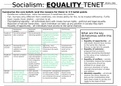
Summarise the core beliefs (and the reasons for them) in 3-5 bullet points
- Reinforces collectivism, more harmonious if conditions are similar.
- Fair, humans only different from conditions, not innate ability for the, to be treated differently. Fulfils
basic needs; food, shelter – common to all.
- Foundational equality – all individuals born with innate human rights – political and legal equality
- Rejection of natural hierarchies – each individual can take up any position in society they want
- Equality of opportunity – all individuals have access to the same chances
What are the key
dichotomies within this
tenet?
1. Equality of opportunity – all
individuals should have access
to the same life chances.
Ensure no barriers for people
2. Equality of outcome –
proposes that economic
rewards should be distributed
to the value of an individual’s
contribution.
3. Equality of welfare – society
is inevitably inequal but argues
that everyone should be
entitled to an equal and
minimum standard of living
through the provision of state
and welfare.
4. Absolute equality – all should
receive the same rewards as
long as the contributions that
have been made to society are
made to the best of their
ability.
Summarise the core beliefs (and the reasons for them) in 3-5 bullet points
- Reinforces collectivism, more harmonious if conditions are similar.
- Fair, humans only different from conditions, not innate ability for the, to be treated differently. Fulfils
basic needs; food, shelter – common to all.
- Foundational equality – all individuals born with innate human rights – political and legal equality
- Rejection of natural hierarchies – each individual can take up any position in society they want
- Equality of opportunity – all individuals have access to the same chances
What are the key
dichotomies within this
tenet?
1. Equality of opportunity – all
individuals should have access
to the same life chances.
Ensure no barriers for people
2. Equality of outcome –
proposes that economic
rewards should be distributed
to the value of an individual’s
contribution.
3. Equality of welfare – society
is inevitably inequal but argues
that everyone should be
entitled to an equal and
minimum standard of living
through the provision of state
and welfare.
4. Absolute equality – all should
receive the same rewards as
long as the contributions that
have been made to society are
made to the best of their
ability.