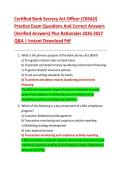
Certified Bank Secrecy Act Officer (CBSAO)
Practice Exam Questions And Correct Answers
(Verified Answers) Plus Rationales 2026 Q&A |
Instant Download Pdf
1. What is the primary purpose of the Bank Secrecy Act (BSA)?
A. To regulate interest rates
B. To prevent money laundering and financial crimes
C. To insure bank deposits
D. To promote consumer lending
Answer: B
The BSA was enacted to detect and prevent money laundering, terrorist
financing, and related financial crimes.
2. Which federal agency administers and enforces the BSA?
A. Federal Reserve
B. FDIC
C. FinCEN
D. OCC
Answer: C
The Financial Crimes Enforcement Network (FinCEN) is responsible for
administering the BSA.
, 3. Which report must be filed for cash transactions exceeding
$10,000 in one business day?
A. SAR
B. CTR
C. FBAR
D. KYC
Answer: B
A Currency Transaction Report (CTR) is required for cash transactions
over $10,000.
4. Structuring is best defined as:
A. Depositing foreign currency
B. Breaking transactions to avoid reporting thresholds
C. Transferring funds internationally
D. Using shell companies
Answer: B
Structuring involves intentionally avoiding reporting requirements such
as CTR thresholds.
5. Which of the following requires a Suspicious Activity Report
(SAR)?
A. Cash deposit of $9,000
B. Any suspicious activity regardless of amount
C. Wire transfer over $3,000
D. ATM withdrawal over $1,000
,Answer: B
Suspicious activity must be reported regardless of dollar amount if
suspicious.
6. SARs must generally be filed within how many calendar days of
detection?
A. 10 days
B. 20 days
C. 30 days
D. 60 days
Answer: C
SARs must generally be filed within 30 calendar days after detection.
7. If no suspect is identified, SAR filing may be extended to:
A. 45 days
B. 60 days
C. 90 days
D. 120 days
Answer: B
When no suspect is identified, institutions may take up to 60 days.
8. Which activity is most indicative of money laundering?
A. Regular payroll deposits
B. Large cash-intensive business activity without explanation
, C. Mortgage payments
D. Direct deposit of salary
Answer: B
Unexplained large cash activity is a classic money laundering red flag.
9. Which document formally outlines a bank’s BSA responsibilities?
A. Call Report
B. BSA/AML Compliance Program
C. Loan Policy
D. Audit Charter
Answer: B
A written BSA/AML Compliance Program is legally required.
10. The four pillars of a BSA/AML program include all EXCEPT:
A. Internal controls
B. Independent testing
C. Customer identification
D. Profit monitoring
Answer: D
Profit monitoring is not one of the four required pillars.
11. The fifth pillar added to BSA/AML requirements involves:
A. Cybersecurity
B. Customer due diligence
Practice Exam Questions And Correct Answers
(Verified Answers) Plus Rationales 2026 Q&A |
Instant Download Pdf
1. What is the primary purpose of the Bank Secrecy Act (BSA)?
A. To regulate interest rates
B. To prevent money laundering and financial crimes
C. To insure bank deposits
D. To promote consumer lending
Answer: B
The BSA was enacted to detect and prevent money laundering, terrorist
financing, and related financial crimes.
2. Which federal agency administers and enforces the BSA?
A. Federal Reserve
B. FDIC
C. FinCEN
D. OCC
Answer: C
The Financial Crimes Enforcement Network (FinCEN) is responsible for
administering the BSA.
, 3. Which report must be filed for cash transactions exceeding
$10,000 in one business day?
A. SAR
B. CTR
C. FBAR
D. KYC
Answer: B
A Currency Transaction Report (CTR) is required for cash transactions
over $10,000.
4. Structuring is best defined as:
A. Depositing foreign currency
B. Breaking transactions to avoid reporting thresholds
C. Transferring funds internationally
D. Using shell companies
Answer: B
Structuring involves intentionally avoiding reporting requirements such
as CTR thresholds.
5. Which of the following requires a Suspicious Activity Report
(SAR)?
A. Cash deposit of $9,000
B. Any suspicious activity regardless of amount
C. Wire transfer over $3,000
D. ATM withdrawal over $1,000
,Answer: B
Suspicious activity must be reported regardless of dollar amount if
suspicious.
6. SARs must generally be filed within how many calendar days of
detection?
A. 10 days
B. 20 days
C. 30 days
D. 60 days
Answer: C
SARs must generally be filed within 30 calendar days after detection.
7. If no suspect is identified, SAR filing may be extended to:
A. 45 days
B. 60 days
C. 90 days
D. 120 days
Answer: B
When no suspect is identified, institutions may take up to 60 days.
8. Which activity is most indicative of money laundering?
A. Regular payroll deposits
B. Large cash-intensive business activity without explanation
, C. Mortgage payments
D. Direct deposit of salary
Answer: B
Unexplained large cash activity is a classic money laundering red flag.
9. Which document formally outlines a bank’s BSA responsibilities?
A. Call Report
B. BSA/AML Compliance Program
C. Loan Policy
D. Audit Charter
Answer: B
A written BSA/AML Compliance Program is legally required.
10. The four pillars of a BSA/AML program include all EXCEPT:
A. Internal controls
B. Independent testing
C. Customer identification
D. Profit monitoring
Answer: D
Profit monitoring is not one of the four required pillars.
11. The fifth pillar added to BSA/AML requirements involves:
A. Cybersecurity
B. Customer due diligence