

CELL
1. Cell Structure & Function
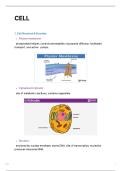
Plasma membrane –
phospholipid bilayer; controls permeability via passive diffusion, facilitated
transport, and active pumps.
Cytoplasm (cytosol) –
site of metabolic reactions; contains organelles.
Nucleus –
enclosed by nuclear envelope; stores DNA, site of transcription; nucleolus
produces ribosomal RNA.
CELL 1
, Mitochondria –
powerhouses; convert glucose to ATP via the citric‑acid cycle and oxidative
phosphorylation.
Ribosomes –
protein synthesis; free (cytosolic) or bound to rough ER.
CELL 2
1. Cell Structure & Function
Plasma membrane –
phospholipid bilayer; controls permeability via passive diffusion, facilitated
transport, and active pumps.
Cytoplasm (cytosol) –
site of metabolic reactions; contains organelles.
Nucleus –
enclosed by nuclear envelope; stores DNA, site of transcription; nucleolus
produces ribosomal RNA.
CELL 1
, Mitochondria –
powerhouses; convert glucose to ATP via the citric‑acid cycle and oxidative
phosphorylation.
Ribosomes –
protein synthesis; free (cytosolic) or bound to rough ER.
CELL 2


