

Function of a Nervous system
Primary function of the nervous system
- To speed, intergrate & co-ordinate physiological and behavioural responses to changes in
the internal and external environments.
Internal changes
- Homeostasis
External changes
- Sensory processing
- Motor co-ordination
Reflexes, cognition, memory, learning
Terms
Afferent (sensory): Conveys information from periphery to CNS
Efferent (motor): Conveys information from CNS to periphery
- Mnemonic: Afferent Arrives- Efferent Exits
Receptor or sensory neuron:
- Specialised cell sensitive to stimuli: Four main types:
, Photoreceptors: found in retina and respond to light
Mechanoreceptros: found in skin, deep tissue, organs and joints and respond to mechanical
force
Thermoreceptors: found in surface tissues; skin, buccal membrane
Chemoreceptors: found in arteries, the olfactory, skin system and tongue
Motor neuron
- Receives information from other neurons and conducts impulses to mulsce or gland cells
Interneuron
- Conveys information between two other neurons
Central nervous system- peripheral nervous system
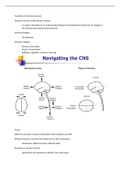
- Central (CNS) = Brain & Spinal cord (everything encased in bone)
- Peripheral (PNS = Everything outside of CNS: Two divisions- somatic & automatic
Somatic Nervous System- Automatic nervous system
- Somatic Nervous System (SNS) = Afferent & Efferent
Afferent: Sends information from detectors and relays it to the CNS
Efferent: Sends voluntary motor signals from CNS to effectors
- Automatic nervous system (ANS): Two divisions- Sympathetic & Parasympathetic
Sympathetic: Involantary response
Parasympathetic: Involuntary response
Neuron- Nerve fibre- nerve
- Neruonal axon covered by endoneurium = nerve fibre
- Collection of nerve fibres wrapped in perinnium = fascicle
- Collection of fascicli covered in empeurium = nerve
Grey and White matter
- Grey matter = mainly neurons: High concentration of neuronal cell bodies seen in cortex and
nuclei
- White matter = High concentration of myelin indicates ‘tracts’ (Pathways)
Primary function of the nervous system
- To speed, intergrate & co-ordinate physiological and behavioural responses to changes in
the internal and external environments.
Internal changes
- Homeostasis
External changes
- Sensory processing
- Motor co-ordination
Reflexes, cognition, memory, learning
Terms
Afferent (sensory): Conveys information from periphery to CNS
Efferent (motor): Conveys information from CNS to periphery
- Mnemonic: Afferent Arrives- Efferent Exits
Receptor or sensory neuron:
- Specialised cell sensitive to stimuli: Four main types:
, Photoreceptors: found in retina and respond to light
Mechanoreceptros: found in skin, deep tissue, organs and joints and respond to mechanical
force
Thermoreceptors: found in surface tissues; skin, buccal membrane
Chemoreceptors: found in arteries, the olfactory, skin system and tongue
Motor neuron
- Receives information from other neurons and conducts impulses to mulsce or gland cells
Interneuron
- Conveys information between two other neurons
Central nervous system- peripheral nervous system
- Central (CNS) = Brain & Spinal cord (everything encased in bone)
- Peripheral (PNS = Everything outside of CNS: Two divisions- somatic & automatic
Somatic Nervous System- Automatic nervous system
- Somatic Nervous System (SNS) = Afferent & Efferent
Afferent: Sends information from detectors and relays it to the CNS
Efferent: Sends voluntary motor signals from CNS to effectors
- Automatic nervous system (ANS): Two divisions- Sympathetic & Parasympathetic
Sympathetic: Involantary response
Parasympathetic: Involuntary response
Neuron- Nerve fibre- nerve
- Neruonal axon covered by endoneurium = nerve fibre
- Collection of nerve fibres wrapped in perinnium = fascicle
- Collection of fascicli covered in empeurium = nerve
Grey and White matter
- Grey matter = mainly neurons: High concentration of neuronal cell bodies seen in cortex and
nuclei
- White matter = High concentration of myelin indicates ‘tracts’ (Pathways)


