Geography Coasts
Coast : the zone between sea and land
Types of coastal environments:
seaside towns/resorts
Salt marsh
Coral reef
Beach (bay)
Cliff coast
Sand dunes
Coasts are systems and change overtime
Inputs —> transfers and processes —> outputs
A coast can change overtime if:
If the atmosphere changes, it can make stronger winds which
leads to stronger waves and can increase the amount of
erosion of rocks.
If more humans settle, you will have a more managed coast
which can make it more unnatural as you are stopping coastal
processes from happening
Different rock types can create a cliff coast (hard rocks) or a
beach (soft rocks)
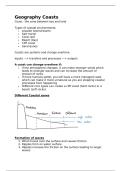
Different Coastal zones
Formation of waves
1. Wind moves over the surface and causes friction
2. Ripples form on water surface
3. Ripples increase the friction on the surface leading to larger
waves
,To increase wave strength:
increase wind power
Increase wind duration
Increase fetch
Fetch = distance over wind is blown or distance wave has to travel
How do waves move?
1. The prevailing wind offshore creates waves out at sea and they
have a circular orbit
2. As the waves approach the shore, friction slows the base of the
wave
3. This causes the orbit to become more elliptical until the wave
breaks over the top
Types of wave
Constructive wave :
STRONG SWASH - deposit sediment on beach
WEAK BACKWASH
Low energy
Small
Long wavelength
Destructive waves :
STRONG BACKWASH - erode the beach
WEAK SWASH
High energy
Tall
Small wavelength
Erosional Processes
Erosion = the gradual wearing and removal of sediment
Abrasion
rocks rub against each other like sandpaper
Hydraulic action
Water is forced into cracks and pressure by air causes rock to
erode
Attrition
rocks bounce and collide with each other
, Solution
chemicals in water cause erosion of rocks
Factors which impact rate of coastal erosion
Fetch
o The further the wave has to travel, the more energy it will
have
Geology
o Rock type and how it is aligned relative to the coast
o How strong it is
Tide
o High tides, particularly in winter, = more erosion
Weather and climate
o Storm will increase rate of erosion as the wave will be
much bigger and warmer water increases the rate of
solution
Humans
o Protecting coastline with groins, rip-rap, break waters,
off-shore bars, vegetation
Geology
1. Rock type - hard rocks (chalk) and soft rocks (clay) which have
different rates of erosion
2. Rock structure - how it is aligned in relation to the coast
DISCORDANT COASTLINE
when bands of different rock type (hard and soft) run
perpendicular to the coast
Coast : the zone between sea and land
Types of coastal environments:
seaside towns/resorts
Salt marsh
Coral reef
Beach (bay)
Cliff coast
Sand dunes
Coasts are systems and change overtime
Inputs —> transfers and processes —> outputs
A coast can change overtime if:
If the atmosphere changes, it can make stronger winds which
leads to stronger waves and can increase the amount of
erosion of rocks.
If more humans settle, you will have a more managed coast
which can make it more unnatural as you are stopping coastal
processes from happening
Different rock types can create a cliff coast (hard rocks) or a
beach (soft rocks)
Different Coastal zones
Formation of waves
1. Wind moves over the surface and causes friction
2. Ripples form on water surface
3. Ripples increase the friction on the surface leading to larger
waves
,To increase wave strength:
increase wind power
Increase wind duration
Increase fetch
Fetch = distance over wind is blown or distance wave has to travel
How do waves move?
1. The prevailing wind offshore creates waves out at sea and they
have a circular orbit
2. As the waves approach the shore, friction slows the base of the
wave
3. This causes the orbit to become more elliptical until the wave
breaks over the top
Types of wave
Constructive wave :
STRONG SWASH - deposit sediment on beach
WEAK BACKWASH
Low energy
Small
Long wavelength
Destructive waves :
STRONG BACKWASH - erode the beach
WEAK SWASH
High energy
Tall
Small wavelength
Erosional Processes
Erosion = the gradual wearing and removal of sediment
Abrasion
rocks rub against each other like sandpaper
Hydraulic action
Water is forced into cracks and pressure by air causes rock to
erode
Attrition
rocks bounce and collide with each other
, Solution
chemicals in water cause erosion of rocks
Factors which impact rate of coastal erosion
Fetch
o The further the wave has to travel, the more energy it will
have
Geology
o Rock type and how it is aligned relative to the coast
o How strong it is
Tide
o High tides, particularly in winter, = more erosion
Weather and climate
o Storm will increase rate of erosion as the wave will be
much bigger and warmer water increases the rate of
solution
Humans
o Protecting coastline with groins, rip-rap, break waters,
off-shore bars, vegetation
Geology
1. Rock type - hard rocks (chalk) and soft rocks (clay) which have
different rates of erosion
2. Rock structure - how it is aligned in relation to the coast
DISCORDANT COASTLINE
when bands of different rock type (hard and soft) run
perpendicular to the coast