3 Attachment
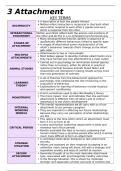
KEY TERMS
A description of how two people interact
Mother-infant interaction is reciprocal in that both infant
RECIPROCITY
and mother respond to each other’s signals and each
elicits a response from the other
INTERACTIONAL Mother and infant reflect both the actions and emotions of
SYNCHRONY the other and do this in a co-ordinated (synchronised) way
Many developmental theories identify a sequence of
qualitatively different behaviours linked to specific ages
STAGES OF
In stages of attachment some characteristics of the
ATTACHMENT
infant’s behaviour towards others change as the infant
gets older
Attachments to two or more people
MULTIPLE Most babies appear to develop multiple attachments once
ATTACHMENTS they have formed one true attachment to a main career
Carried out in psychology on non-human animal species
rather than on humans, either for ethical or practical
ANIMAL STUDIES reasons (practical because animals breed faster and
researchers are interested in seeing results across more
than one generation of animals)
A set of theories from the behaviourist approach to
psychology, that emphasise the role of learning in the
LEARNING acquisition of behaviour
THEORY Explanations for learning of behaviour include classical
and operant conditioning
A term sometimes used to describe Bowlby’s theory
The mono means ‘one’ and indicates that one particular
MONOTROPIC
attachment is different from all others and of central
importance to the child’s development
The mental representations we all carry with us of our
INTERNAL attachment to our primary caregiver
WORKING They are important in affecting our future relationships
MODELS because they carry our perception of what relationships
are like
This refers to the time within which an attachment must
form if it is to form at all
Lorenz and Harlow noted that attachment in birds and
CRITICAL PERIOD monkeys had critical periods
Bowlby extended the idea to humans, proposing that
human infants have a sensitive period after which it will be
much more difficult to form an attachment
A controlled observation designed to test attachment
security
STRANGE
Infants are assessed on their response to playing in an
SITUATION
unfamiliar room, being left alone, left with a stranger and
separation anxiety and ease of comfort at reunion
SECURE Generally thought of as the most desirable attachment
ATTACHMENT type, associated with psychologically healthy outcomes
In the Strange Situation, this is shown by moderate
stranger and separation anxiety and ease of comfort and
, reunion
An attachment type characterised by low anxiety but
INSECURE- weak attachment
AVOIDANT In the Strange Situation, this is shown by low stranger and
ATTACHMENT separation anxiety and little response to reunion (an
avoidance of the caregiver)
An attachment type characterised by strong attachment
INSECURE- and high anxiety
RESISTANT In the Strange Situation, this is shown by high levels of
ATTACHMENT stranger and separation anxiety and by resistance to be
comforted at reunion
‘Culture’ refers to the norms and values that exist within
any group of people
Cultural variations then are the differences in norms and
CULTURAL
values that exist between people in different groups
VARIATIONS
In attachment research, we are concerned with the
differences in the proportion of children of different
attachment types
The emotional and intellectual consequences of separation
between a child and his/her mother or mother substitute
MATERNAL Bowlby proposed that continuous care from a mother is
DEPRIVATION essential for normal psychological development, and that
prolonged separation from this adult causes serious
damage to emotional and intellectual development
A term for the effects of living in an institutional setting
The term ‘institution’ refers to a place like a hospital or an
orphanage where children live for long, continuous periods
of time
INSTITUTIONALISA
In such places there is often very little emotional care
TION
provided
In attachment research, we are interested in the effects of
institutional care on children’s attachment and
subsequent development
These concern children placed in care because their
parents cannot look after them
ORPHAN STUDIES
An orphan is a child whose parents have either died or
have abandoned them permanently
CHILDHOOD Affiliations with other people in childhood, including
RELATIONSHIPS friends and classmates, and with adults such as teachers
Those relationships the child goes on to have later in life
as an adult
ADULT
These include friendships and working relationships but
RELATIONSHIPS
most critically relationships with romantic partners and
the person’s own children
The mental representations we all carry with us of our
INTERNAL attachment to our primary caregiver
WORKING They are important in affecting our future relationships
MODELS because they carry our perception of what relationships
are like
A
ASOCIAL
A
INDISCRIMINATE
SPECIFIC A
, A
IMPRINTING
CLASSICAL A
CONDITIONING
OPERANT A
CONDITIONING
SOCIAL A
RELEASERS
KEY PSYCHOLOGISTS & DATES
FELDMAN & EIDELMAN (2007) MELTZOFF & MOORE (1977) ISABELLA ET AL. (1989)
FELDMAN (2012)
GRATIER (2003) SCHAFFER & EMERSON (1964) GROSSMAN (2002)
TIFFANY FIELD (1978) LORENZ & HARLOW DOLLARD & MILLER 1950
SEARS (1975)
ATTACHMENT
A close two-way emotional bond between two individuals in which each
individual sees the other as essential for their own emotional security
Attachment in humans takes a few months to develop
We can recognise an attachment when people display the following
behaviours…
o PROXIMITY – People try to stay physically close to those with
attachments
o SEPARATION DISTRESS – People are distressed when the person leaves
o SECURE-BASE BEHAVIOUR – Even when we are independent of our
attachment figures, we tend to make regular contact with them
Infants display secure-base behaviour when they return to
their attachment figure while playing
Introduction to attachment
CAREGIVER-INFANT INTERACTIONS
KEY TERMS
A description of how two people interact
Mother-infant interaction is reciprocal in that both infant
RECIPROCITY
and mother respond to each other’s signals and each
elicits a response from the other
INTERACTIONAL Mother and infant reflect both the actions and emotions of
SYNCHRONY the other and do this in a co-ordinated (synchronised) way
Many developmental theories identify a sequence of
qualitatively different behaviours linked to specific ages
STAGES OF
In stages of attachment some characteristics of the
ATTACHMENT
infant’s behaviour towards others change as the infant
gets older
Attachments to two or more people
MULTIPLE Most babies appear to develop multiple attachments once
ATTACHMENTS they have formed one true attachment to a main career
Carried out in psychology on non-human animal species
rather than on humans, either for ethical or practical
ANIMAL STUDIES reasons (practical because animals breed faster and
researchers are interested in seeing results across more
than one generation of animals)
A set of theories from the behaviourist approach to
psychology, that emphasise the role of learning in the
LEARNING acquisition of behaviour
THEORY Explanations for learning of behaviour include classical
and operant conditioning
A term sometimes used to describe Bowlby’s theory
The mono means ‘one’ and indicates that one particular
MONOTROPIC
attachment is different from all others and of central
importance to the child’s development
The mental representations we all carry with us of our
INTERNAL attachment to our primary caregiver
WORKING They are important in affecting our future relationships
MODELS because they carry our perception of what relationships
are like
This refers to the time within which an attachment must
form if it is to form at all
Lorenz and Harlow noted that attachment in birds and
CRITICAL PERIOD monkeys had critical periods
Bowlby extended the idea to humans, proposing that
human infants have a sensitive period after which it will be
much more difficult to form an attachment
A controlled observation designed to test attachment
security
STRANGE
Infants are assessed on their response to playing in an
SITUATION
unfamiliar room, being left alone, left with a stranger and
separation anxiety and ease of comfort at reunion
SECURE Generally thought of as the most desirable attachment
ATTACHMENT type, associated with psychologically healthy outcomes
In the Strange Situation, this is shown by moderate
stranger and separation anxiety and ease of comfort and
, reunion
An attachment type characterised by low anxiety but
INSECURE- weak attachment
AVOIDANT In the Strange Situation, this is shown by low stranger and
ATTACHMENT separation anxiety and little response to reunion (an
avoidance of the caregiver)
An attachment type characterised by strong attachment
INSECURE- and high anxiety
RESISTANT In the Strange Situation, this is shown by high levels of
ATTACHMENT stranger and separation anxiety and by resistance to be
comforted at reunion
‘Culture’ refers to the norms and values that exist within
any group of people
Cultural variations then are the differences in norms and
CULTURAL
values that exist between people in different groups
VARIATIONS
In attachment research, we are concerned with the
differences in the proportion of children of different
attachment types
The emotional and intellectual consequences of separation
between a child and his/her mother or mother substitute
MATERNAL Bowlby proposed that continuous care from a mother is
DEPRIVATION essential for normal psychological development, and that
prolonged separation from this adult causes serious
damage to emotional and intellectual development
A term for the effects of living in an institutional setting
The term ‘institution’ refers to a place like a hospital or an
orphanage where children live for long, continuous periods
of time
INSTITUTIONALISA
In such places there is often very little emotional care
TION
provided
In attachment research, we are interested in the effects of
institutional care on children’s attachment and
subsequent development
These concern children placed in care because their
parents cannot look after them
ORPHAN STUDIES
An orphan is a child whose parents have either died or
have abandoned them permanently
CHILDHOOD Affiliations with other people in childhood, including
RELATIONSHIPS friends and classmates, and with adults such as teachers
Those relationships the child goes on to have later in life
as an adult
ADULT
These include friendships and working relationships but
RELATIONSHIPS
most critically relationships with romantic partners and
the person’s own children
The mental representations we all carry with us of our
INTERNAL attachment to our primary caregiver
WORKING They are important in affecting our future relationships
MODELS because they carry our perception of what relationships
are like
A
ASOCIAL
A
INDISCRIMINATE
SPECIFIC A
, A
IMPRINTING
CLASSICAL A
CONDITIONING
OPERANT A
CONDITIONING
SOCIAL A
RELEASERS
KEY PSYCHOLOGISTS & DATES
FELDMAN & EIDELMAN (2007) MELTZOFF & MOORE (1977) ISABELLA ET AL. (1989)
FELDMAN (2012)
GRATIER (2003) SCHAFFER & EMERSON (1964) GROSSMAN (2002)
TIFFANY FIELD (1978) LORENZ & HARLOW DOLLARD & MILLER 1950
SEARS (1975)
ATTACHMENT
A close two-way emotional bond between two individuals in which each
individual sees the other as essential for their own emotional security
Attachment in humans takes a few months to develop
We can recognise an attachment when people display the following
behaviours…
o PROXIMITY – People try to stay physically close to those with
attachments
o SEPARATION DISTRESS – People are distressed when the person leaves
o SECURE-BASE BEHAVIOUR – Even when we are independent of our
attachment figures, we tend to make regular contact with them
Infants display secure-base behaviour when they return to
their attachment figure while playing
Introduction to attachment
CAREGIVER-INFANT INTERACTIONS