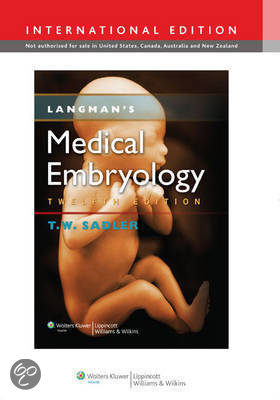
Test Bank For Langman’s Medical
Embryology (Twelfth Edition) by T. W.
Sadler.
National Board–Style MCQs with 100%
Correct Answers and Explanations
,Table of Contents
Part 1: General Embryology
● Introduction: Clinical Relevance and Historical Perspective
● Chapter 1: Introduction to Molecular Regulation and Signaling
● Chapter 2: Gametogenesis: Conversion of Germ Cells into Male and Female
Gametes
● Chapter 3: First Week of Development: Ovulation to Implantation
● Chapter 4: Second Week of Development: Bilaminar Germ Disc
● Chapter 5: Third Week of Development: Trilaminar Germ Disc
● Chapter 6: Third to Eighth Weeks: The Embryonic Period
● Chapter 7: The Gut Tube and the Body Cavities
● Chapter 8: Third Month to Birth: The Fetus and Placenta
● Chapter 9: Birth Defects and Prenatal Diagnosis
Part 2: Systems-Based Embryology
● Chapter 10: The Axial Skeleton
● Chapter 11: Muscular System
● Chapter 12: Limbs: Growth, development, and musculature
● Chapter 13: Cardiovascular System
● Chapter 14: Respiratory System
● Chapter 15: Digestive System
● Chapter 16: Urogenital System
● Chapter 17: Head and Neck
● Chapter 18: Central Nervous System
● Chapter 19: Ear:
● Chapter 20: Eye
● Chapter 21: Integumentary System
,Topic 1: Introduction to Molecular Regulation and Signaling
1. A researcher identifies a mutation in a regulatory sequence located
50 kilobases upstream of a gene essential for limb development.
Although the gene's coding sequence (exons) is normal, the gene is
not expressed in the developing limb bud. This regulatory sequence,
which can act at a distance to increase the rate of transcription, is
most likely a(n):
A. Promoter
B. Enhancer
C. Silencer
D. Splice site
E. Transcription factor
Correct Answer: B
Explanation: Enhancers are regulatory elements of DNA that can be located far upstream,
downstream, or even within an intron of a gene. They bind transcription factors to increase
the rate of transcription by looping the DNA to interact with the promoter. Unlike
promoters, which are immediately adjacent to the gene, enhancers are tissue-specific and
act at a distance.
2. A newborn is diagnosed with a specific form of Wilms tumor. Genetic analysis reveals
that the WT1 gene is present, but the variety of protein isoforms produced is significantly
reduced compared to healthy controls. This defect most likely involves which of the
following processes?
A. DNA methylation
B. Histone acetylation
C. Alternative splicing
D. Protein phosphorylation
E. Gene duplication
Correct Answer: C
Explanation: Alternative splicing allows a single gene to produce multiple different proteins
(isoforms) by selecting different combinations of exons. The WT1 gene is a classic example
, where different splice variants have distinct roles in renal and gonadal development.
Defects in this process result in a loss of functional diversity in proteins.
3. During the process of induction, a signal from the notochord induces the overlying
ectoderm to become the neural plate. If the responding ectodermal cells lack the specific
cell-surface receptors to recognize the signaling molecule, they are said to lack:
A. Induction
B. Determination
C. Competence
D. Differentiation
E. Specification
Correct Answer: C
Explanation: Competence is the ability of a "responder" cell to react to an inductive signal
from an "inducer." It requires the responder to have the appropriate molecular machinery,
such as receptors and signal transduction components, to interpret the signal.
4. A child is born with holoprosencephaly, a severe midline defect of the brain and face.
The underlying molecular cause is a "haploinsufficiency" of a signaling molecule that
normally establishes the midline. Which pathway is most likely affected?
A. Wnt pathway
B. Fibroblast Growth Factor (FGF) pathway
C. Notch pathway
D. Sonic Hedgehog (Shh) pathway
E. Transforming Growth Factor-beta (TGF-β) pathway
Correct Answer: D
Explanation: Sonic Hedgehog (Shh) is the "master gene" for midline patterning in the
CNS. Loss of one Shh allele (haploinsufficiency) or interference with its signaling (e.g., by
cholesterol inhibitors) prevents the brain from dividing into two hemispheres, leading to
holoprosencephaly.
5. A patient presents with a rare skeletal dysplasia characterized by the premature fusion
of cranial sutures (craniosynostosis). The condition is traced to a "gain-of-function"
mutation in a receptor that normally regulates mesenchymal cell proliferation and
differentiation through tyrosine kinase activity. This receptor belongs to which family?
Embryology (Twelfth Edition) by T. W.
Sadler.
National Board–Style MCQs with 100%
Correct Answers and Explanations
,Table of Contents
Part 1: General Embryology
● Introduction: Clinical Relevance and Historical Perspective
● Chapter 1: Introduction to Molecular Regulation and Signaling
● Chapter 2: Gametogenesis: Conversion of Germ Cells into Male and Female
Gametes
● Chapter 3: First Week of Development: Ovulation to Implantation
● Chapter 4: Second Week of Development: Bilaminar Germ Disc
● Chapter 5: Third Week of Development: Trilaminar Germ Disc
● Chapter 6: Third to Eighth Weeks: The Embryonic Period
● Chapter 7: The Gut Tube and the Body Cavities
● Chapter 8: Third Month to Birth: The Fetus and Placenta
● Chapter 9: Birth Defects and Prenatal Diagnosis
Part 2: Systems-Based Embryology
● Chapter 10: The Axial Skeleton
● Chapter 11: Muscular System
● Chapter 12: Limbs: Growth, development, and musculature
● Chapter 13: Cardiovascular System
● Chapter 14: Respiratory System
● Chapter 15: Digestive System
● Chapter 16: Urogenital System
● Chapter 17: Head and Neck
● Chapter 18: Central Nervous System
● Chapter 19: Ear:
● Chapter 20: Eye
● Chapter 21: Integumentary System
,Topic 1: Introduction to Molecular Regulation and Signaling
1. A researcher identifies a mutation in a regulatory sequence located
50 kilobases upstream of a gene essential for limb development.
Although the gene's coding sequence (exons) is normal, the gene is
not expressed in the developing limb bud. This regulatory sequence,
which can act at a distance to increase the rate of transcription, is
most likely a(n):
A. Promoter
B. Enhancer
C. Silencer
D. Splice site
E. Transcription factor
Correct Answer: B
Explanation: Enhancers are regulatory elements of DNA that can be located far upstream,
downstream, or even within an intron of a gene. They bind transcription factors to increase
the rate of transcription by looping the DNA to interact with the promoter. Unlike
promoters, which are immediately adjacent to the gene, enhancers are tissue-specific and
act at a distance.
2. A newborn is diagnosed with a specific form of Wilms tumor. Genetic analysis reveals
that the WT1 gene is present, but the variety of protein isoforms produced is significantly
reduced compared to healthy controls. This defect most likely involves which of the
following processes?
A. DNA methylation
B. Histone acetylation
C. Alternative splicing
D. Protein phosphorylation
E. Gene duplication
Correct Answer: C
Explanation: Alternative splicing allows a single gene to produce multiple different proteins
(isoforms) by selecting different combinations of exons. The WT1 gene is a classic example
, where different splice variants have distinct roles in renal and gonadal development.
Defects in this process result in a loss of functional diversity in proteins.
3. During the process of induction, a signal from the notochord induces the overlying
ectoderm to become the neural plate. If the responding ectodermal cells lack the specific
cell-surface receptors to recognize the signaling molecule, they are said to lack:
A. Induction
B. Determination
C. Competence
D. Differentiation
E. Specification
Correct Answer: C
Explanation: Competence is the ability of a "responder" cell to react to an inductive signal
from an "inducer." It requires the responder to have the appropriate molecular machinery,
such as receptors and signal transduction components, to interpret the signal.
4. A child is born with holoprosencephaly, a severe midline defect of the brain and face.
The underlying molecular cause is a "haploinsufficiency" of a signaling molecule that
normally establishes the midline. Which pathway is most likely affected?
A. Wnt pathway
B. Fibroblast Growth Factor (FGF) pathway
C. Notch pathway
D. Sonic Hedgehog (Shh) pathway
E. Transforming Growth Factor-beta (TGF-β) pathway
Correct Answer: D
Explanation: Sonic Hedgehog (Shh) is the "master gene" for midline patterning in the
CNS. Loss of one Shh allele (haploinsufficiency) or interference with its signaling (e.g., by
cholesterol inhibitors) prevents the brain from dividing into two hemispheres, leading to
holoprosencephaly.
5. A patient presents with a rare skeletal dysplasia characterized by the premature fusion
of cranial sutures (craniosynostosis). The condition is traced to a "gain-of-function"
mutation in a receptor that normally regulates mesenchymal cell proliferation and
differentiation through tyrosine kinase activity. This receptor belongs to which family?