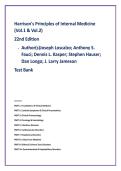
Harrison's Principles of Internal Medicine
(Vol.1 & Vol.2)
22nd Edition
• Author(s)Joseph Loscalzo; Anthony S.
Fauci; Dennis L. Kasper; Stephen Hauser;
Dan Longo; J. Larry Jameson
Test Bank
Covered
PART 1: Foundations of Clinical Medicine
PART 2: Cardinal Symptoms & Clinical Presentations
PART 3: Clinical Pharmacology
PART 4: Oncology & Hematology
PART 5: Infectious Diseases
PART 6: Cardiovascular Disorders
PART 7: Respiratory Disorders
PART 8: Critical Care Medicine
PART 9: Kidney & Urinary Tract Disorders
PART 10: Gastrointestinal & Hepatobiliary Disorders
,PART 11: Immune-Mediated & Rheumatologic Disorders
PART 12: Endocrinology & Metabolism
PART 13: Neurologic & Psychiatric Disorders
PART 14: Toxicology & Environmental Injury
PART 15: Environmental & Occupational Medicine
PART 16: Genetics, Precision & Systems Medicine
PART 17–20: Special & Emerging Topics
Harrison’s Principles of Internal Medicine, 22nd ed.
Chapters 1–13 | Foundational Concepts in Clinical Medicine
FAST-REVISION Nursing MCQs (20 items total)
1. Which principle best defines evidence-based medical
practice?
A. Reliance on expert opinion
B. Use of randomized trials only
C. Integration of clinical expertise, patient values, and best
evidence
D. Application of standardized protocols
Correct Answer: C
Rationale: Evidence-based medicine integrates scientific
evidence with clinician expertise and patient preferences to
guide care.
,Citation: Harrison’s Principles of Internal Medicine, 22nd ed.,
Ch. 1 – The Practice of Medicine
2. A nurse supporting population health initiatives is most
aligned with which goal?
A. Treating acute illness
B. Reducing health disparities
C. Increasing specialty referrals
D. Expanding hospital capacity
Correct Answer: B
Rationale: Promoting good health emphasizes prevention and
reduction of disparities at the population level.
Citation: Harrison’s, 22nd ed., Ch. 2 – Promoting Good Health
3. Which factor most strongly contributes to vaccine
hesitancy?
A. Cost of immunization
B. Access to health facilities
C. Mistrust of health institutions
D. Lack of vaccine efficacy
Correct Answer: C
Rationale: Vaccine opposition commonly stems from mistrust
and misinformation rather than scientific evidence.
, Citation: Harrison’s, 22nd ed., Ch. 3 – Vaccine Opposition and
Hesitancy
4. In shared clinical decision-making, the nurse’s primary role
is to:
A. Select the most cost-effective treatment
B. Present options aligned with patient values
C. Ensure physician authority is maintained
D. Limit patient involvement
Correct Answer: B
Rationale: Shared decision-making prioritizes patient values
and informed preferences.
Citation: Harrison’s, 22nd ed., Ch. 4 – Decision-Making in
Clinical Medicine
5. Precision medicine is best defined as care based on:
A. Standardized clinical pathways
B. Genomic, environmental, and lifestyle variability
C. Population averages
D. Disease severity only
Correct Answer: B
Rationale: Precision medicine individualizes care using biologic
and environmental data.
(Vol.1 & Vol.2)
22nd Edition
• Author(s)Joseph Loscalzo; Anthony S.
Fauci; Dennis L. Kasper; Stephen Hauser;
Dan Longo; J. Larry Jameson
Test Bank
Covered
PART 1: Foundations of Clinical Medicine
PART 2: Cardinal Symptoms & Clinical Presentations
PART 3: Clinical Pharmacology
PART 4: Oncology & Hematology
PART 5: Infectious Diseases
PART 6: Cardiovascular Disorders
PART 7: Respiratory Disorders
PART 8: Critical Care Medicine
PART 9: Kidney & Urinary Tract Disorders
PART 10: Gastrointestinal & Hepatobiliary Disorders
,PART 11: Immune-Mediated & Rheumatologic Disorders
PART 12: Endocrinology & Metabolism
PART 13: Neurologic & Psychiatric Disorders
PART 14: Toxicology & Environmental Injury
PART 15: Environmental & Occupational Medicine
PART 16: Genetics, Precision & Systems Medicine
PART 17–20: Special & Emerging Topics
Harrison’s Principles of Internal Medicine, 22nd ed.
Chapters 1–13 | Foundational Concepts in Clinical Medicine
FAST-REVISION Nursing MCQs (20 items total)
1. Which principle best defines evidence-based medical
practice?
A. Reliance on expert opinion
B. Use of randomized trials only
C. Integration of clinical expertise, patient values, and best
evidence
D. Application of standardized protocols
Correct Answer: C
Rationale: Evidence-based medicine integrates scientific
evidence with clinician expertise and patient preferences to
guide care.
,Citation: Harrison’s Principles of Internal Medicine, 22nd ed.,
Ch. 1 – The Practice of Medicine
2. A nurse supporting population health initiatives is most
aligned with which goal?
A. Treating acute illness
B. Reducing health disparities
C. Increasing specialty referrals
D. Expanding hospital capacity
Correct Answer: B
Rationale: Promoting good health emphasizes prevention and
reduction of disparities at the population level.
Citation: Harrison’s, 22nd ed., Ch. 2 – Promoting Good Health
3. Which factor most strongly contributes to vaccine
hesitancy?
A. Cost of immunization
B. Access to health facilities
C. Mistrust of health institutions
D. Lack of vaccine efficacy
Correct Answer: C
Rationale: Vaccine opposition commonly stems from mistrust
and misinformation rather than scientific evidence.
, Citation: Harrison’s, 22nd ed., Ch. 3 – Vaccine Opposition and
Hesitancy
4. In shared clinical decision-making, the nurse’s primary role
is to:
A. Select the most cost-effective treatment
B. Present options aligned with patient values
C. Ensure physician authority is maintained
D. Limit patient involvement
Correct Answer: B
Rationale: Shared decision-making prioritizes patient values
and informed preferences.
Citation: Harrison’s, 22nd ed., Ch. 4 – Decision-Making in
Clinical Medicine
5. Precision medicine is best defined as care based on:
A. Standardized clinical pathways
B. Genomic, environmental, and lifestyle variability
C. Population averages
D. Disease severity only
Correct Answer: B
Rationale: Precision medicine individualizes care using biologic
and environmental data.