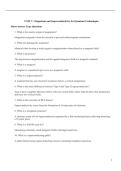
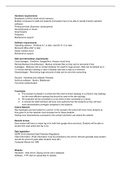
UNIT V: Magnetism and Superconductivity for Quantum Technologies
Short Answer Type Questions
1. What is the atomic origin of magnetism?
Magnetism originates from the electron’s spin and orbital angular momentum.
2. What are diamagnetic materials?
Materials that develop a weak negative magnetisation when placed in a magnetic field.
3. What is hysteresis?
The lag between magnetization and the applied magnetic field in a magnetic material.
4. What is a magnon?
A magnon is a quantized spin wave in a magnetic solid.
5. What is a superconductor?
A material that has zero electrical resistance below a critical temperature.
6. What is the main difference between Type I and Type II superconductors?
Type I show complete Meissner effect with one critical field, while Type II allow flux penetration
and have two critical fields.
7. What is the core idea of BCS theory?
Superconductivity arises from the formation of Cooper pairs of electrons.
8. What is a Josephson junction?
A structure made of two superconductors separated by a thin insulating barrier allowing tunneling
of Cooper pairs.
9. What is a SQUID used for?
Measuring extremely small magnetic fields with high sensitivity.
10. What is a superconducting qubit?
A qubit formed using superconducting circuits containing Josephson junctions.
1
, Essay-type questions
1. Differentiate among the diamagnetic, paramagnetic, ferromagnetic, antiferromagnetic and
ferrimagnetic materials by classifying their properties.
,
Ferrim
Property Diamagnetic Paramagnetic Ferromagnetic Antiferromagnetic
agnetic
Relative
Permeability μr < 1 μr > 1 μr >> 1 μr > 1 μr > 1
(μr)
Induced
magneti
zation
Induced
Induced Induced is in the
magnetization in Strong induced
magnetization is magnetization in the directio
Magnetization the direction of magnetization;
opposite to direction of field; n of the
(M) applied field; M is positive and
applied field; M is positive but field; M
M is positive very high
M is negative low is
and moderate
positive
and
high
χ is
Susceptibility χ is low and χ is high and high
χ is negative χ is low and positive
(χ) positive positive and
positive
χ = C / (T – Tc)
Temperature χ=C/
χ is independent χ = C / T (Curie (Curie–Weiss
Dependence of χ = C / (T + Tc) (T +
of temperature law) law), Tc = Curie
χ Tc)
temperature
Ferrites,
Organic Alkali metals, Transition metals, Salts of transition ferri
Examples
materials transition metals rare earth metals elements material
s
Large net Net magnetic moment Large net
Exists in
Net Exists in magnetic exists in direction ofmagnetic
opposite
Magnetic direction of moment in applied field (very moment in the
direction to
Moment applied field direction of small due to direction of
applied field
applied field cancellation) applied field
Induced Moderately Strong induced Large induced
Induced Induced moment in the
moment is induced moment moment in moment in
Magnetic direction of applied
opposite to in direction of direction of direction of
Moment field
applied field field field applied field
2
Short Answer Type Questions
1. What is the atomic origin of magnetism?
Magnetism originates from the electron’s spin and orbital angular momentum.
2. What are diamagnetic materials?
Materials that develop a weak negative magnetisation when placed in a magnetic field.
3. What is hysteresis?
The lag between magnetization and the applied magnetic field in a magnetic material.
4. What is a magnon?
A magnon is a quantized spin wave in a magnetic solid.
5. What is a superconductor?
A material that has zero electrical resistance below a critical temperature.
6. What is the main difference between Type I and Type II superconductors?
Type I show complete Meissner effect with one critical field, while Type II allow flux penetration
and have two critical fields.
7. What is the core idea of BCS theory?
Superconductivity arises from the formation of Cooper pairs of electrons.
8. What is a Josephson junction?
A structure made of two superconductors separated by a thin insulating barrier allowing tunneling
of Cooper pairs.
9. What is a SQUID used for?
Measuring extremely small magnetic fields with high sensitivity.
10. What is a superconducting qubit?
A qubit formed using superconducting circuits containing Josephson junctions.
1
, Essay-type questions
1. Differentiate among the diamagnetic, paramagnetic, ferromagnetic, antiferromagnetic and
ferrimagnetic materials by classifying their properties.
,
Ferrim
Property Diamagnetic Paramagnetic Ferromagnetic Antiferromagnetic
agnetic
Relative
Permeability μr < 1 μr > 1 μr >> 1 μr > 1 μr > 1
(μr)
Induced
magneti
zation
Induced
Induced Induced is in the
magnetization in Strong induced
magnetization is magnetization in the directio
Magnetization the direction of magnetization;
opposite to direction of field; n of the
(M) applied field; M is positive and
applied field; M is positive but field; M
M is positive very high
M is negative low is
and moderate
positive
and
high
χ is
Susceptibility χ is low and χ is high and high
χ is negative χ is low and positive
(χ) positive positive and
positive
χ = C / (T – Tc)
Temperature χ=C/
χ is independent χ = C / T (Curie (Curie–Weiss
Dependence of χ = C / (T + Tc) (T +
of temperature law) law), Tc = Curie
χ Tc)
temperature
Ferrites,
Organic Alkali metals, Transition metals, Salts of transition ferri
Examples
materials transition metals rare earth metals elements material
s
Large net Net magnetic moment Large net
Exists in
Net Exists in magnetic exists in direction ofmagnetic
opposite
Magnetic direction of moment in applied field (very moment in the
direction to
Moment applied field direction of small due to direction of
applied field
applied field cancellation) applied field
Induced Moderately Strong induced Large induced
Induced Induced moment in the
moment is induced moment moment in moment in
Magnetic direction of applied
opposite to in direction of direction of direction of
Moment field
applied field field field applied field
2