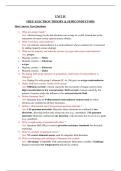
UNIT IV
FREE ELECTRON THEORY & SEMICONDUCTORS
Short Answer Type Questions
1. What are energy bands?
Ans: Allowed energy levels that electrons can occupy in a solid, formed due to the
interaction of many closely spaced atomic orbitals.
2. What is extrinsic semiconductor?
Ans: An extrinsic semiconductor is a semiconductor whose conductivity is increased
by adding impurity atoms (doping)
3. What are the majority and minority carriers in p-type and n-type semiconductor?
Ans: p-type:
• Majority carriers → Holes
• Minority carriers → Electrons
n-type:
• Majority carriers → Electrons
• Minority carriers → Holes
4. By doping fifth group elements in germanium, which type of semiconductor is
obtained ?
Ans: Doping Ge with group-5 elements (P, As, Sb) gives an n-type semiconductor.
5. Define Diffusion current. Define Drift current.
Ans: Diffusion current: Current caused by the movement of charge carriers from
high concentration to low concentration. Drift current: Current caused by the
motion of carriers under the influence of an external electric field.
6. Define Quantum Dots?
Ans: Quantum dots are 0-dimensional semiconductor nanocrystals in which
electrons are confined in all three directions.
7. Define 1-dimensioanl and 2 dimensional quantum materials ?
Ans: 1-D quantum materials: Materials where electrons are confined in two
directions, allowing motion only along one axis (e.g., nanotubes). 2-D quantum
materials: Materials confined in one direction, with electrons free to move in a plane
(e.g., graphene).
8. Write an application of quantum hall effect ?
Ans: Quantum Hall Effect is used in precision resistance standards for electrical
metrology.
9. Write an example of quantum sensor ?
Ans: NV-center diamond sensor used for magnetic field detection.
10. Write an advantage and challenge of Quantum dot as qubit.
Ans: Advantage: Compatible with semiconductor fabrication; scalable. Challenge:
Require extremely low temperatures and precise control.
, Essay-type questions (Long answers)
1. Obtain an expression for electrical conductivity on the basis of quantum
free electron theory.
Ans:
Sommerfeld applied the principles of quantum mechanics and Fermi-Dirac statistics to the classical
free electron theory.
According to quantum theory, the free electrons occupy different energy levels up to Fermi
level at 0 K. So they possess different energies and hence they possess different velocities.
We assume a sphere of radius VF, at the origin of velocity space as shown
Distribution of
in figure.
velocities of free
Each point inside the sphere represents velocity of a free electron. This
sphere is called “Fermi Sphere” E
In the absence of an external electric field, the velocity vectors cancel
each other in pairs and the net velocity of electrons in all directions is zero.
Now if an electric field applied externally along negative x – direction on
these electrons as shown in figure, then a force eE acts on each electrons along
x – direction.
Displacement
In quantum theory, the velocity of a free electron can be represented in
of velocities
terms of propagation vector as
sphere
2mE ℏ2 𝜅2 p2
𝜅2 = or E = =
ℏ2 2m 2m
ℏ𝜅
i.e., p = ℏ𝜅 = m𝑣 ⇒ 𝑣 = m
→(1)
Differentiating equation (1) w.r.t time t
𝑑𝑣 ℏ 𝑑𝜅
𝑎= 𝑑𝑡
= m 𝑑𝑡 →(2)
The force on an electron due to an applied electric field is eE
ℏ 𝑑𝜅 𝑑𝜅
𝑒E = m × m 𝑑𝑡 or ℏ 𝑑𝑡 = 𝑒E →(3)
𝑒E
𝑑𝜅 = ℏ
𝑑𝑡 →(4)
𝑒E𝑡
Integrating equation (4) gives 𝜅(𝑡) − 𝜅(0) = ℏ
→(5)
Let the mean collision time and mean free path of a free electron present at Fermi surface is
𝜆F
represented as τF and λF, respectively then, we have τF =
VF
→(6)
For an electron at Fermi level, consider t = τF and 𝜅(𝑡) − 𝜅(0) = ∆𝜅 in equation (5)
FREE ELECTRON THEORY & SEMICONDUCTORS
Short Answer Type Questions
1. What are energy bands?
Ans: Allowed energy levels that electrons can occupy in a solid, formed due to the
interaction of many closely spaced atomic orbitals.
2. What is extrinsic semiconductor?
Ans: An extrinsic semiconductor is a semiconductor whose conductivity is increased
by adding impurity atoms (doping)
3. What are the majority and minority carriers in p-type and n-type semiconductor?
Ans: p-type:
• Majority carriers → Holes
• Minority carriers → Electrons
n-type:
• Majority carriers → Electrons
• Minority carriers → Holes
4. By doping fifth group elements in germanium, which type of semiconductor is
obtained ?
Ans: Doping Ge with group-5 elements (P, As, Sb) gives an n-type semiconductor.
5. Define Diffusion current. Define Drift current.
Ans: Diffusion current: Current caused by the movement of charge carriers from
high concentration to low concentration. Drift current: Current caused by the
motion of carriers under the influence of an external electric field.
6. Define Quantum Dots?
Ans: Quantum dots are 0-dimensional semiconductor nanocrystals in which
electrons are confined in all three directions.
7. Define 1-dimensioanl and 2 dimensional quantum materials ?
Ans: 1-D quantum materials: Materials where electrons are confined in two
directions, allowing motion only along one axis (e.g., nanotubes). 2-D quantum
materials: Materials confined in one direction, with electrons free to move in a plane
(e.g., graphene).
8. Write an application of quantum hall effect ?
Ans: Quantum Hall Effect is used in precision resistance standards for electrical
metrology.
9. Write an example of quantum sensor ?
Ans: NV-center diamond sensor used for magnetic field detection.
10. Write an advantage and challenge of Quantum dot as qubit.
Ans: Advantage: Compatible with semiconductor fabrication; scalable. Challenge:
Require extremely low temperatures and precise control.
, Essay-type questions (Long answers)
1. Obtain an expression for electrical conductivity on the basis of quantum
free electron theory.
Ans:
Sommerfeld applied the principles of quantum mechanics and Fermi-Dirac statistics to the classical
free electron theory.
According to quantum theory, the free electrons occupy different energy levels up to Fermi
level at 0 K. So they possess different energies and hence they possess different velocities.
We assume a sphere of radius VF, at the origin of velocity space as shown
Distribution of
in figure.
velocities of free
Each point inside the sphere represents velocity of a free electron. This
sphere is called “Fermi Sphere” E
In the absence of an external electric field, the velocity vectors cancel
each other in pairs and the net velocity of electrons in all directions is zero.
Now if an electric field applied externally along negative x – direction on
these electrons as shown in figure, then a force eE acts on each electrons along
x – direction.
Displacement
In quantum theory, the velocity of a free electron can be represented in
of velocities
terms of propagation vector as
sphere
2mE ℏ2 𝜅2 p2
𝜅2 = or E = =
ℏ2 2m 2m
ℏ𝜅
i.e., p = ℏ𝜅 = m𝑣 ⇒ 𝑣 = m
→(1)
Differentiating equation (1) w.r.t time t
𝑑𝑣 ℏ 𝑑𝜅
𝑎= 𝑑𝑡
= m 𝑑𝑡 →(2)
The force on an electron due to an applied electric field is eE
ℏ 𝑑𝜅 𝑑𝜅
𝑒E = m × m 𝑑𝑡 or ℏ 𝑑𝑡 = 𝑒E →(3)
𝑒E
𝑑𝜅 = ℏ
𝑑𝑡 →(4)
𝑒E𝑡
Integrating equation (4) gives 𝜅(𝑡) − 𝜅(0) = ℏ
→(5)
Let the mean collision time and mean free path of a free electron present at Fermi surface is
𝜆F
represented as τF and λF, respectively then, we have τF =
VF
→(6)
For an electron at Fermi level, consider t = τF and 𝜅(𝑡) − 𝜅(0) = ∆𝜅 in equation (5)