
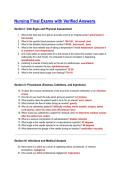
Nursing Final Exams with Verified Answers.
Section I: Vital Signs and Physical Assessment
1. What is the best way to to get an accurate count of an irregular pulse? apical pulse (1
full minute)
2. What is the systolic blood pressure number? 100-140 ; 1st sound; start
3. What is the diastolic blood pressure number? 60-90 ; last sound ; done
4. What is the most reliable way of taking a temperature? rectal temperature ,(because it
is a person's core temperature)
5. One nurse takes an apical pulse for a full minute at the same time another nurse takes a
radial pulse for a full minute. It's compared to ensure circulation is happening.
apical/radial pulse
6. Listening to sounds of body parts w/ the aid of a stethoscope. auscultation
7. Instrument to examine the eye. ophthalmoscope
8. What is the normal range for adult respirations? 12-20
9. What is the normal blood sugar (non-fasting)? 70-110
Section II: Procedures (Enemas, Catheters, and Injections)
10.To allow the mucous membranes of the anus time to absorb medication or oil. retention
enema
11.How far do you insert the tube when giving an enema? 3-4 (inches)
12.What position does the patient need to be in for an enema? sim's lateral
13.What controls the flow of water during an enema? gravity
14.Why do we catheterize patients? difficulty voiding, sterile sample, surgery, spinal
cord injuries, strict I/O, keep urine off pressure ulcer
15.When would you catheterize a patient for residual urine? to determine residual volume
after the patient has voided
16.What is a serious complication of catheterization? bladder infection
17.What angle is the needle injected in a subcutaneous injection? 45 degrees
18.What angle is the needle injected in an intramuscular injection? 90 degrees
19.What determines the gauge of the needle during an injection? medication viscosity
Section III: Infections and Medical Asepsis
20.Harm done to a client as a result of neglecting duties, procedures, or ordinary
precautions. negligence
21.How would you define professional negligence? malpractice
Section I: Vital Signs and Physical Assessment
1. What is the best way to to get an accurate count of an irregular pulse? apical pulse (1
full minute)
2. What is the systolic blood pressure number? 100-140 ; 1st sound; start
3. What is the diastolic blood pressure number? 60-90 ; last sound ; done
4. What is the most reliable way of taking a temperature? rectal temperature ,(because it
is a person's core temperature)
5. One nurse takes an apical pulse for a full minute at the same time another nurse takes a
radial pulse for a full minute. It's compared to ensure circulation is happening.
apical/radial pulse
6. Listening to sounds of body parts w/ the aid of a stethoscope. auscultation
7. Instrument to examine the eye. ophthalmoscope
8. What is the normal range for adult respirations? 12-20
9. What is the normal blood sugar (non-fasting)? 70-110
Section II: Procedures (Enemas, Catheters, and Injections)
10.To allow the mucous membranes of the anus time to absorb medication or oil. retention
enema
11.How far do you insert the tube when giving an enema? 3-4 (inches)
12.What position does the patient need to be in for an enema? sim's lateral
13.What controls the flow of water during an enema? gravity
14.Why do we catheterize patients? difficulty voiding, sterile sample, surgery, spinal
cord injuries, strict I/O, keep urine off pressure ulcer
15.When would you catheterize a patient for residual urine? to determine residual volume
after the patient has voided
16.What is a serious complication of catheterization? bladder infection
17.What angle is the needle injected in a subcutaneous injection? 45 degrees
18.What angle is the needle injected in an intramuscular injection? 90 degrees
19.What determines the gauge of the needle during an injection? medication viscosity
Section III: Infections and Medical Asepsis
20.Harm done to a client as a result of neglecting duties, procedures, or ordinary
precautions. negligence
21.How would you define professional negligence? malpractice


