HSCO 506 Exam 3.docx Grade 100/ PRACTICE SOLUTION
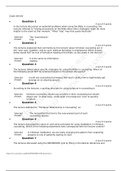
HSCO 506 Exam Grade 100/ PRACTICE SOLUTION Question 1 4 out of 4 points In the lecture discussion on potential problems when using the Bible in counseling, the lecturer referred to “relying excessively on the Bible when other strategies might be more helpful to the client at that moment.” What “trap” may that quote illustrate? Question 2 4 out of 4 points The lectures explained that comments by the lecturer about Christian counseling are in the “soul care” tradition, and as such, spiritual formation is emphasized. Which answer below would NOT be true of formative reading of the Bible, as discussed in the lecture? Question 3 4 out of 4 points The lectures talked about specific strategies for using the Bible in counseling. Which of the following would NOT be endorsed based on the lecture discussion? Question 4 According to the lectures, a guiding principle for using scripture in counseling is: Christian counselors should use scripture in their counseling but should always ask “in what ways, under what circumstances” prior to quoting scripture. Question 5 The lecture defines the “Trinitarian Relationship in Counseling” as: Question 6 4 out of 4 points The lecture discussed the value of, and some principles for using meditation in Christian counseling. Which of the following statements best corresponds with the lecture content? Question 7 4 out of 4 points The lectures discussed using the METAMORPH grid by filling in the biblical references and spiritual formation columns. What is the purpose behind doing that? Question 8 4 out of 4 points Although the lectures emphasized the importance of inside-out change, the lectures also explained the value of outside-in change. What is the function of dislocating experiences in the context of outside-in change? Question 9 4 out of 4 points The lectures talked about several ways that Scripture could be used in counseling. Which of the following are legitimate ways to use Scripture with our clients? Question 10 4 out of 4 points In our Christian counseling, if we want to help our client read the Bible for spiritual formation, what is true? Question 11 4 out of 4 points Which answer below best describes the statement: “We can always count on God’s Word, but we must be careful of our interpretations and applications,” (from the Five Potential Problems When Using the Bible in Christian Counseling lecture)? Question 12 4 out of 4 points The lectures talk about the “level of risk” that different forms of prayer introduce during counseling. What is true from that discussion? Question 13 4 out of 4 points If we want our clients to “set the stage” for formative reading of scripture, what would we encourage them to do? Question 14 Healing prayer can best be described as Question 15 Based on the week five lecture, what are some appropriate ways to use Scripture in counseling? Directly using Scripture, implicitly utilizing scriptural principles within counseling strategies, and using Scripture to evaluate to determine if a counseling strategy is biblically consistent or biblically neutral. Question 16 Some beginning Christian counselors may be tempted to quote a quick verse, or give an easy biblical solution without delving into deeper issues in the life of the client. What caution about using the Bible in counseling might that illustrate? Question 17 In the context of the discussion on inside-out/outside-in change, the lecture used the term “condemnation engineering” as an example of a mechanism of outside-in change. What is an example of that mechanism? Question 18 As a Christian counselor, I can use the Bible in an anthropological way. What would be an example of that in counseling? Question 19 The week 5 lecture talked about “depreciative desires” as a hindrance to reading Scripture for spiritual formation. What would be an example of that hindrance in the life of a client? Question 20 Prayer helps us to get beyond the illusion that we are self-sufficient to move us to the reality that we are dependent on God. Question 21 Similar to our consideration of using Scripture in Christian counseling, since prayer is a godly endeavor, we should always open up our counseling sessions with a spoken prayer. Question 22 A basic principle of prayer is that when we get closer to God, we also get closer to people as well. Question 23 In the lecture discussion of prayer in Christian counseling, the definition of prayer focused more on connecting with God, rather than learning how to pray to get our petitions answered. Question 24 3 out of 3 points According to the lecture, helping a client change his/her behavior is never beneficial in producing true inner change. Question 25 Since the Bible promises that God’s word “will not come back void” any use of scripture in counseling will be beneficial to the client. Question 26 Christian meditation, in the context of spiritual counseling may be incompatible with understanding what is going on.
Written for
- Institution
- Liberty University
- Module
- HSCO 506 (HSCO506)
Document information
- Uploaded on
- March 12, 2021
- Number of pages
- 5
- Written in
- 2020/2021
- Type
- Exam (elaborations)
- Contains
- Unknown
Subjects
-
hsco 506
-
in the lecture discussion on potential problems when using the bible in counseling
-
the lecturer referred to “relying excessively on the bible when other strategies might be more helpful to t

Also available in package deal