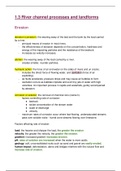
1.3 River channel processes and landforms
Erosion
abrasion (corrasion): the wearing away of the bed and the bank by the load carried
by a river.
- principal means of erosion in most rivers.
- the effectiveness of abrasion depends on the concentration, hardness and
energy of the impacting particles and the resistance of the bedrock.
- increases as velocity increases.
attrition: the wearing away of the load carried by a river.
- creates smaller, rounder particles.
hydraulic action: the force of air and water on the sides of rivers and un cracks.
- includes the direct force of flowing water, and cavitation (force of air
exploding).
- as fluids accelerate, pressure drops and may cause air bubbles to form.
- cavitation occurs as bubbles implode and evict tiny jets of water with high
velocities. An important process in rapids and waterfalls, gently accompanied
by abrasion.
corrosion or solution: the removal of chemical ions (calcium).
- factors controlling rate of corrosion:
● bedrock
● solute concentration of the stream water
● scale of discharge
● velocity
- maximum rates of corrosion occur where fast-flowing, undersaturated streams
pass over soluble rocks - humid zone streams flowing over limestone.
Factors affecting rate of erosion:
load: the heavier and sharper the load, the greater the erosion
velocity: the greater the velocity, the greater the erosion.
gradient: increased gradient increases erosion.
pH: rates of solution are increased when the water is more acidic
geology: soft, unconsolidated rocks such as sand and gravel are easily eroded.
human impact: deforestation, dams and bridges interfere with the natural flow and
increase rate of erosion.
,Erosion by the river will provide loose material, carried by the river as load.
Global sediment yield
conversion of a value of mean annual sediment and solute load to an estimate of the
rate of land surface lowering by fluvial denudation: combined sediment load of 250
tonnes/km2 or 0.1mm lost per year. This figure varies in terms of geographical
location: Europe and Eurasia = 10 tonnes/km2
contrastingly, in areas such as Taiwan or New Zealand's South Island, this figure can
reach up to 10,000 tonnes/km2 . In these cases, steep high rainfall and tectonic
instability are major influences. Other influences may include scale of vegetation
cover, seasonal variations in discharge and human activity.
Low flows: remove little sediment, but are more common.
High flows: not much sediment is removed due to its rarity.
Load transport
suspended load: smallest particles (silts and clays) carried in suspension
saltated load: larger particles (sands, gravels, very small stones) transported in a
series of hops.
tracted load: very large pebbles slowly moving along the bed.
solution: carried as dissolved load in areas of calcareous rock.
Deposition and sedimentation
, causes of deposition:
- a shallowing of gradient, which decreases velocity and energy
- a decrease in the volume of water and the channel
- an increase in friction between water and the channel.
The Hjulstrom curve
critical erosion velocity: lowest velocity at which grains of a given size can be moved.
Relationship between these variables is shows by the Hjulstrom curve.
E.g: sand can be moved more easily than silt or clay, as fine-grained particles tend
to move more cohesive. High velocities are required to move gravel and cobbles
because of their large size.
Features of the Hjulstrom curve
- the smallest and largest particles require high velocities to lift them. E.g,
particles between 0.1mm and 1mm require velocities of around 100 mm/s to
be entrained, compared with values of 500mm/s to lift clay (0.01mm). Clay
resists entrainment due to its cohesion; gravel due to its weight.
- higher velocities are required for entrainment than for transport.
- when velocities fall below a certain level, those particles are deposited.
River flow
velocity and discharge: controlled by:
- gradient of channel bed
Erosion
abrasion (corrasion): the wearing away of the bed and the bank by the load carried
by a river.
- principal means of erosion in most rivers.
- the effectiveness of abrasion depends on the concentration, hardness and
energy of the impacting particles and the resistance of the bedrock.
- increases as velocity increases.
attrition: the wearing away of the load carried by a river.
- creates smaller, rounder particles.
hydraulic action: the force of air and water on the sides of rivers and un cracks.
- includes the direct force of flowing water, and cavitation (force of air
exploding).
- as fluids accelerate, pressure drops and may cause air bubbles to form.
- cavitation occurs as bubbles implode and evict tiny jets of water with high
velocities. An important process in rapids and waterfalls, gently accompanied
by abrasion.
corrosion or solution: the removal of chemical ions (calcium).
- factors controlling rate of corrosion:
● bedrock
● solute concentration of the stream water
● scale of discharge
● velocity
- maximum rates of corrosion occur where fast-flowing, undersaturated streams
pass over soluble rocks - humid zone streams flowing over limestone.
Factors affecting rate of erosion:
load: the heavier and sharper the load, the greater the erosion
velocity: the greater the velocity, the greater the erosion.
gradient: increased gradient increases erosion.
pH: rates of solution are increased when the water is more acidic
geology: soft, unconsolidated rocks such as sand and gravel are easily eroded.
human impact: deforestation, dams and bridges interfere with the natural flow and
increase rate of erosion.
,Erosion by the river will provide loose material, carried by the river as load.
Global sediment yield
conversion of a value of mean annual sediment and solute load to an estimate of the
rate of land surface lowering by fluvial denudation: combined sediment load of 250
tonnes/km2 or 0.1mm lost per year. This figure varies in terms of geographical
location: Europe and Eurasia = 10 tonnes/km2
contrastingly, in areas such as Taiwan or New Zealand's South Island, this figure can
reach up to 10,000 tonnes/km2 . In these cases, steep high rainfall and tectonic
instability are major influences. Other influences may include scale of vegetation
cover, seasonal variations in discharge and human activity.
Low flows: remove little sediment, but are more common.
High flows: not much sediment is removed due to its rarity.
Load transport
suspended load: smallest particles (silts and clays) carried in suspension
saltated load: larger particles (sands, gravels, very small stones) transported in a
series of hops.
tracted load: very large pebbles slowly moving along the bed.
solution: carried as dissolved load in areas of calcareous rock.
Deposition and sedimentation
, causes of deposition:
- a shallowing of gradient, which decreases velocity and energy
- a decrease in the volume of water and the channel
- an increase in friction between water and the channel.
The Hjulstrom curve
critical erosion velocity: lowest velocity at which grains of a given size can be moved.
Relationship between these variables is shows by the Hjulstrom curve.
E.g: sand can be moved more easily than silt or clay, as fine-grained particles tend
to move more cohesive. High velocities are required to move gravel and cobbles
because of their large size.
Features of the Hjulstrom curve
- the smallest and largest particles require high velocities to lift them. E.g,
particles between 0.1mm and 1mm require velocities of around 100 mm/s to
be entrained, compared with values of 500mm/s to lift clay (0.01mm). Clay
resists entrainment due to its cohesion; gravel due to its weight.
- higher velocities are required for entrainment than for transport.
- when velocities fall below a certain level, those particles are deposited.
River flow
velocity and discharge: controlled by:
- gradient of channel bed